
- Stone8
- Reports3
-cushion-yellowishgreentobrownishorange-alexandrite-0.4900-cts-k13125-1.jpg?d=200x200&v=20250422230655)



-cushion-yellowishgreentobrownishorange-alexandrite-0.4900-cts-k13125-1.jpg?d=750x750&s=ngc&v=20250422230655)


0.49 Ct. Alexandrite from Ceylon (Sri Lanka)
This loose stone ships by Mar 22
Item ID: | K13125 |
|---|---|
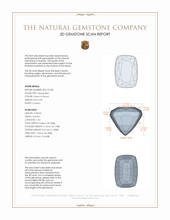
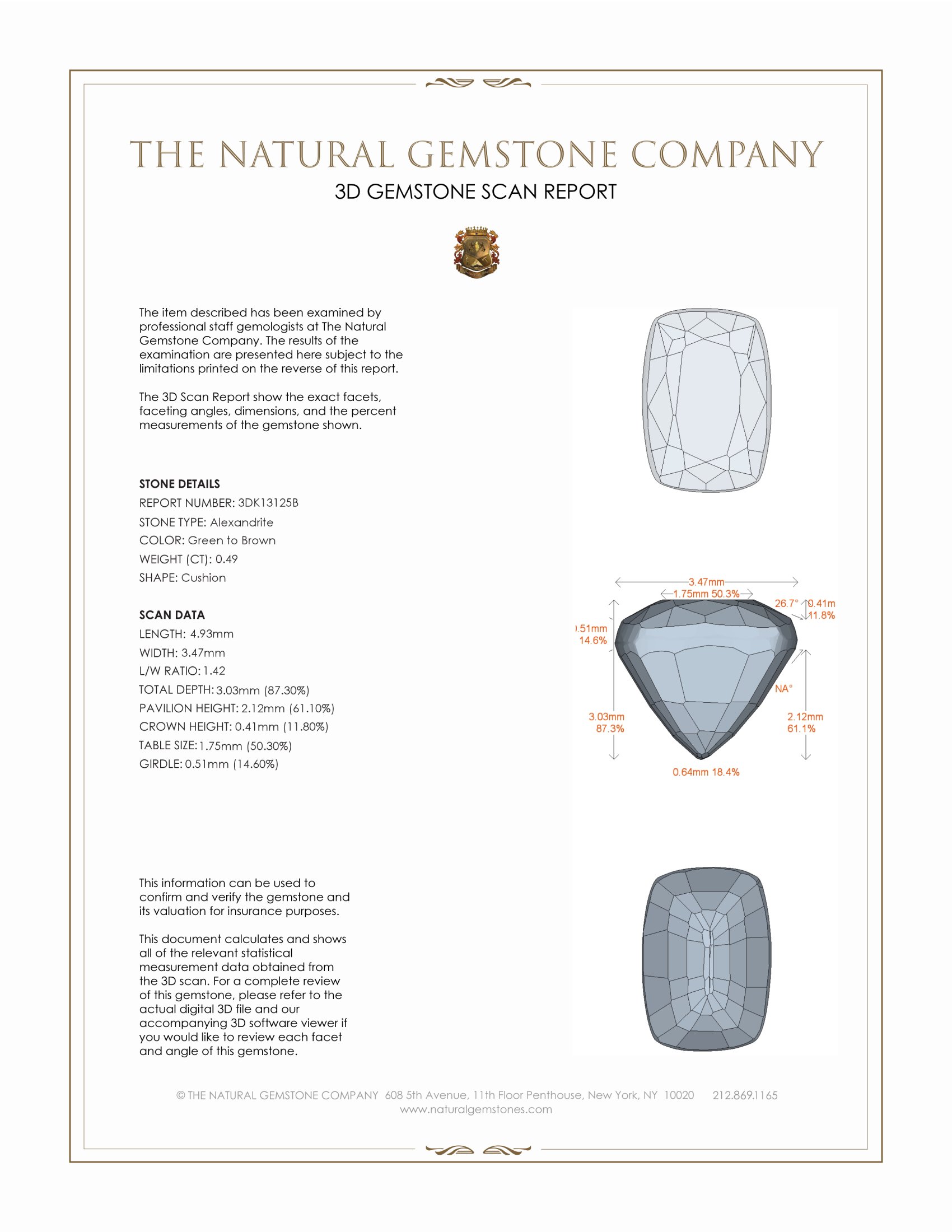
Dimensions (MM): help | Length: 4.93 Width: 3.47 Height: 3.03 |
Weight: | 0.49 Ct. |
Color: help | Green to Brown |
Color intensity: help | Medium |
Clarity: help | Eye Clean |
Shape: help | Cushion |
Cut: | Mixed Brilliant |
Cutting style: | Faceted |
Enhancements: help | No Enhancement |
Origin: help | Ceylon (Sri Lanka) |
Per carat price: help | $1,592 |
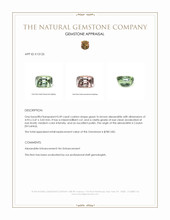
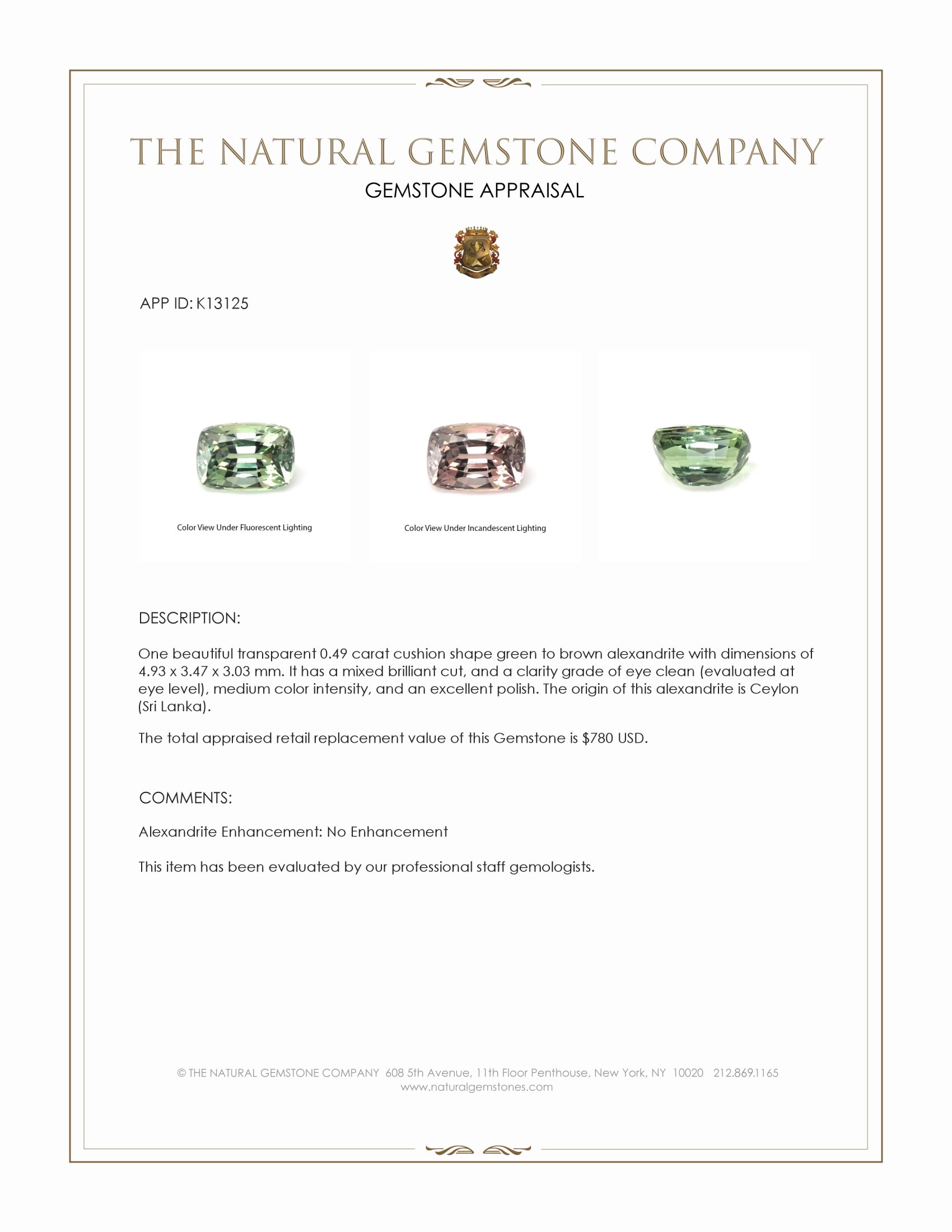
This 0.49 carat cushion shape alexandrite from Ceylon, Sri Lanka, in the inventory of The Natural Gemstone Company, is a transparent specimen that demonstrates the subtlety and complexity of classic color change stones. The proportions measure 4.93 millimeters by 3.47 millimeters by 3.03 millimeters, and the gem carries a mixed brilliant cut that balances a faceted crown with a pavillion architecture tuned for both scintillation and color saturation. Clarity is graded as eye clean when evaluated at eye level, which permits unimpeded light transmission through the body of the stone and enhances the optical phenomena for which alexandrite is prized. Color behavior is described as a green to brown change, with medium color intensity, and the surface finish has been executed to an excellent polish. There has been no enhancement applied to this material, leaving the crystal lattice and trace element chemistry in their natural state, which is especially important for collectors and connoisseurs who prioritize untreated provenance.
From a faceting and light performance perspective, the mixed brilliant motif employed on this cushion profile was selected to optimize two competing objectives, color modulation and brilliance. The crown incorporates smaller star and kite facets that break incident light into numerous small flashes, producing a lively scintillation that accentuates hue areas and strong pleochroic zones. The pavillion has been cut with a series of parallel facets that guide light back through the table and crown in controlled rays rather than broad leaks, a strategy that increases color saturation in a stone of these dimensions. When measured against its overall outline, the depth dimension yields an effective depth ratio in the high seventies percent range relative to the mean of length and width, a deliberate choice by the cutter to trade off some spread for intensified saturation and a clearer color change. The excellent polish is evident on facet junctions and girdle symmetry, and that finishing quality reduces light scatter at the surface which in turn clarifies the color transition under differing light sources.
The color change phenomenon observed in this specimen, green to brown, is a function of the stone s transition metal chemistry and the interaction of light sources with the discrete absorption bands within the visible spectrum. In alexandrite, chromium and occasionally vanadium act as chromophores, creating selective absorption that shifts the perceived hue as the spectral power distribution of the illuminant changes. In daylight or fluorescent spectra rich in short wavelengths the stone presents as a grassy to bluish green with medium intensity, while incandescent and other warm light sources emphasize longer wavelengths producing a brown to brownish pink appearance in this particular material. Medium color intensity in an alexandrite of this size is often preferable to extreme saturation because it preserves clarity and internal brightness, and it allows the effect to be visible without the stone becoming visually opaque. The eye clean clarity amplifies the optical effect because internal inclusions would otherwise scatter light and soften the distinct hue transition. For gem cutters and designers, the interplay of facet design, polish, and intrinsic pleochroism is what makes small alexandrites perform beyond their carat weight.
When placed in historical context, this Ceylon alexandrite offers a different set of virtues than the large Russian imperial alexandrites that historically commanded extraordinary premiums for their deep, dramatic color changes. Russian stones discovered in the 19th century are renowned for intense, saturated color change from emerald green to raspberry red, but they are rare and frequently show strong saturation that can reduce apparent clarity in small sizes. Ceylon alexandrite is known for its lighter, more pastel oriented palette and for a gentler, sophisticated transition, which many collectors and jewelers find highly desirable for refined, everyday wearable pieces. Compared to famous colored gems such as the deeply saturated imperial alexandrites and the dramatic historical sapphires, this stone s value derives from its natural, unenhanced state, its surgical cut that maximizes optical return at a small carat weight, and its eye clean clarity which is scarce in alexandrite of this color profile. The craftsmanship exhibited in its cutting places it in the company of well cut historic pieces, where proportion and finish were prioritized to reveal the stone s inner life. For clients seeking a piece that embodies the allure of classic alexandrite lore while offering the assured transparency and finish required for contemporary fine jewelry, this specimen from The Natural Gemstone Company presents a compelling balance of historical reference and modern lapidary precision.
For practical use and setting recommendations, the cushion outline with controlled depth and mixed brilliant faceting is well suited to closed or semi closed settings that protect the girdle while allowing an even light environment to show the color change. Bezel settings that incorporate well proportioned galleries can enhance the perceived color shift by modulating the balance of ambient and transmitted light, while prong settings that allow overhead daylight and warm indoor light to interact with the stone will maximize the visible transition for the wearer. For collectors focused on provenance, the absence of enhancement and the documented Ceylon origin increase long term desirability and resale integrity, and for designers, the 0.49 carat weight and compact dimensions make the gem ideal as a focal solitaire in a ring or as the central component of a refined pendant. The Natural Gemstone Company stands behind the material quality and the natural origin of this alexandrite, and we can provide additional imagery and spectral readings on request to assist in matching the stone to a particular design or collection intent.


