
Queen Victoria’s Scottish Agates: The Royal Fashion That Celebrated Scotland
Queen Victoria’s influence on nineteenth-century fashion extended far beyond dresses, mourning jewelry, and diamonds. Queen Victoria’s Scottish Agates became part of one of the more distinctive trends associated with her reign, reflecting her growing enthusiasm for jewelry and designs inspired by Scotland.
After Queen Victoria and Prince Albert developed a deep affection for the Scottish Highlands, Scottish-inspired designs became increasingly fashionable. Among the materials that captured this aesthetic were locally sourced agates and other decorative stones, often arranged in bold patterns and mounted in silver.
The result was a jewelry style that combined natural beauty, regional identity, craftsmanship, and royal fashion.
Today, Victorian Scottish agate jewelry offers an intriguing look at how a monarch’s personal tastes could help transform regional materials into a major nineteenth-century jewelry trend.
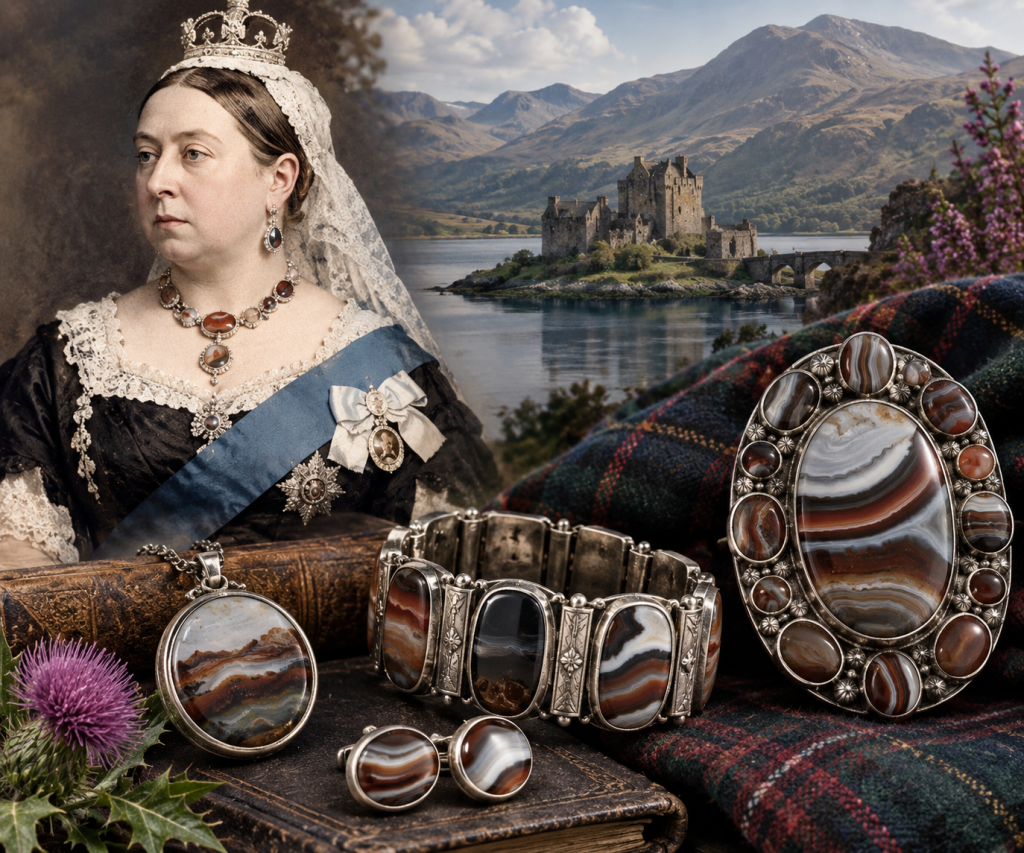
Queen Victoria’s Love for Scotland
Queen Victoria first visited Scotland with Prince Albert in 1842. The landscape, culture, and relative privacy of the Highlands made a strong impression on the royal couple.
Their connection with Scotland deepened over the following years.
In 1848, they leased Balmoral, and Prince Albert later purchased the estate. The existing residence was eventually replaced by the present Balmoral Castle, completed during the 1850s.
Balmoral became an important royal retreat and helped strengthen Victoria’s personal identification with Scotland.
Her enthusiasm was reflected in clothing, interior decoration, art, and jewelry.
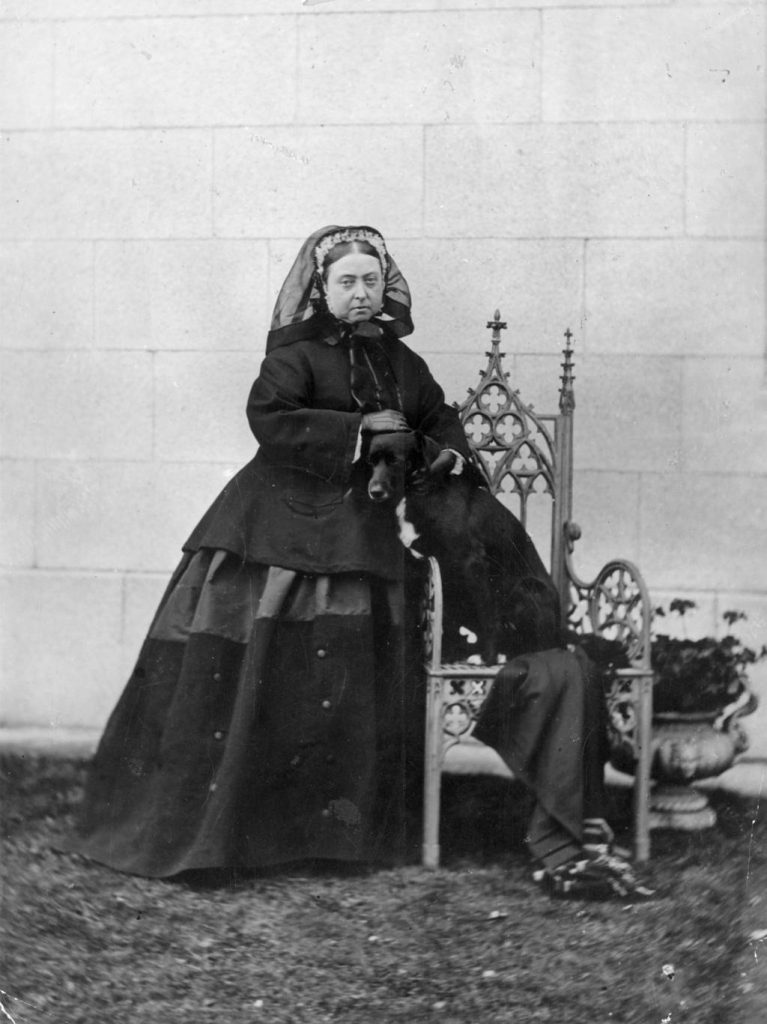
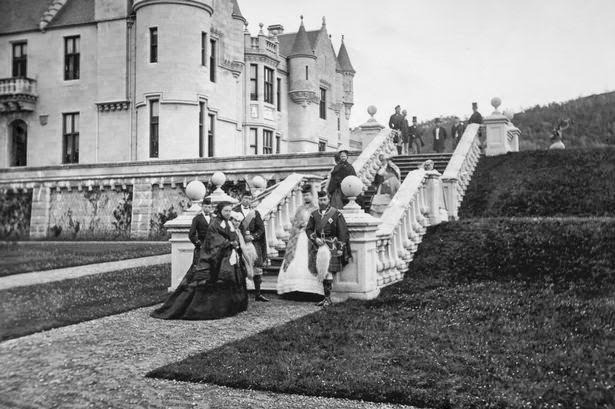
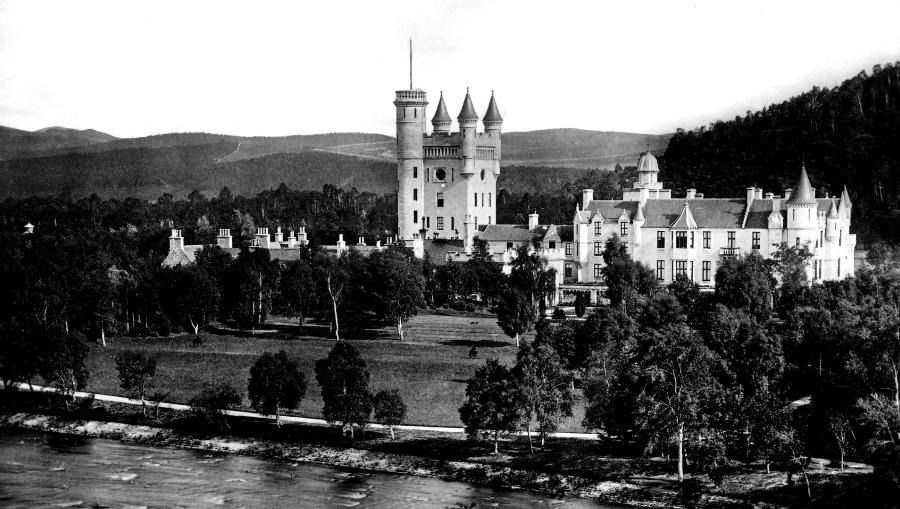
What Is Scottish Agate Jewelry?
The term “Scottish agate jewelry” is often used broadly for nineteenth-century Scottish-style jewelry incorporating polished ornamental stones.
Agate itself is a variety of chalcedony and can display bands, patterns, and variations in color. Scottish jewelry also incorporated other locally associated materials, including jasper and bloodstone.
Craftspeople took advantage of these natural patterns by cutting stones into geometric sections and arranging contrasting colors beside one another.
Typical colors included:
- Warm brown and orange
- Gray
- Cream and white
- Deep green
- Red
- Black or very dark tones
The resulting pieces often had an earthy appearance quite different from conventional diamond or precious gemstone jewelry.
How Queen Victoria Helped Make Scottish Jewelry Fashionable
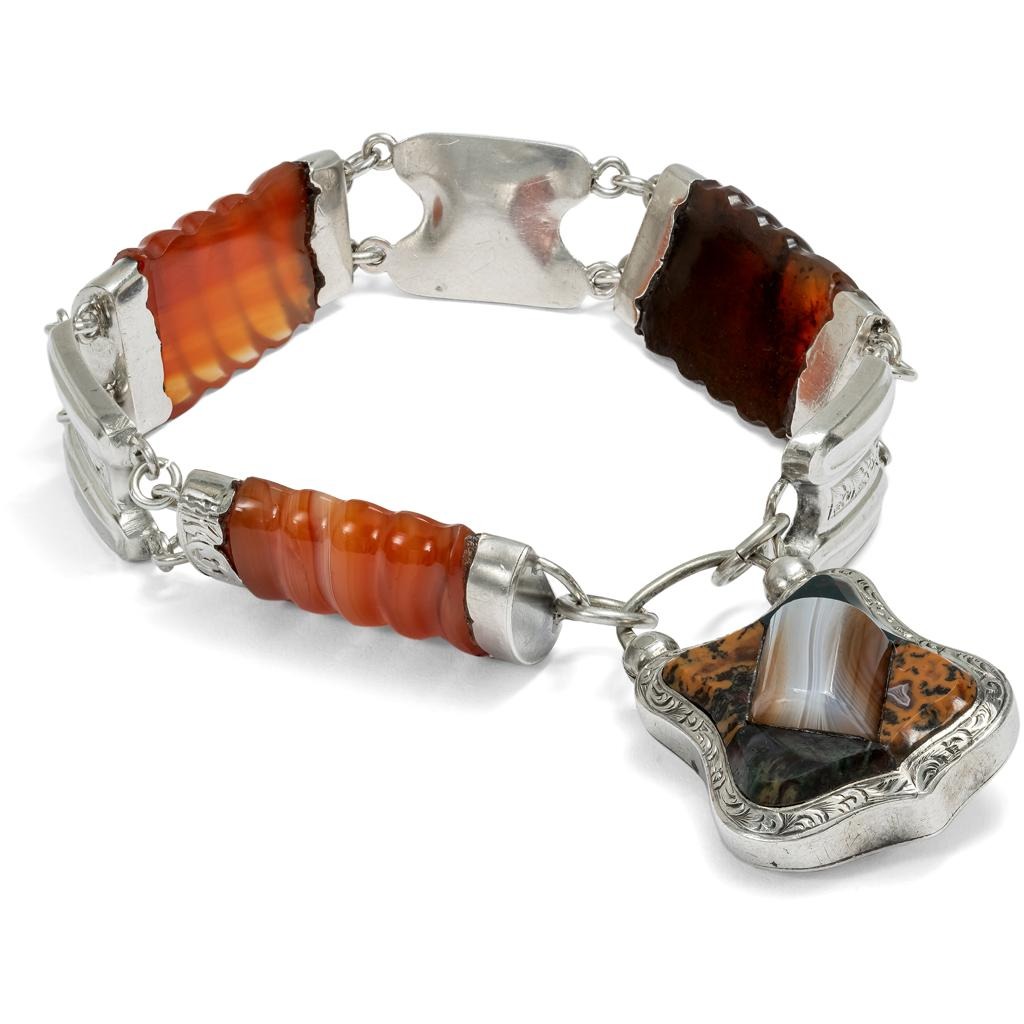
Queen Victoria did not invent Scottish agate jewelry. Scottish craftsmen were already producing jewelry using local stones and traditional designs.
Her influence came from visibility.
Victoria’s enthusiasm for Scotland helped create a wider fascination with Highland culture among fashionable Victorian society. Scottish-inspired clothing, tartans, accessories, and jewelry became increasingly desirable.
Wearing Scottish jewelry offered people outside Scotland a way to participate in this romanticized Highland aesthetic.
The trend became particularly prominent during the middle decades of the nineteenth century.
The Rise of “Pebble Jewelry”
Queen Victoria’s Scottish agates helped bring greater attention to the Scottish agate pieces from this period, which are also commonly described as “pebble jewelry.”
The name sounds modest, but many examples involved sophisticated lapidary work.
Different stones had to be carefully selected, cut, polished, and fitted together to create precise patterns. Instead of depending primarily on brilliance, as diamond jewelry does, pebble jewelry celebrated natural color and pattern.
This gave each piece considerable individuality.
Two agates from the same general region could display completely different banding and coloration, meaning the material itself became an important part of the design.
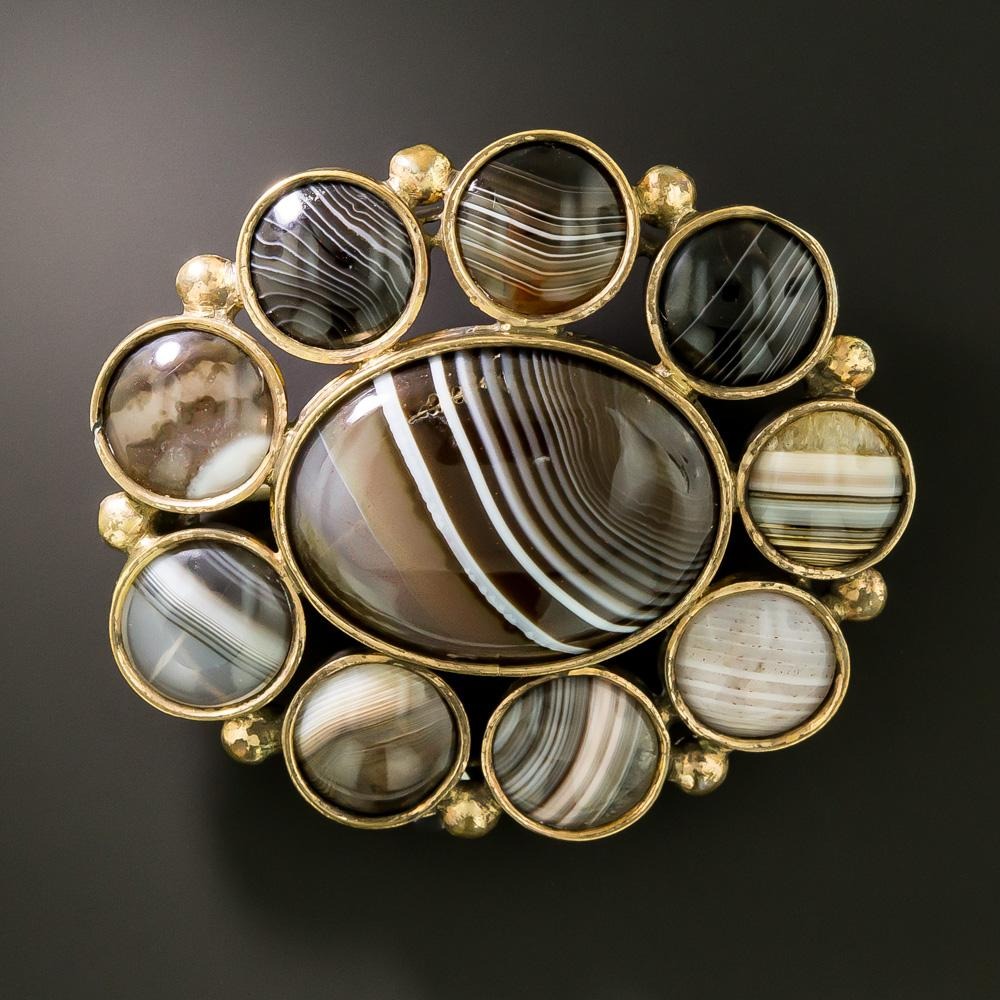
Brooches Became Particularly Popular
Brooches were among the most recognizable forms of Victorian Scottish jewelry.
Designs ranged from relatively simple circular arrangements to elaborate forms inspired by traditional Scottish objects.
Some incorporated:
- Crosses
- Knots
- Shields
- Thistles
- Dirks
- Swords
- Buckles
Agate sections could be combined with silver and occasionally accented with other gemstones.
These pieces allowed jewelry makers to blend Victorian decorative fashion with visual references to Scottish history and identity.
The Scottish Thistle in Victorian Jewelry
The thistle became an especially recognizable motif.
Long associated with Scotland, it appeared frequently in nineteenth-century Scottish-inspired jewelry.
Jewelry designers could represent the flower using engraved metal, colored stones, or combinations of both.
A thistle brooch set with agate or other Scottish stones carried more than decorative appeal. It immediately communicated a connection with Scotland.
For Victorian buyers fascinated by Highland culture, this symbolism was part of the attraction.
Agate Bracelets and Necklaces
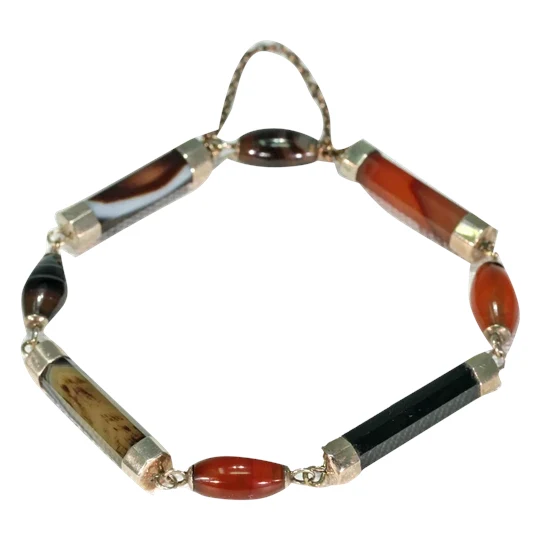
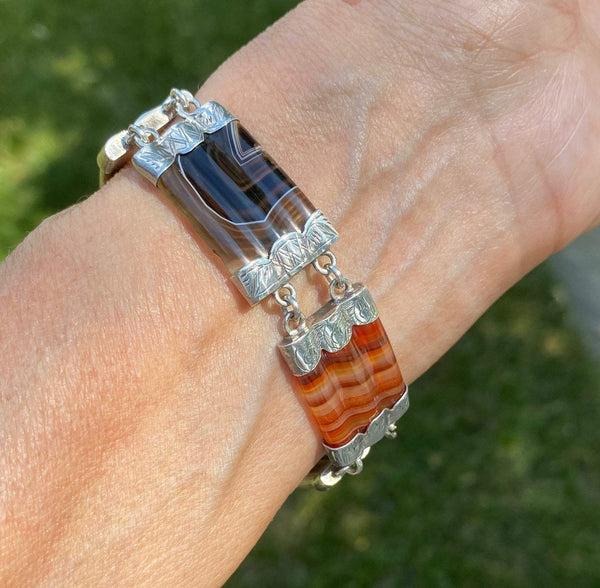
Scottish agate was not limited to brooches.
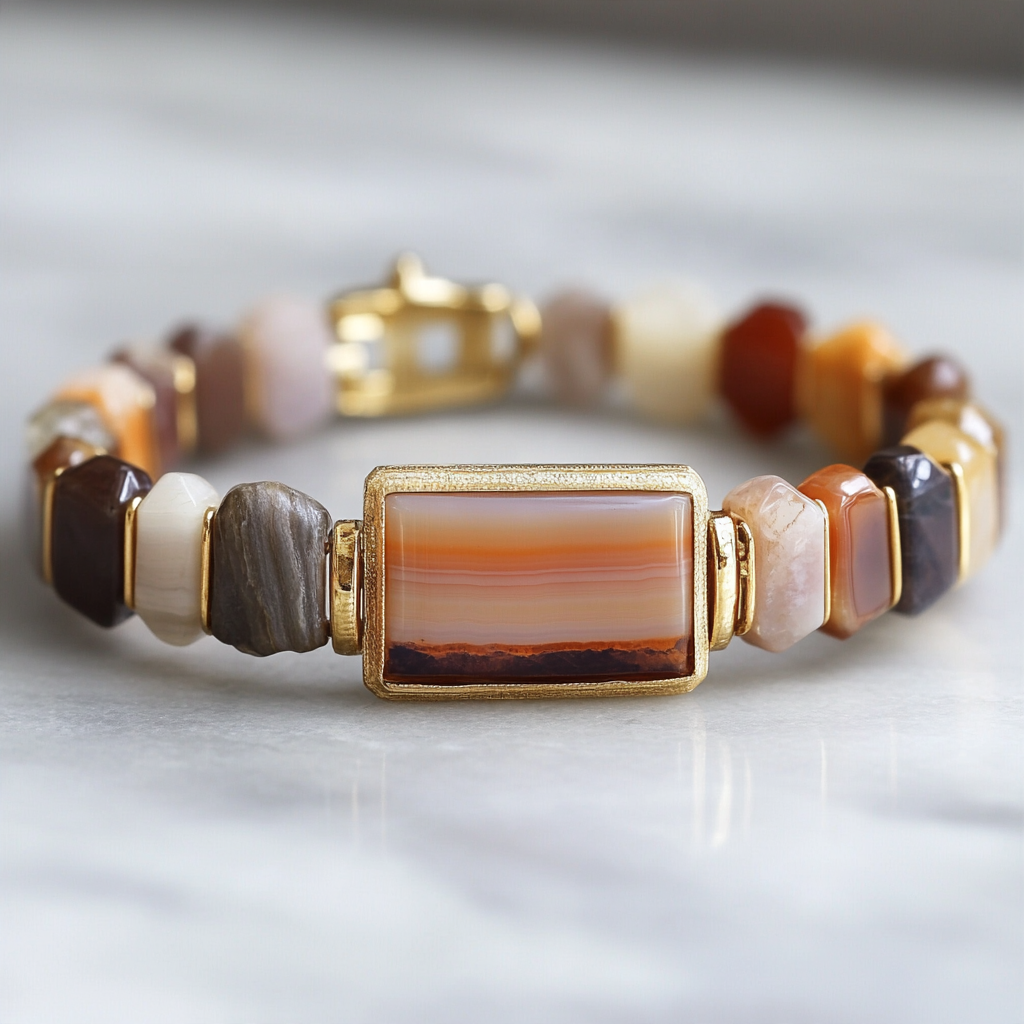
Victorian jewelers also created bracelets using multiple polished sections of agate connected by silver fittings. The differences between individual stones could produce striking sequences of brown, gray, red, green, and white.
Necklaces, earrings, pendants, and other accessories were also produced.
These designs demonstrated one of agate’s greatest advantages as a jewelry material: variety.
Rather than demanding perfect uniformity, designers could deliberately celebrate differences between stones.
The Beauty Was in the Pattern
The beauty of Queen Victoria’s Scottish agates was found primarily in their color, banding, and natural patterns rather than the brilliance associated with transparent faceted gemstones.
Some stones display clearly defined layers, while others contain cloudy areas, stripes, irregular markings, or contrasting sections.
Victorian craftspeople often positioned these patterns carefully within a design. The objective was not necessarily to make the material look perfectly symmetrical or flawless. Instead, the natural pattern became part of the artistic composition.
That philosophy feels surprisingly contemporary. Modern jewelry increasingly celebrates unusual inclusions, textures, and individual gemstone patterns, yet Victorian Scottish agate jewelry was doing something similar more than a century ago.
Was All “Scottish Agate” Actually from Scotland?
This is where the history becomes more complicated.
The enormous popularity of Scottish-style jewelry eventually created demand beyond what local materials and production could easily satisfy.
As the style expanded, pieces inspired by Scottish designs were produced elsewhere, and not every stone used in jewelry marketed or described as Scottish necessarily originated in Scotland.
For collectors today, this distinction matters.
A Victorian Scottish-style agate brooch and a piece made from documented Scottish material are not necessarily the same thing.
Provenance, construction, hallmarks, design, and materials all require consideration when evaluating antique examples.
Queen Victoria, Prince Albert, and Personal Jewelry
Jewelry held considerable personal meaning for Queen Victoria.
Prince Albert frequently influenced or commissioned jewelry for her, and Victoria used jewelry to commemorate relationships, births, deaths, and important events.
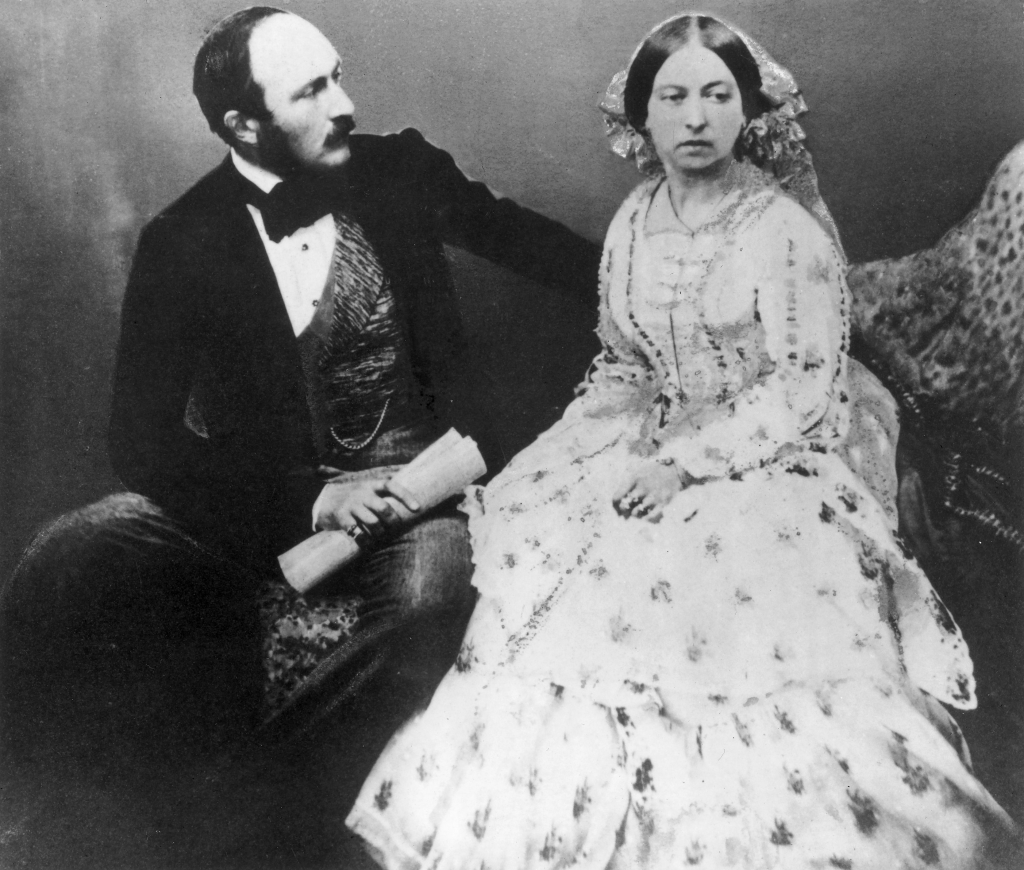
Scottish-inspired pieces fitted naturally into this highly personal approach.
The Highlands represented family life, escape from formal court routines, and time spent with Albert and their children.
After Prince Albert died in 1861, Victoria’s relationship with Balmoral became even more emotionally significant.
Scotland was therefore not merely a fashionable theme for the Queen. It was closely connected with her private life.
Scottish Jewelry After Prince Albert’s Death
Victoria entered prolonged mourning following Albert’s death.
Her mourning had a major influence on Victorian fashion, particularly the popularity of dark clothing and mourning jewelry.
Scottish jewelry continued to be worn and produced during the later nineteenth century, although designs evolved.
Darker materials could also suit Victorian mourning aesthetics, while Scotland itself remained closely associated with Victoria’s memories of Albert.
The combination of personal grief, royal symbolism, and Scottish identity gives jewelry from this period a particularly interesting historical context.
Why Agate Worked So Well in Victorian Jewelry
Agate was perfectly suited to the Victorian fascination with symbolism and natural materials.
It offered:
Individuality. No two naturally patterned agates are exactly identical.
Color. One mineral family could provide numerous combinations of brown, red, gray, white, orange, and other tones.
Durability. Agate has a Mohs hardness of approximately 6.5–7, making it reasonably suitable for jewelry.
Design flexibility. It could be carved, polished, shaped, or assembled into geometric patterns.
Regional character. Scottish stones allowed jewelry to carry an association with landscape and place.
Together, these qualities made agate ideal for the Highland-inspired jewelry fashionable during Victoria’s reign.
From Regional Craft to Victorian Fashion
Perhaps the most interesting aspect of Queen Victoria’s connection with Scottish agate jewelry is the way royal enthusiasm helped elevate a regional tradition.
The materials themselves were not extraordinarily rare.
There were no enormous diamonds or priceless rubies required.
Instead, the attraction came from craftsmanship, natural patterns, cultural associations, and the growing Victorian fascination with Scotland.
Royal fashion provided the final ingredient.
Once Victoria and Albert publicly embraced Highland culture, Scottish-inspired designs gained an audience far beyond Scotland.
Collecting Victorian Scottish Agate Jewelry Today
Original nineteenth-century Scottish agate jewelry remains collectible today.
Collectors may look at several characteristics when evaluating pieces, including craftsmanship, age, condition, hallmarks, design complexity, stone patterns, and provenance.
Pieces with unusual forms or particularly sophisticated stonework may attract additional interest.
However, buyers should be cautious about assuming that every antique-looking agate brooch is genuinely Victorian or Scottish.
Later reproductions and Scottish-inspired pieces exist, making knowledgeable examination important for significant purchases.
A Surprisingly Modern Jewelry Style
Look at a fine Victorian Scottish agate bracelet today and it does not necessarily feel like conventional nineteenth-century royal jewelry.
Its geometric shapes, contrasting natural materials, silver construction, and earthy colors can appear remarkably modern.
That may explain part of its continuing appeal.
Scottish agate jewelry does not rely primarily on gemstone rarity. Its beauty comes from natural patterns and thoughtful design.
Each stone looks slightly different, giving the finished piece a character that cannot be perfectly duplicated.
Final Thoughts
Queen Victoria’s Scottish agates represent a fascinating meeting point between monarchy, fashion, craftsmanship, and the natural landscape.
Victoria and Prince Albert’s enthusiasm for Scotland, particularly their life at Balmoral, helped fuel a broader nineteenth-century fascination with Highland culture. Scottish-style jewelry became part of that movement, with agate, jasper, bloodstone, silver, and traditional motifs transformed into distinctive brooches, bracelets, necklaces, and other ornaments.
Perhaps the most interesting part of the story is that the gemstones themselves were not exceptionally rare. Their importance came from somewhere else: they represented Scotland.
Through Queen Victoria’s influence, pieces of patterned stone associated with the Scottish landscape became fashionable objects worn far beyond the Highlands.
More than a century later, Queen Victoria’s Scottish agates remain a reminder that a gemstone’s appeal does not always depend on rarity or price. Sometimes history, craftsmanship, place, and personal meaning can make a simple stone extraordinary.
Explore our collection of natural agates and find a unique stone with beautiful colors, patterns, and character.