
Tutankhamun’s Lapis Lazuli Treasures
Few archaeological discoveries have captured the world’s imagination quite like Tutankhamun’s Lapis Lazuli Treasures. When his tomb was uncovered in Egypt’s Valley of the Kings in 1922, it revealed an extraordinary collection of gold, jewelry, ceremonial objects, amulets, and funerary treasures that had remained hidden for more than 3,000 years. Among these remarkable discoveries, lapis lazuli stood out for its striking deep-blue color, creating a beautiful contrast with gold and reflecting the gemstone’s importance in ancient Egyptian royal culture.
Gold may dominate the first impression of Tutankhamun’s treasures, but another material repeatedly provides a dramatic contrast: lapis lazuli.
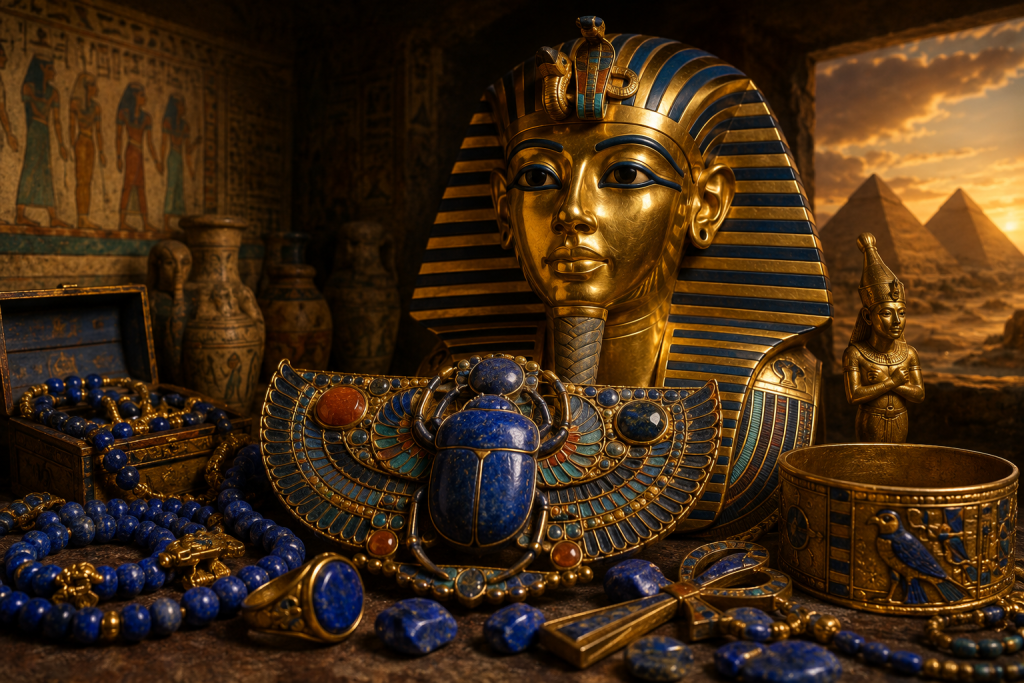
With its intense deep-blue color, lapis lazuli had been prized in Egypt long before Tutankhamun’s reign. It appeared in jewelry, amulets, inlays, and royal objects, where its rich blue appearance complemented gold beautifully. Among Tutankhamun’s possessions, lapis lazuli was used in some remarkable objects, including elements of his famous funerary mask and an extraordinary scarab pectoral.
Together, Tutankhamun’s lapis lazuli treasures reveal a story of royal craftsmanship, ancient symbolism, long-distance trade, and the Egyptian fascination with color and the divine.
Who Was Tutankhamun?
Tutankhamun was a pharaoh of Egypt’s 18th Dynasty, ruling during the New Kingdom in the 14th century BCE. Although his reign was relatively short, his name became one of the most recognizable in ancient Egyptian history because of the remarkable survival of his tomb.
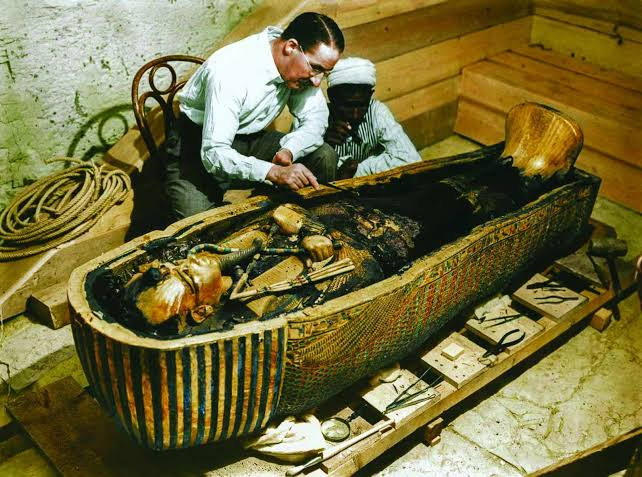
The tomb, known today as KV62, was discovered in the Valley of the Kings in 1922 by archaeologist Howard Carter’s excavation team.
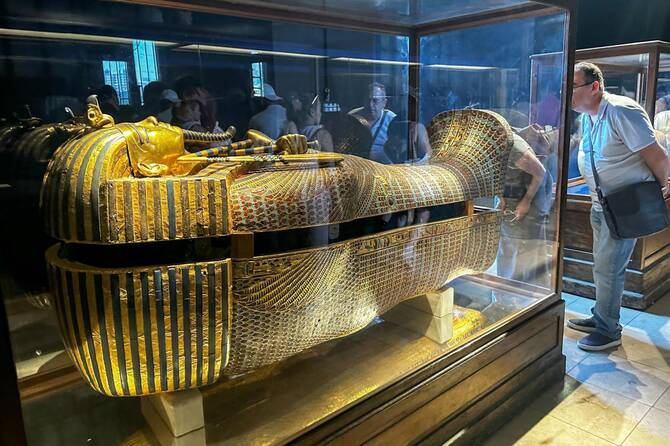
Unlike many royal tombs that had been extensively robbed in antiquity, Tutankhamun’s burial retained an exceptional collection of objects. These treasures offered historians and archaeologists a rare opportunity to examine the materials, craftsmanship, religious beliefs, and royal lifestyle of New Kingdom Egypt.
Among those materials was the unmistakable blue of lapis lazuli.
Why Was Lapis Lazuli So Important in Ancient Egypt?
Lapis lazuli is immediately recognizable for its deep royal-blue to blue-violet color, sometimes accompanied by small golden-looking flecks of pyrite.
Unlike gemstones consisting of a single mineral, lapis lazuli is a rock composed primarily of lazurite together with other minerals. Its intense color has made it desirable for thousands of years.
Ancient Egyptian artisans used lapis lazuli for jewelry, beads, amulets, scarabs, inlays, and decorative objects. Surviving Egyptian pieces demonstrate that the material was valued centuries before Tutankhamun was born. The Metropolitan Museum of Art, for example, holds ancient Egyptian lapis lazuli amulets dating from the Middle Kingdom through the early New Kingdom.
Its visual relationship with gold was especially powerful.
Deep blue lapis beside brilliant yellow gold created a striking contrast that became characteristic of some of ancient Egypt’s most beautiful luxury objects.
The Blue and Gold of Tutankhamun
The combination of gold and blue is one of the most recognizable features of Tutankhamun’s treasures.
This was not merely an attractive decorative choice.
The official description of Tutankhamun’s famous burial mask at the Grand Egyptian Museum explains that the king is presented in relation to Osiris and the sun god Re, whose body was believed to be gold and whose hair was associated with lapis lazuli.
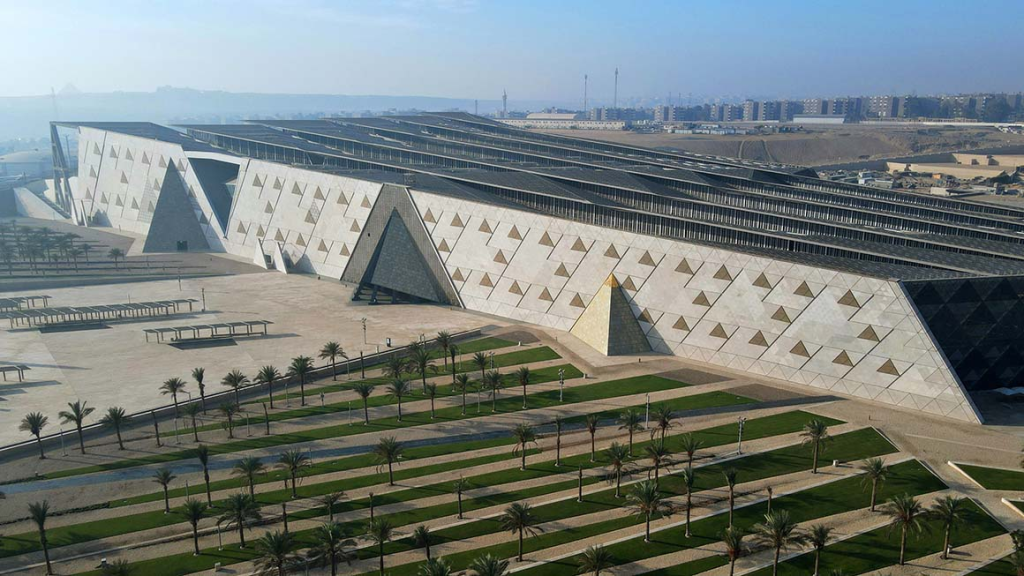
This connection gives the materials a deeper meaning.
Gold could evoke the brilliance and permanence of the divine, while the intense blue associated with lapis lazuli contributed to an image that was both royal and otherworldly.
For Tutankhamun, therefore, gemstones and precious materials were capable of doing far more than demonstrating wealth. They formed part of a sophisticated visual language involving kingship, protection, transformation, and the afterlife.
Lapis Lazuli in Tutankhamun’s Famous Golden Mask
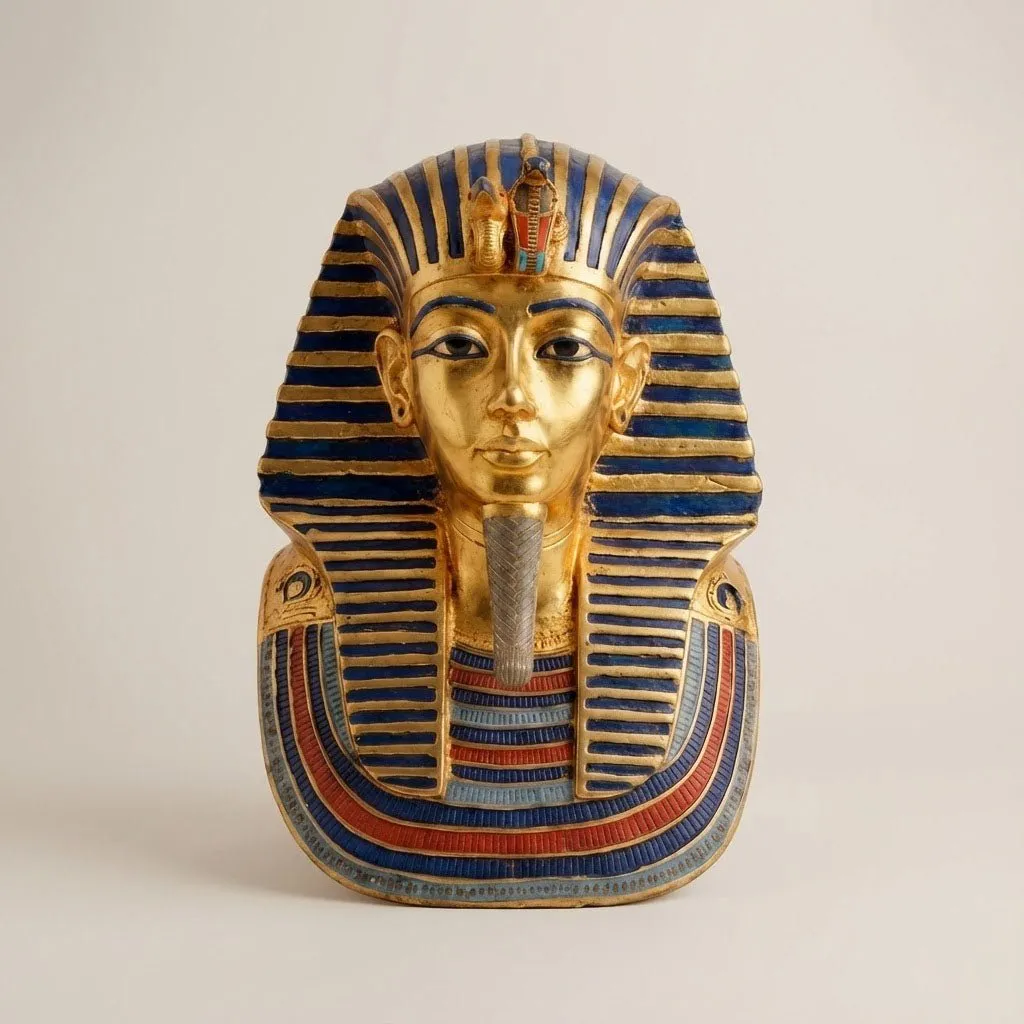
No object associated with Tutankhamun is more famous than his golden funerary mask.
Placed over the head and shoulders of the mummified pharaoh, the mask remains one of the greatest surviving achievements of ancient Egyptian craftsmanship.
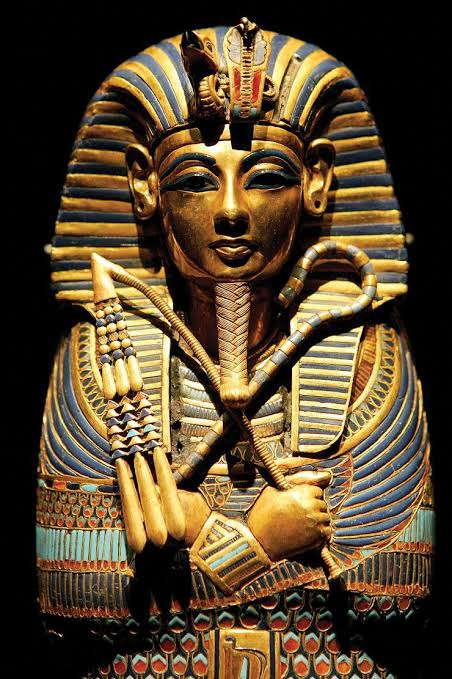
The mask combines gold with several other materials, including lapis lazuli, obsidian, carnelian, faience, quartzite, and colored glass. The Grand Egyptian Museum specifically identifies lapis lazuli among its materials.
The deep-blue detailing around the king’s eyes is particularly significant. Historical museum documentation identifies the eyebrows and eyelids as inlaid with lapis lazuli, while quartz and obsidian were used to create elements of the eyes.
Against the warm surface of the gold, the dark-blue lapis creates a dramatic definition around Tutankhamun’s face.
Not Everything Blue Is Lapis Lazuli
There is an important detail that is sometimes lost in popular descriptions of Tutankhamun’s mask.
The famous blue stripes of the nemes headcloth are not simply all lapis lazuli.
Documentation from the original excavation records lapis-lazuli-colored glass in several blue areas of the mask, while modern descriptions distinguish these glass elements from actual lapis lazuli used elsewhere. The Tutankhamun Spatial Archive, based on Howard Carter’s excavation records, documents blue glass used to imitate lapis lazuli in portions of the headdress and beard.
This distinction makes the mask even more interesting.
Ancient Egyptian craftsmen deliberately combined natural gemstones with sophisticated colored glass, selecting materials according to the visual and symbolic effect they wanted to achieve.
The result was not simply a display of expensive stones. It was an exceptionally controlled composition of color, texture, symbolism, and craftsmanship.
The Extraordinary Lapis Lazuli Scarab Pectoral
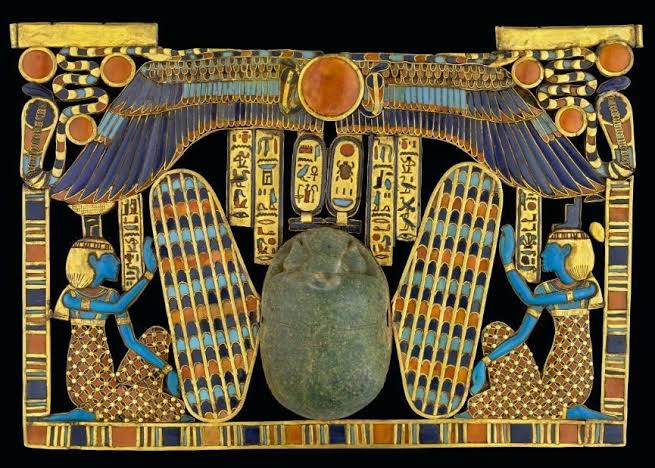
Perhaps an even more impressive example of lapis lazuli among Tutankhamun’s treasures is a magnificent pectoral centered around a large lapis lazuli scarab.
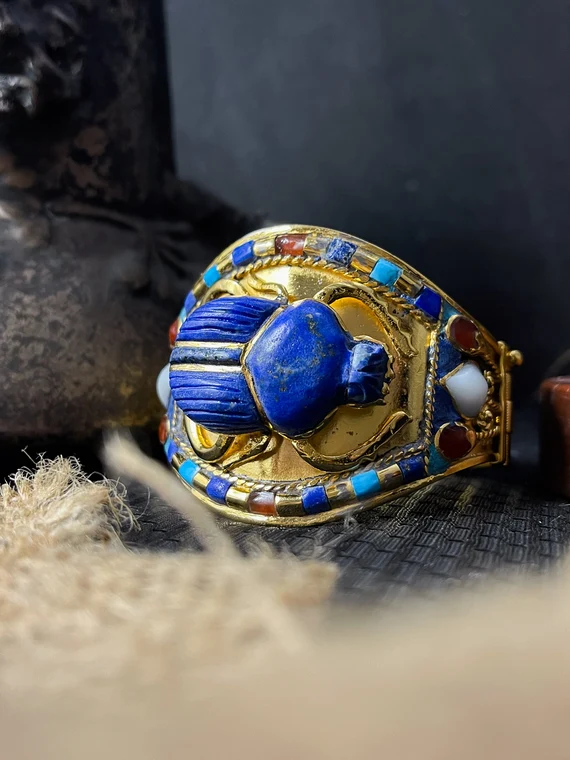
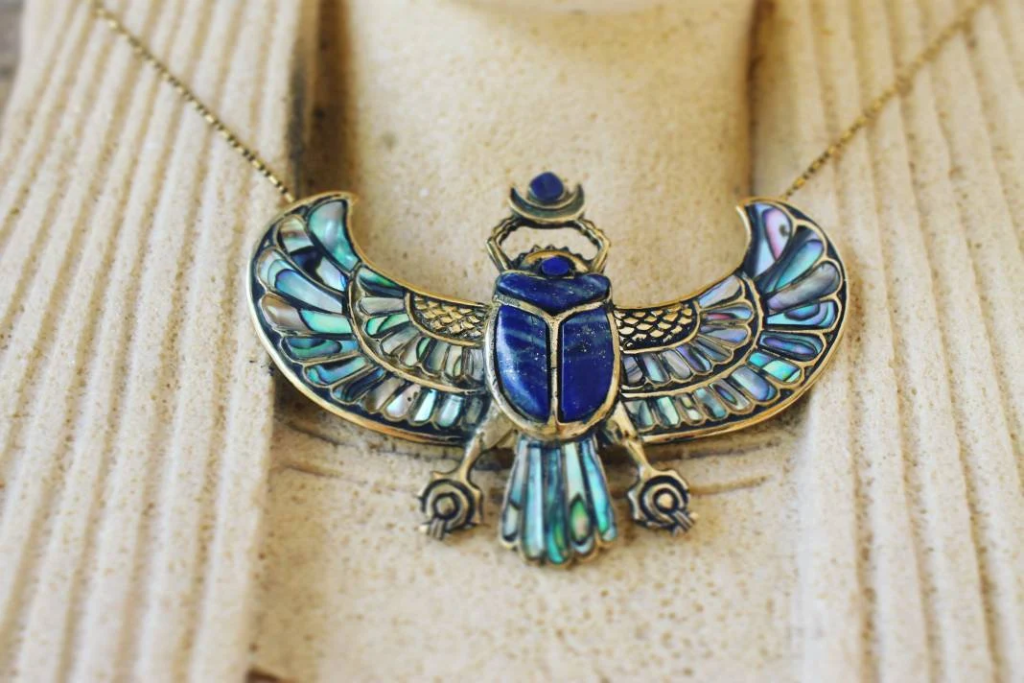
This elaborate jewel incorporates the throne name of Tutankhamun, Nebkheperure, into its design.
At its center is the large lapis lazuli scarab. Around it are additional royal and religious symbols, including solar and lunar disks, cobras, ankh signs, and Eyes of Horus. The lower portion contains floral decoration incorporating lapis lazuli, carnelian, and colored glass.
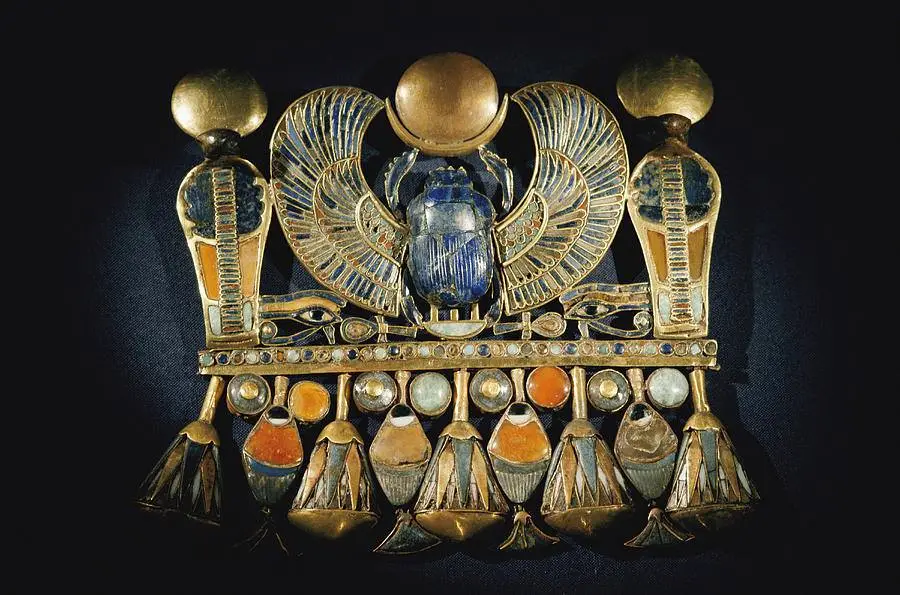
Here, lapis lazuli is not merely a small decorative accent.
It becomes the visual center of the jewel.
The scarab itself carried enormous significance in ancient Egyptian belief. Closely associated with the scarab beetle and the god Khepri, it became connected with ideas of renewal, regeneration, and the daily rebirth of the sun.
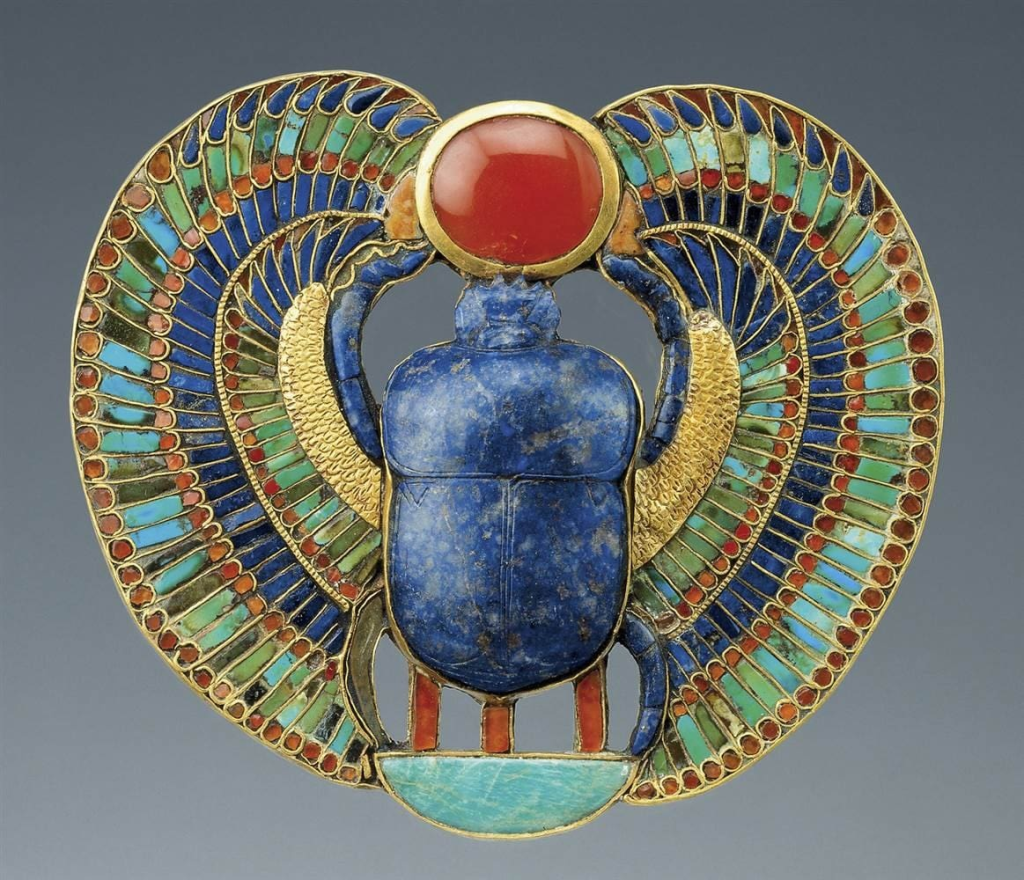
Combining this powerful symbol with deep-blue lapis lazuli and gold created an object that was visually magnificent and rich in meaning.
Lapis Lazuli Jewelry Found in Tutankhamun’s Tomb
Lapis lazuli appeared beyond the mask and pectoral.
One particularly fascinating surviving object is a lapis lazuli bracelet inlay carved in the form of a sphinx. The Metropolitan Museum of Art records that the piece came from Tutankhamun’s tomb and dates to approximately 1336–1327 BCE. The object was later returned to Egypt.
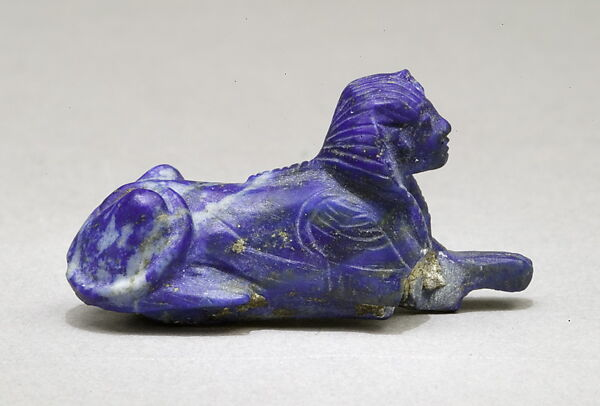
Although small, such pieces provide important evidence of how Egyptian craftsmen worked lapis lazuli into complex forms.
The stone could be polished into beads, carefully cut into decorative inlays, or carved into recognizable symbolic forms.
These objects demonstrate that lapis lazuli was not simply collected as an attractive blue material. Egyptian artisans understood how to shape it into objects that contributed to much larger artistic and religious compositions.
A Gemstone That Had to Travel
One of the most extraordinary aspects of ancient Egyptian lapis lazuli is that the finest material was not native to Egypt.
Historically, one of the world’s most important sources of lapis lazuli was located in what is now Afghanistan, particularly the Badakhshan region.

For lapis lazuli to reach Egyptian workshops, the material therefore had to travel through extensive networks of exchange.
That makes every ancient Egyptian lapis object part of a much larger story.
Long before modern transportation, traders moved valuable materials across enormous distances. Lapis lazuli passed between regions and civilizations before eventually reaching craftspeople who transformed the rough material into jewelry, amulets, scarabs, and royal decorations.
By the time of Tutankhamun, lapis lazuli represented not only beauty but also access to valuable international resources and sophisticated trade networks.
A tiny blue inlay in a pharaoh’s jewel could therefore represent a journey covering thousands of kilometers.
Why Did Ancient Egyptians Value the Color Blue?
To understand the attraction of lapis lazuli, it is useful to consider the importance of blue in ancient Egyptian visual culture.
The color naturally recalled the sky and the life-giving waters of the Nile. Within Egyptian religious art, blue could also carry associations with the heavens, creation, fertility, and divine existence.
The visual effect of lapis lazuli was therefore especially appropriate for royal and religious objects.
Placed beside gold, the stone produced an almost celestial combination: deep blue against radiant sunlight.
The Egyptian desire for this appearance was so strong that artisans also developed blue glass and faience capable of creating similar effects.
Tutankhamun’s mask demonstrates this particularly well. Natural lapis lazuli and lapis-colored glass could appear within the same masterpiece, allowing artisans to maintain a carefully controlled blue-and-gold visual scheme.
Lapis Lazuli and the Protection of the Pharaoh
Many objects placed in Egyptian royal tombs were not simply possessions for display. They had religious and protective functions connected with the deceased king’s journey into the afterlife.
The golden mask itself had a protective purpose. The Global Egyptian Museum explains that it covered the wrapped mummy and was associated with a magical spell intended to protect the king’s body and assist his resurrection.
Likewise, scarabs, amulets, divine symbols, and protective imagery appeared throughout Egyptian funerary culture.
Lapis lazuli was incorporated into this symbolic environment.
Its use in royal amulets, scarabs, jewelry, and funerary objects placed the blue stone within a broader system in which material, color, image, and religious meaning worked together.
Rather than viewing Tutankhamun’s lapis lazuli simply as decoration, it is more accurate to see it as one element within a carefully designed royal burial tradition.
The Craftsmanship Behind Tutankhamun’s Lapis Treasures
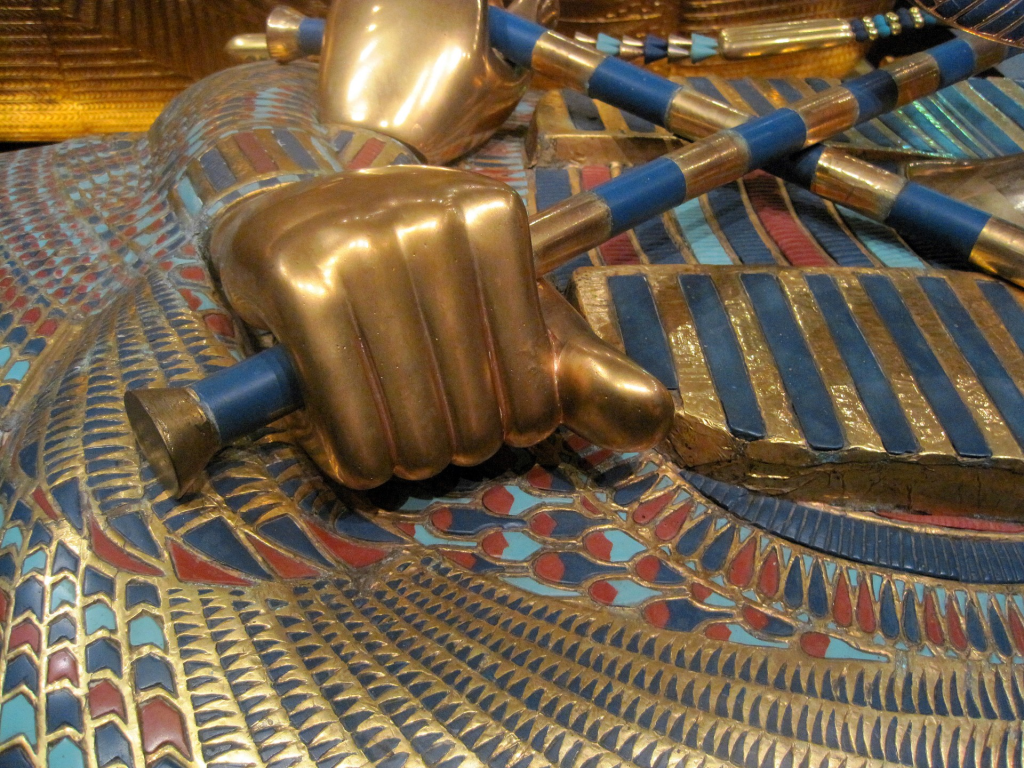
Tutankhamun’s treasures also reveal the extraordinary abilities of ancient Egyptian craftspeople.
Working with lapis lazuli required precision. Small pieces had to be shaped, polished, and fitted into elaborate designs alongside materials with very different physical characteristics.
Gold, carnelian, quartz, obsidian, faience, glass, and lapis lazuli could all appear within a single object.
The result was an early form of sophisticated mixed-material jewelry design.
Tutankhamun’s pectorals demonstrate this particularly beautifully. Instead of allowing one gemstone to dominate every part of a jewel, artisans created detailed compositions in which different colors and materials were used to define individual symbols.
Deep blue lapis might sit beside orange-red carnelian, brilliant gold, turquoise-colored glass, and other contrasting materials.
More than three millennia later, these combinations remain visually striking.
What Tutankhamun’s Treasures Tell Us About Lapis Lazuli
Tutankhamun’s collection helps explain why lapis lazuli has remained one of history’s most recognizable ornamental stones.
Its importance did not depend upon brilliance in the way we might judge a diamond today.
Instead, its appeal came from color, rarity, symbolism, craftsmanship, and cultural meaning.
For the ancient Egyptians, a piece of lapis lazuli could become part of a royal portrait, a protective amulet, a scarab representing regeneration, or an elaborate piece of ceremonial jewelry.
Tutankhamun’s treasures preserve all these ideas in an unusually powerful way.
They show us a society in which gemstones were not chosen simply because they were beautiful.
They were chosen because beauty itself could carry meaning.
From an Ancient Tomb to a Modern Icon
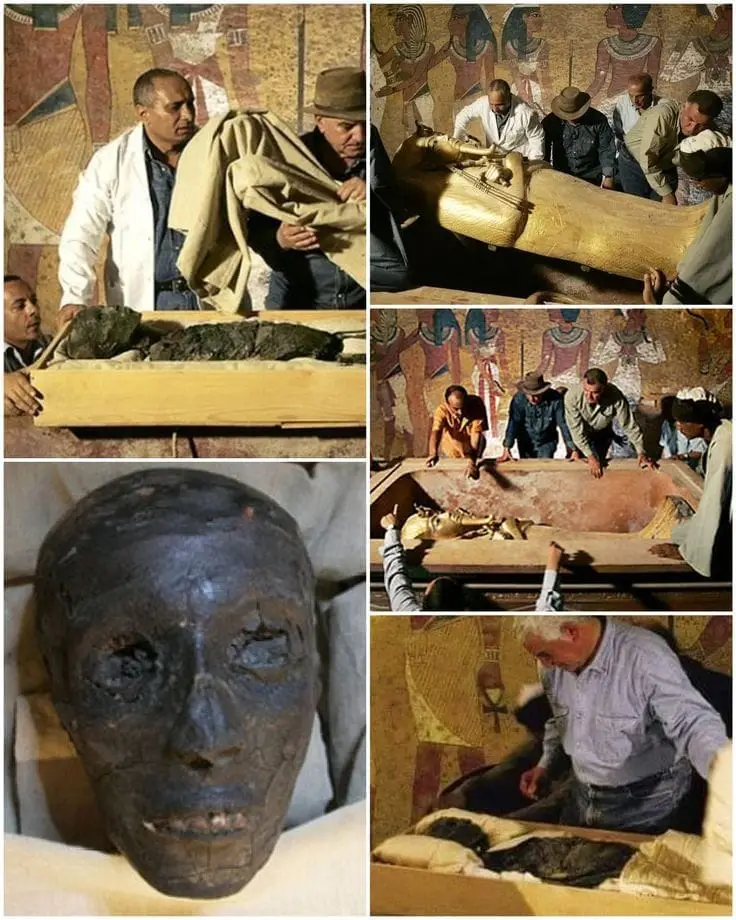
When Tutankhamun’s tomb was uncovered in the twentieth century, its treasures transformed the young pharaoh into a global cultural icon.
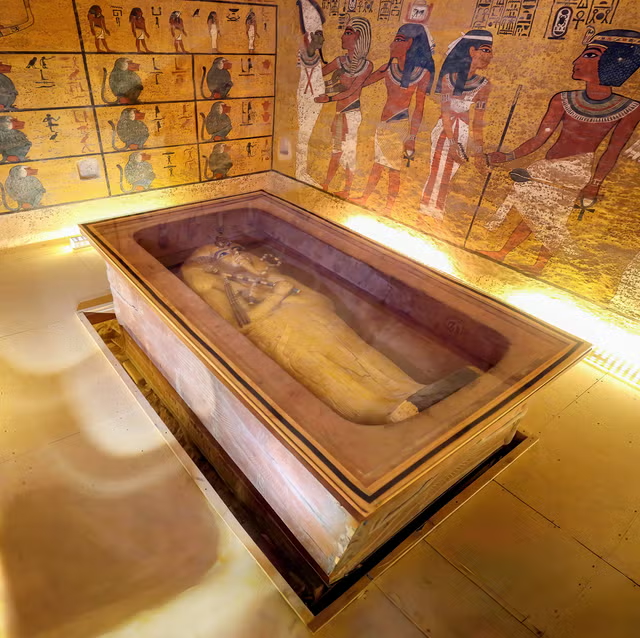
The extraordinary survival of his burial objects allowed modern audiences to see the remarkable sophistication of ancient Egyptian jewelry and decorative arts.
Gold naturally attracted enormous attention, but the lapis lazuli deserves a closer look.
Without the deep blues surrounding Tutankhamun’s eyes, the lapis scarab at the center of his pectoral, and the blue materials appearing throughout his royal treasures, many of these objects would have a very different visual character.
The stone provided contrast.
It provided symbolism.
And, perhaps most importantly, it helped connect the image of the king with the colors of the divine world imagined by ancient Egypt.
The Enduring Beauty of Tutankhamun’s Lapis Lazuli Treasures
More than 3,000 years after Tutankhamun was buried, the blue and gold of his treasures remain instantly recognizable.
His funerary mask, scarab pectoral, jewelry, and other objects demonstrate how highly ancient Egyptian craftspeople valued lapis lazuli and how skillfully they combined it with gold, carnelian, glass, faience, and other materials.
Yet the story of Tutankhamun’s lapis lazuli treasures is about more than beautiful jewelry.
It is a story of ancient trade routes stretching across vast distances, highly skilled gemstone carving, religious symbolism, royal power, and humanity’s enduring fascination with color.
For Tutankhamun, lapis lazuli was more than a beautiful blue stone.
Within the artistic and religious language of ancient Egypt, it became part of something much greater: an image of kingship designed to endure for eternity.
Explore our Lapis Lazuli Collection to discover beautiful pieces showcasing the stone’s captivating deep-blue color and timeless appeal.