
- Stone10
- Reports2
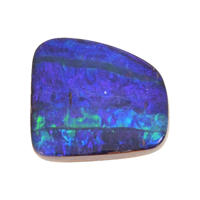
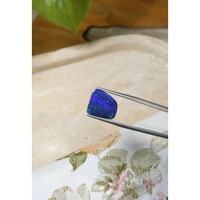
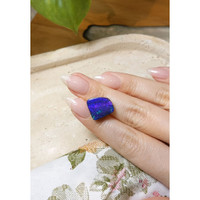


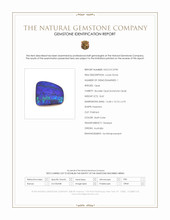


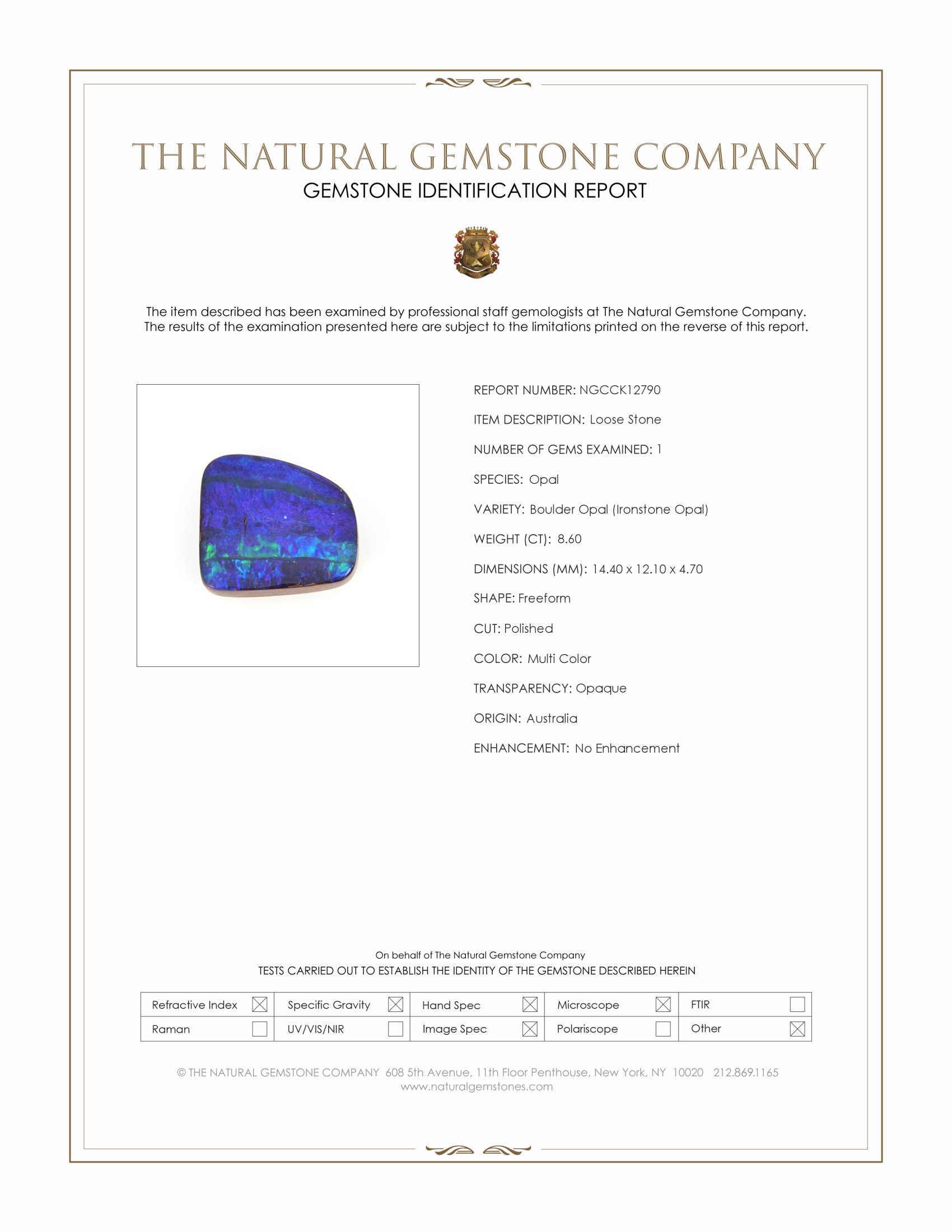
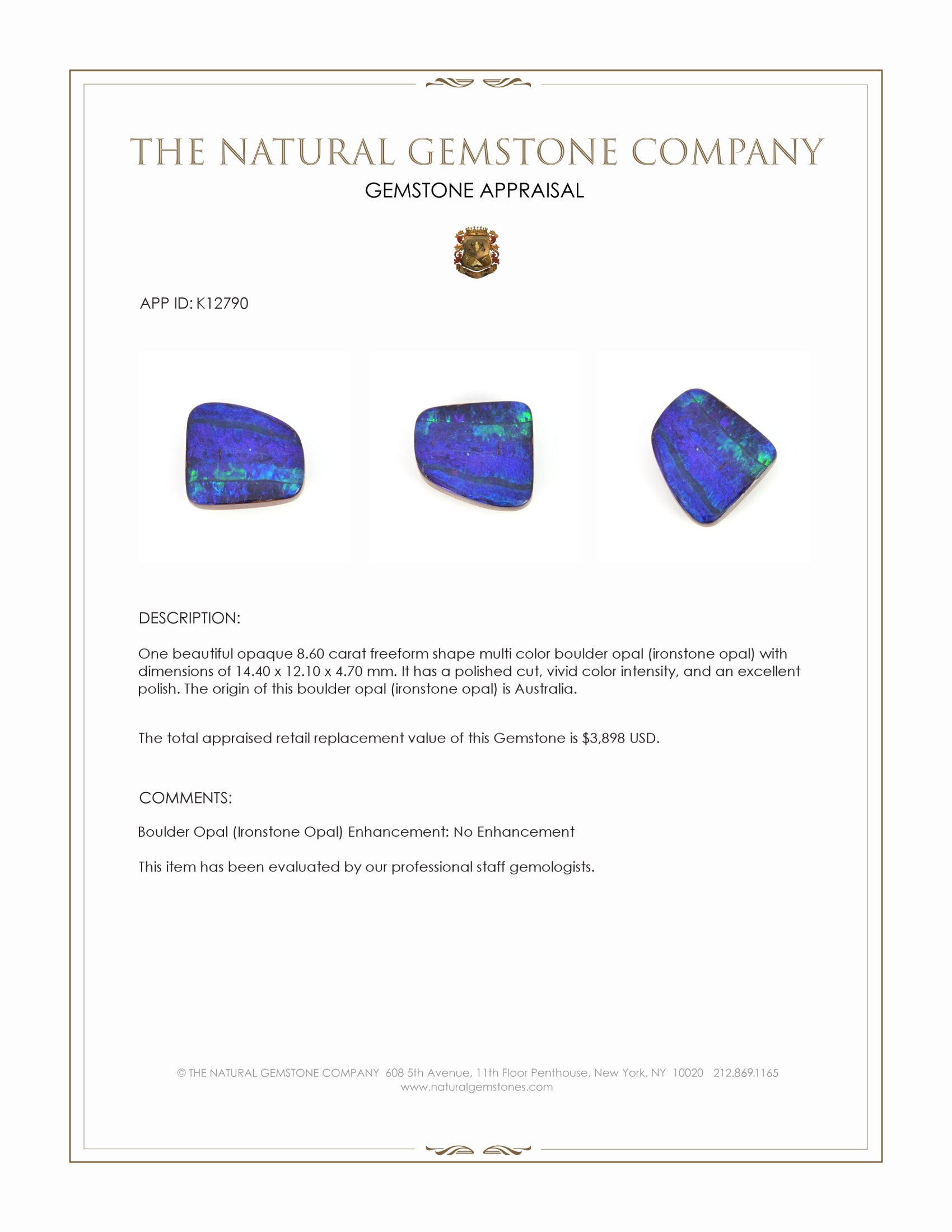
8.60 Ct. Multi Color Boulder Opal (Ironstone Opal) from Australia
This loose stone is available to ship now
Item ID: | K12790 |
|---|---|
Dimensions (MM): help | Length: 14.4 Width: 12.1 Height: 4.7 |
Weight: | 8.60 Ct. |
Color: help | Multi Color |
Color intensity: help | Vivid |
Clarity: help | Not Applicable |
Shape: help | Freeform |
Cut: | Polished |
Cutting style: | Tablet |
Enhancements: help | No Enhancement |
Origin: help | Australia |
Per carat price: help | $453 |
This listing presents one beautiful opaque 8.60 carat freeform shape Boulder Opal, Ironstone Opal, precisely measured at 14.40 x 12.10 x 4.70 mm, cut in a Tablet style and offered as a polished cut with vivid color intensity and an excellent polish, origin Australia, enhancement no enhancement, supplied by The Natural Gemstone Company. The freeform profile respects the natural opal seam within its ironstone matrix, producing an organic outline that was selected to maximize face up color and surface continuity. The Tablet cutting style used for this specimen results in a low domed face and a broad flat pavilion, which preserves thickness for structural integrity while exposing a generous surface area of play of color. The stone is opaque by nature, and the ironstone substrate remains visible along the edges and through linear banding, providing a stable backing that enhances contrast and color saturation across the visible face. The finish is a premium lapidary polish, achieved through progressively finer abrasives and final mechanical buffing, yielding a surface free of polish haze and able to return specular highlights that interact with the opal body color.
From a technical lapidary perspective, Boulder Opal, Ironstone Opal differs fundamentally from precious opal in its composite structure, with silica opal seams and patches integrated into a denser ironstone host. This specimen exhibits broad patchy play of color that is oriented along the seam plane, which explains the choice of a Tablet cut to align the most vivid layers with the orientation the viewer will most often see. The cutting process began with controlled trimming of the host matrix to reveal the richest opal seam, followed by careful grinding to define the freeform Tablet silhouette, and final sanding and polishing under controlled humidity to avoid micro cracking. The polish quality and edge relief indicate meticulous work to maintain the dark ironstone rim, which acts as a natural contrast agent, intensifying blues and greens and sharpening pattern boundaries. Color grading for opal emphasizes hue, brightness, and pattern definition rather than traditional clarity categories, and this stone rates at the upper end for brightness with consistently saturated cobalt and teal flashes against a near black body tone, classifying it as a vivid visual specimen.
When comparing brilliance and visual performance to more common gemstones, it is important to distinguish the mechanisms that produce visible fire and brilliance. Transparent gems such as diamond and sapphire derive sparkle from refraction and internal reflection controlled by refractive index, facet geometry, and clarity, whereas opal produces color through diffraction of light by orderly stacked silica spheres in its microstructure. The result is not brilliance in the traditional sense, but a spectral play of color that shifts with observer movement and illumination angle. Relative to diamonds, this Boulder Opal will not exhibit facet scintillation, but it offers a richer dynamic color phenomenon that can appear more dramatic in low angle lighting or against a dark field. Compared to colored stones like blue sapphire or emerald, this specimen stands out by providing multiple hues simultaneously and by changing the apparent color balance as the piece is turned. The ironstone backing further increases apparent contrast, making the blues and greens appear deeper and more luminous than they would over a pale or colorless substrate. In practical terms, a well cut Tablet Boulder Opal such as this communicates more visual complexity and optical variability than many single hue gems, and it does so with a surface polish that returns intense specular highlights to emphasize the color patches.
For buyers and designers who appreciate technical detail and practical application, this Boulder Opal, Ironstone Opal offers a clear set of advantages and considerations. Its hardness is lower than corundum and diamond, therefore settings that protect the girdle and edges are advisable, and the Tablet profile benefits from bezel or partial bezel settings that secure the broad flat pavilion while showcasing the polished face. The freeform outline invites bespoke mounting that follows the natural contour, preserving the ironstone edge as a design element to accentuate contrast. Care guidelines include avoiding ultrasonic cleaning and harsh chemical exposure, and recommending gentle cleaning with a soft cloth and mild soapy water. From a valuation standpoint, the combination of vivid color intensity, excellent polish, and untouched natural state with no enhancement contributes positively to rarity and desirability, especially given the Australian origin which is recognized for high quality boulder opal material. The Natural Gemstone Company stands behind the craftsmanship and optical grading of this piece, and we can provide bespoke setting advice to maximize visual impact, or detailed images and viewing recommendations to ensure the stone meets exacting expectations before purchase.


