
- Stone14
- Reports2

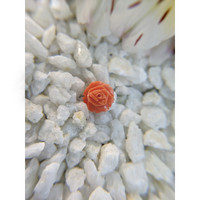
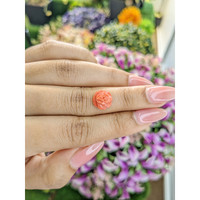
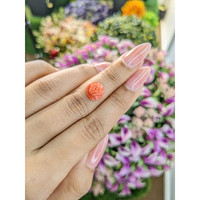
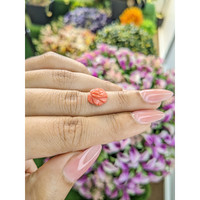
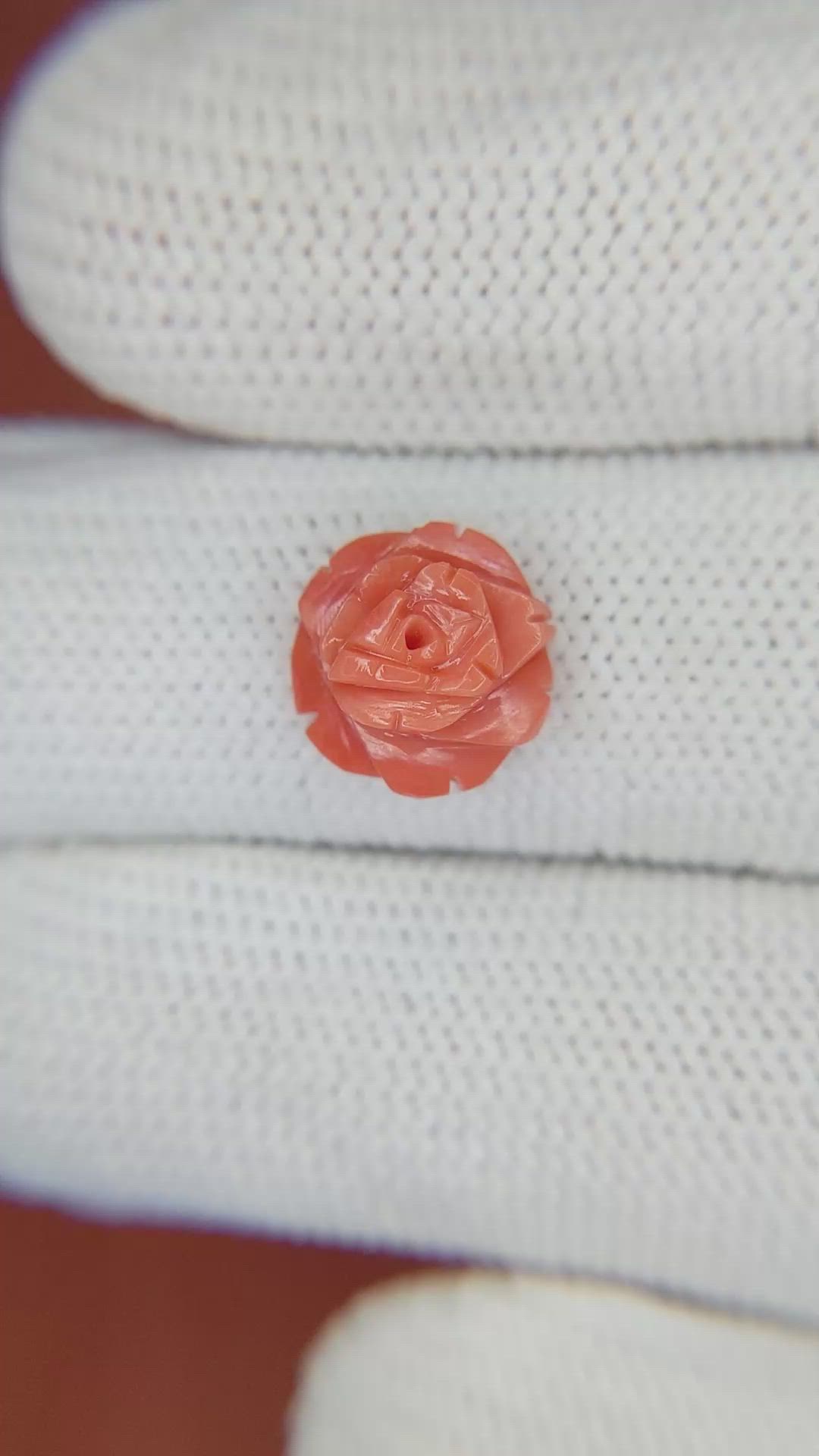




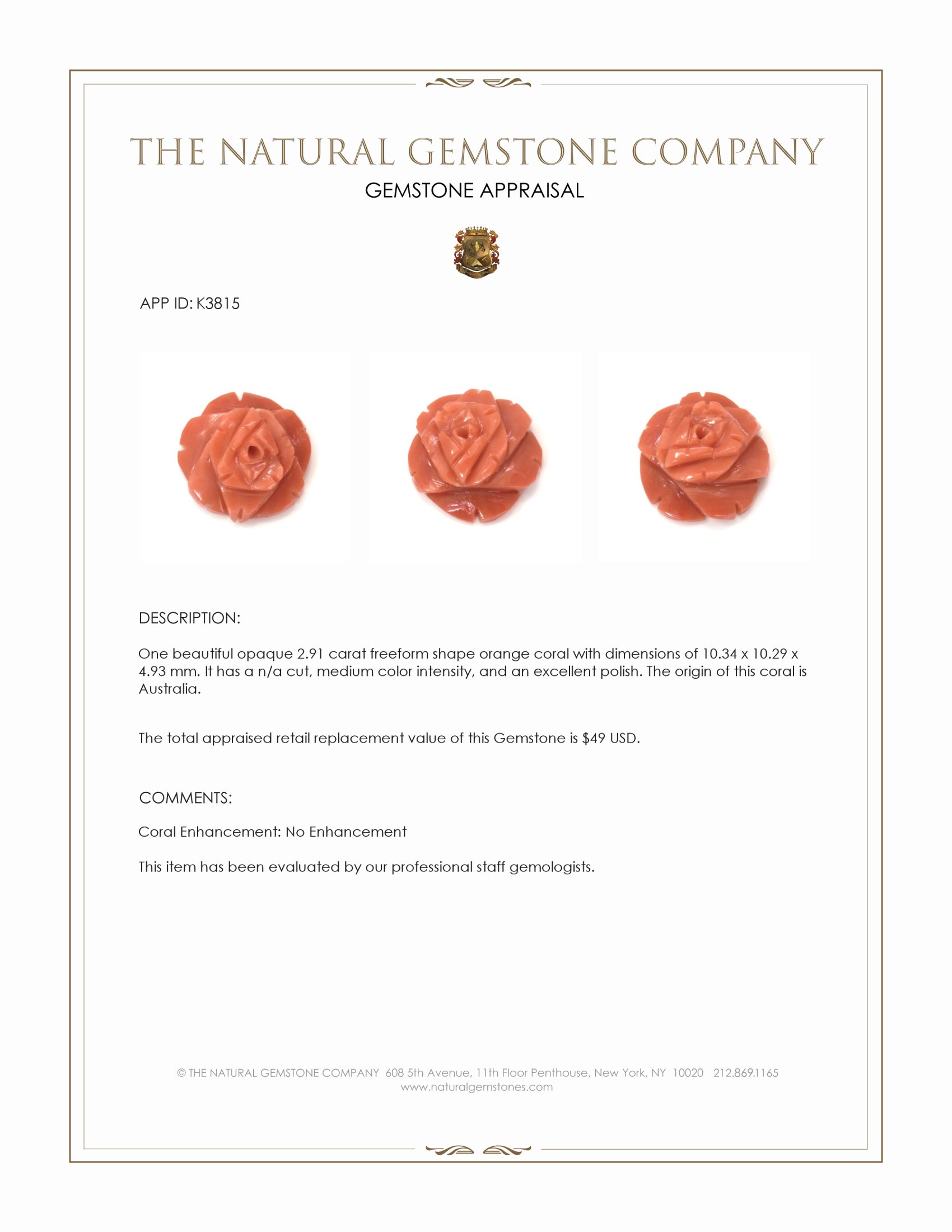
2.91 Ct. Coral from Australia
This loose stone is available to ship now
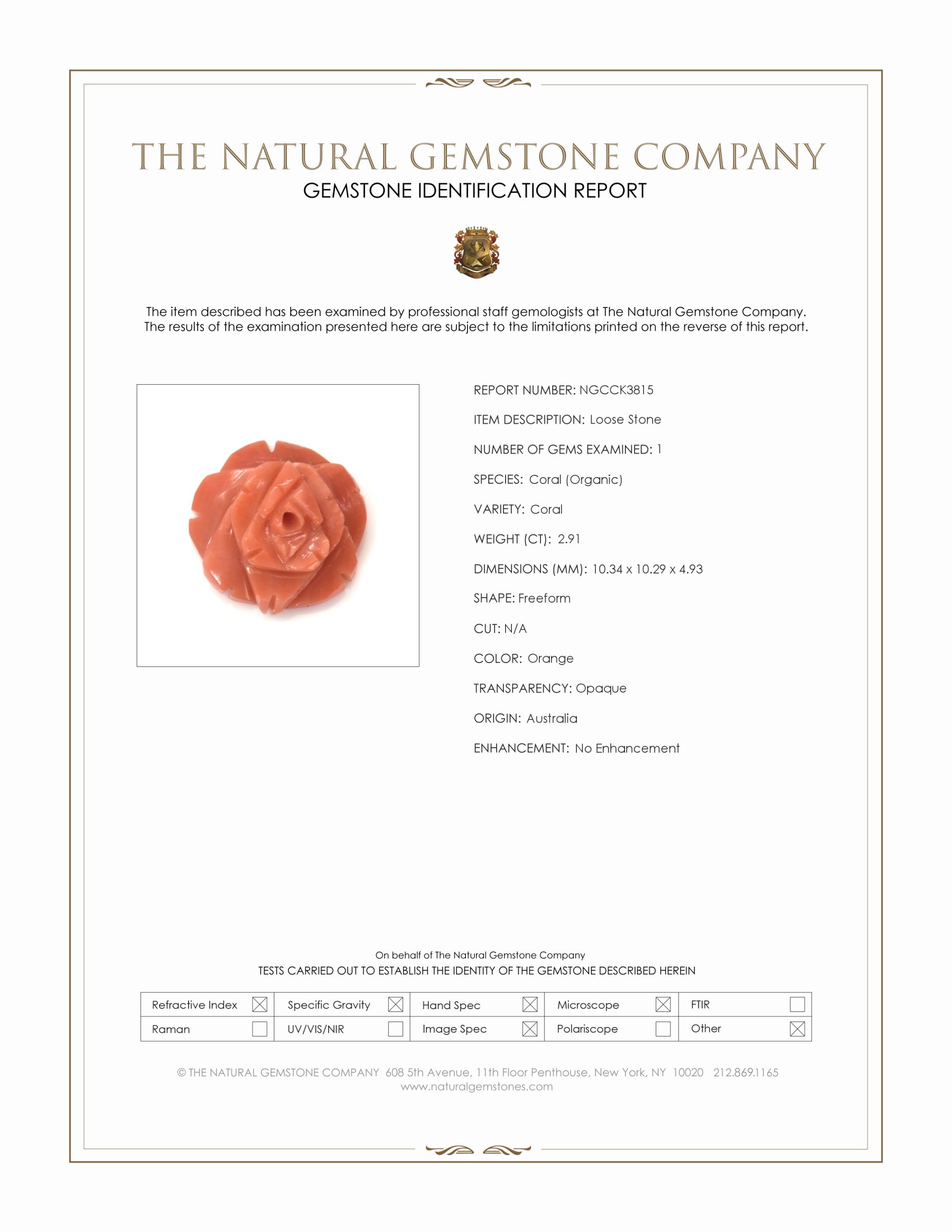
Item ID: | K3815 |
|---|---|
Dimensions (MM): help | Length: 10.34 Width: 10.29 Height: 4.93 |
Weight: | 2.91 Ct. |
Color: help | Orange |
Color intensity: help | Medium |
Clarity: help | Not Applicable |
Shape: help | Freeform |
Cut: | N/A |
Cutting style: | Carving |
Enhancements: help | No Enhancement |
Origin: help | Australia |
Per carat price: help | $17 |
This specimen is a 2.91 carat piece of natural orange coral, presented in a freeform shape with precise dimensions of 10.34 x 10.29 x 4.93 mm, originating from Australia. The piece exhibits medium color intensity, falling into a balanced orange grade that displays warmth without top loading or extreme saturation, enabling versatility in design and ease of color matching. The item is carved into a floral motif, a stylized rose, which leverages the material thickness to create layered petals and controlled relief, while maintaining the inherent freeform perimeter rather than a strict geometric outline. The cut is recorded as not applicable, reflecting the organic and carved nature of the material rather than faceted geometry, and the polish is graded excellent, delivering a smooth waxy to subvitreous lustre that is characteristic of well finished coral. Enhancement testing and provenance research indicate no enhancement, the color is natural and untreated, and the Australian origin is documented, allowing confident attribution for collectors and designers who prioritize natural, provenance backed materials.
From a material science perspective this coral behaves as an organic calcium carbonate based gem material with typical Mohs hardness in the range of approximately 3.5 to 4, which informs both handling and setting strategy. The polished surface shows the expected uniformity of color with minimal veining or zoning, and the medium color intensity suggests an even distribution of natural pigments within the skeletal structure. Under magnification one would expect to observe subtle growth lines and fine microstructure related to coral biogenic accretion, rather than crystalline cleavage planes. Porosity is low in this specimen due to dense formation and the thorough polishing process, however the organic nature requires avoidance of prolonged exposure to acids, strong solvents, and high heat which can alter color and surface quality. The untreated status was confirmed through standard gemological protocols, including microscopic inspection for concentrated dye in fissures, solvent spot testing where appropriate, and UV response consistent with natural, unaltered coral materials. The excellent polish minimizes surface irregularities, which improves tactile feel and reduces places where dirt or oils could accumulate, important considerations for wearable pieces.
The craftsmanship reflects a careful balance between conserving weight and maximizing sculptural impact, the rose carving utilizes controlled depth to form distinct petal planes and a central culet like aperture which enhances three dimensionality without compromising structural integrity. Carving techniques employed would include staged abrasion with graduated diamond impregnated burs and fine abrasive wheels for shaping, followed by sequential polishing compounds culminating in a final wax or rouge stage to achieve the described excellent polish. Sculptural elements such as petal bevels and crisp termination points have been kept conservative relative to the thickness, which preserves edge strength and reduces the likelihood of chipping during setting. The freeform outline is intentionally retained to emphasize the organic origin and to offer designers flexibility, the slightly asymmetrical perimeter provides movement and character, while the near square footprint of the dimensions allows predictable material distribution when designing bezels or mounts. The density and depth allow for shallow relief carving without creating thin fragile sections, an important technical detail for subsequent lapidary operations or for drilling if bead conversion is desired.
For mounting and care the material properties and the carved profile recommend protective settings that distribute stress and limit exposure, a closed bezel or a low profile collet setting is preferred to shield the perimeter and the delicate petal terminations. If used in rings, avoid prong only settings that concentrate force on small points, and consider seat liners or resin backs for pieces intended for daily wear to protect against mechanical shock and to stabilize the piece within the metal surround. Cleaning should be performed with a soft cloth and mild soapy water, avoid ultrasonic cleaners and steam, and avoid chemical cleaners that contain acids or alkalies. For designers seeking color harmony, the medium orange tone pairs strongly with warm alloys such as 18 karat yellow gold or rose gold, and can be accentuated with small white brilliants or cognac colored accent stones to create contrast without overwhelming the organic depth of the coral. The Natural Gemstone Company provides this item with full disclosure of origin and untreated status, and we can supply high resolution images, condition reports, and optional mounting services on request, to facilitate incorporation into finished jewelry with technical confidence and provenance clarity.


