
- Stone10
- Reports3
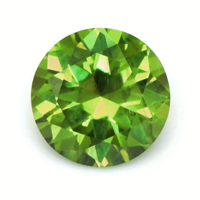
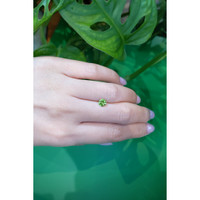




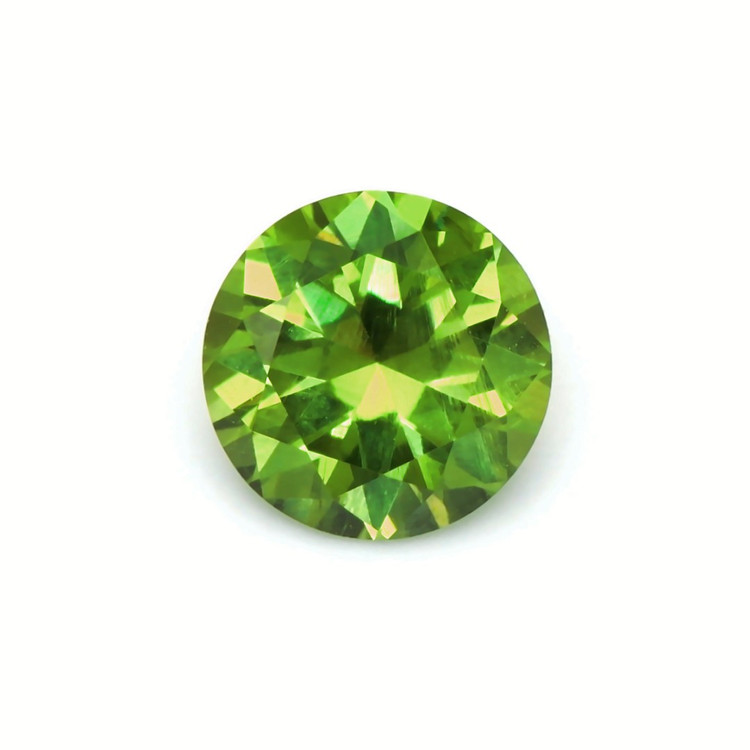


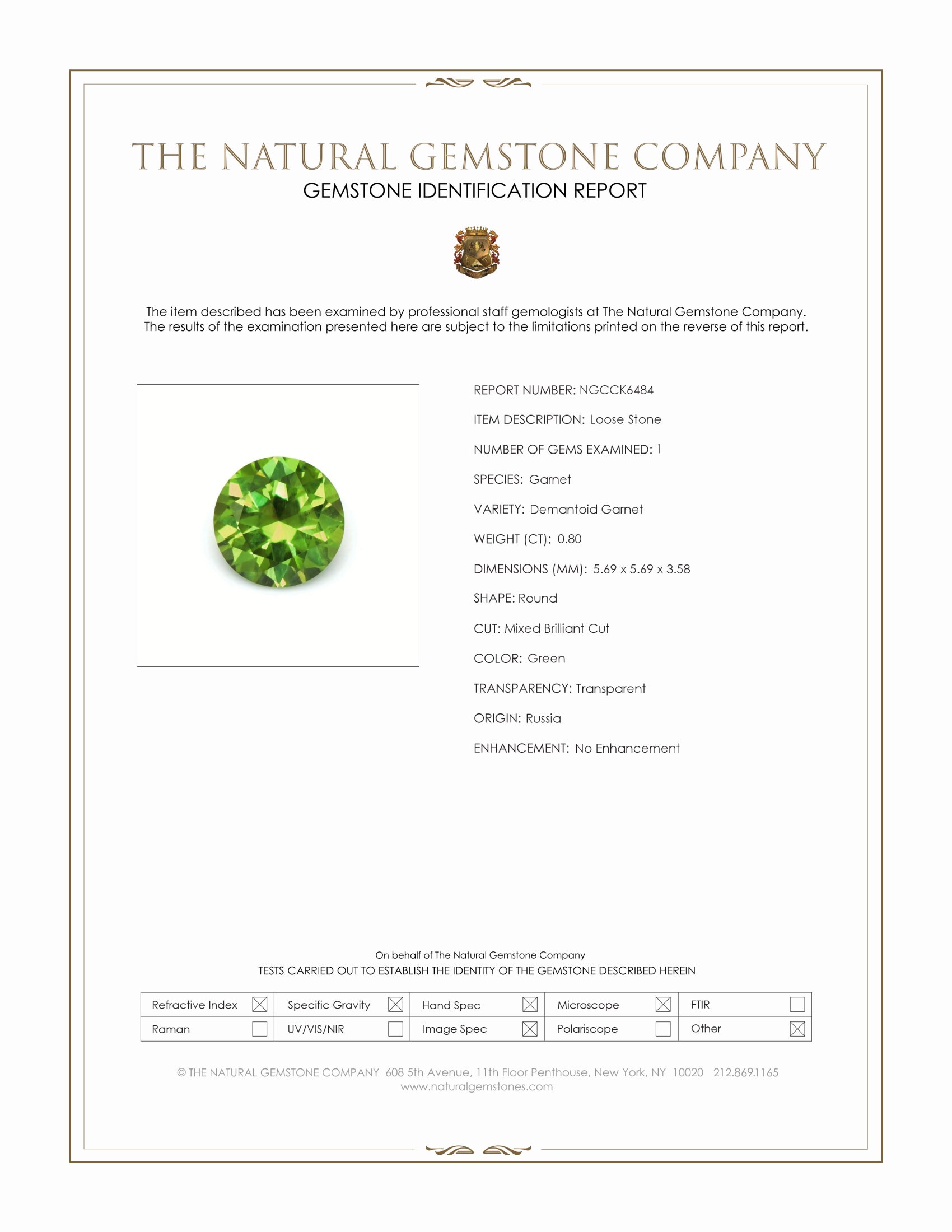
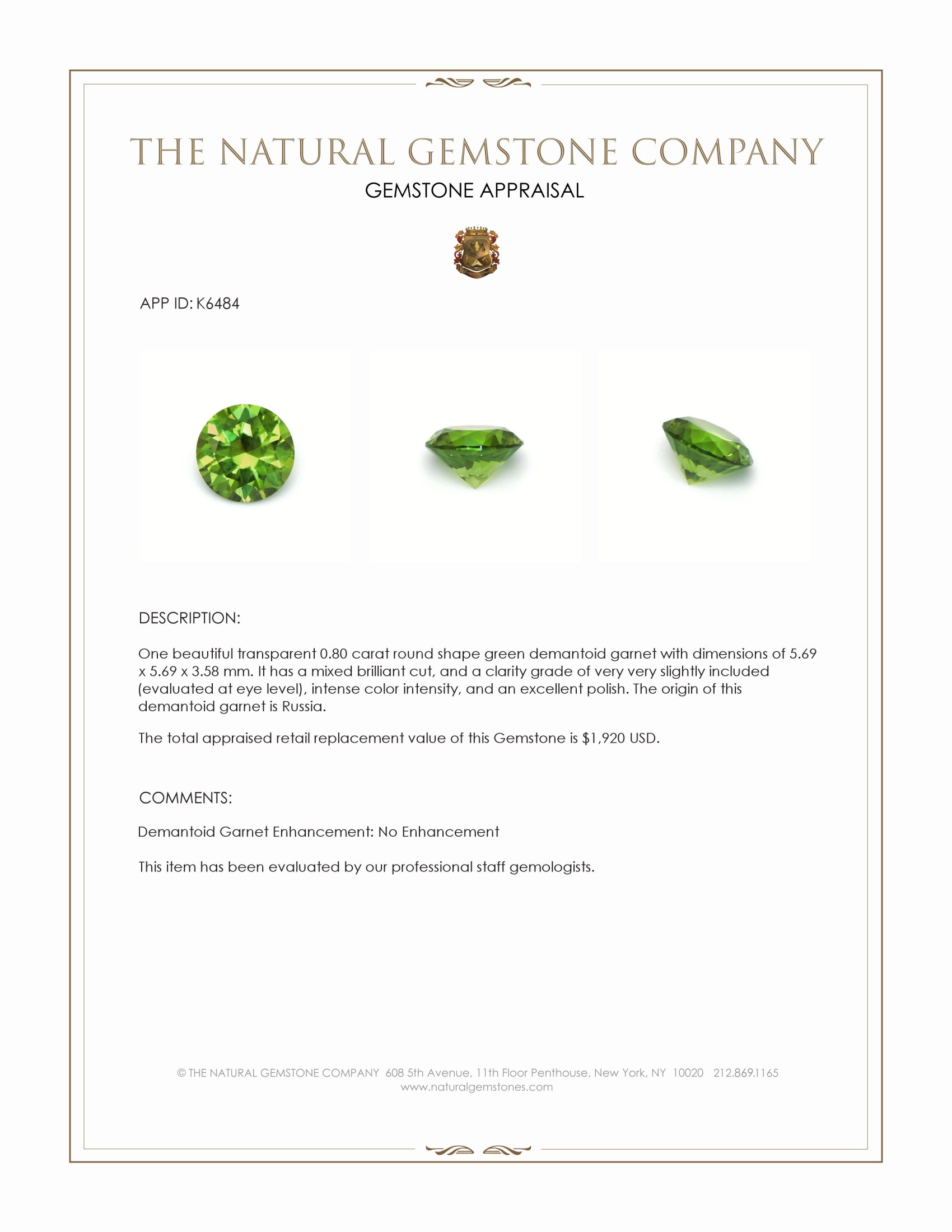
0.80 Ct. Green Demantoid Garnet from Russia
This loose stone is available to ship now
Item ID: | K6484 |
|---|---|
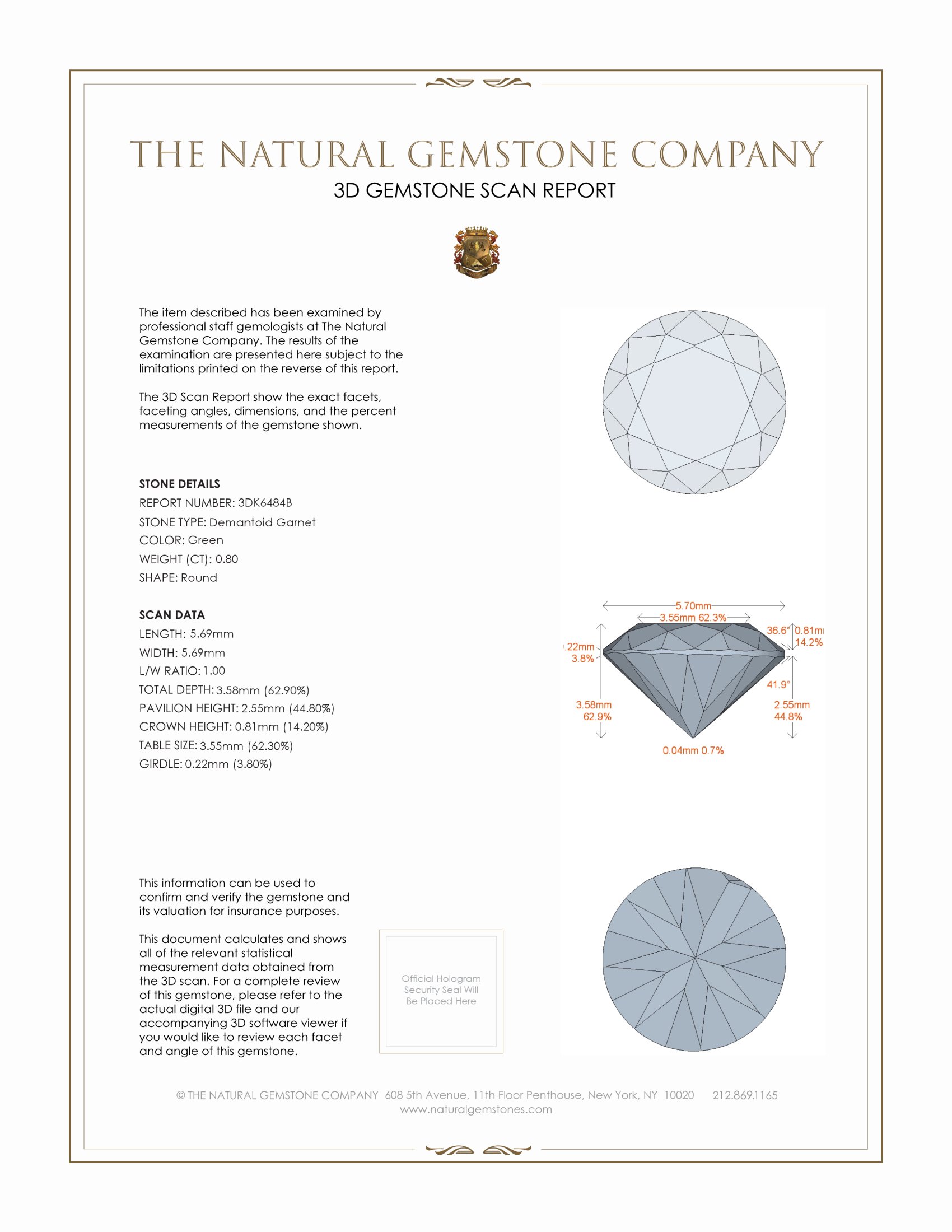
Dimensions (MM): help | Length: 5.69 Width: 5.69 Height: 3.58 |
Weight: | 0.80 Ct. |
Color: help | Green |
Color intensity: help | Intense |
Clarity: help | Very Very Slightly Included |
Shape: help | Round |
Cut: | Mixed Brilliant Cut |
Cutting style: | Faceted |
Enhancements: help | No Enhancement |
Origin: help | Russia |
Per carat price: help | $2,400 |
This transparent green demantoid garnet weighs 0.80 carat, and it is a round shape measuring 5.69 x 5.69 x 3.58 mm, cut in a mixed brilliant style, clarity grade very very slightly included, evaluated at eye level, intense color intensity, and excellent polish. Origin Russia, enhancement none, provenance consistent with classic Ural material. This specimen displays the compact dimensions and density that are characteristic of demantoid andradite, a gem that presents a weight to face up size relationship slightly different from lighter gemstones. The mixed brilliant execution combines a brilliant crown with a precisely faceted pavilion geometry engineered to maximize return of light and to balance the strong dispersion of demantoid. The finish is technically precise, with facet junctions that meet sharply, a well proportioned table, and a girdle thickness calibrated to preserve durability while allowing secure setting in fine jewelry. At eye level the stone reads as very very slightly included, indicating that any internal features are minute and do not interfere with the stone s visual performance, while the excellent polish enhances both contrast and scintillation.
To understand the character of this demantoid it helps to travel back millions of years into the geological processes that produced it. Deep within the ancient rocks of the Ural region, magmatic activity and tectonic metamorphism created a suite of calcium iron silicate environments where andradite crystals could nucleate. Hydrothermal fluids, enriched in chromium and iron, migrated through fractures and contact zones between ultramafic and carbonate rocks, dissolving and redepositing elements as temperature and pressure fluctuated. In localized pockets where conditions favored high silica and calcium activity, andradite crystals began to grow. Trace chromium substituting into the crystal lattice imparted the intense green hue that defines demantoid. The growth regime was episodic, allowing euhedral to subhedral crystals to develop over extended intervals, while late stage serpentinization and fibrous mineral growth yielded the characteristic needle like inclusions often associated with Russian demantoid. Those fibrous inclusions, commonly chrysotile or other radial fibers, formed contemporaneously with the garnet during cooling and fluid infiltration, and in this particular stone they remain extremely fine, observable only under high magnification, which is why the clarity grade at eye level is very very slightly included.
The cutting and faceting of this 0.80 carat round demantoid required deliberate decisions that reflect an understanding of both the material s optical constants and the physical geometry of the rough. The measured depth of 3.58 mm over a diameter of 5.69 mm yields a depth proportion of approximately 62.9 percent, a proportion that balances brilliance with face up spread for a stone of this density. The mixed brilliant approach typically employs a brilliant facet pattern on the crown to disperse light into spectral fire, coupled with a modified pavilion that controls internal reflections and reduces windowing. For demantoid, with its relatively high refractive index and notable dispersion, pavilion angles are tuned to optimize total internal reflection, and crown angles are calibrated to convert return light into lively scintillation rather than internal extinction. The cutter honored the rough s shape, orienting the pavilion and crown to align the stone s optic axes for maximal color saturation and to minimize the visual impact of internal features. The excellent polish is evident in the smooth facet planes and crisp facet junctions, which allow precise phase relationships between adjacent facets, ensuring strong contrast and pinpoint reflections that contribute to the gem s apparent brilliance.
In practical terms this gemstone presents a rare combination of intense green color, high transparency, and superior cutting craftsmanship, qualities that make it suitable for center stone use in rings, pendants, or bespoke designs where optical performance is paramount. The intense color intensity indicates a strong saturation with a balanced tone, producing a vivid green that reads as natural and lively under varied lighting scenarios; the transparency and very very slight inclusions mean that light transmission is unobstructed, supporting both brilliance and dispersion. Compared to other green gemstones such as emerald or tsavorite, demantoid offers exceptional fire and a different textural character due to its specific internal reflections and higher specific gravity, yielding a denser tactile feel. Care for demantoid is straightforward, avoid ultrasonics if the mounting exposes internal inclusions to stress, clean gently with mild soap and warm water and a soft brush, and store separately to prevent abrasion of facet edges. This piece is offered by The Natural Gemstone Company, presented as a natural, unenhanced Russian demantoid with documented measurements, cut characteristics, and an honest assessment of clarity and color. For buyers who value traceable origin, technical precision in cut, and the unique optical properties of demantoid, this 0.80 carat round specimen represents a technically superior and historically resonant choice.


