
- Pair8
- Reports2


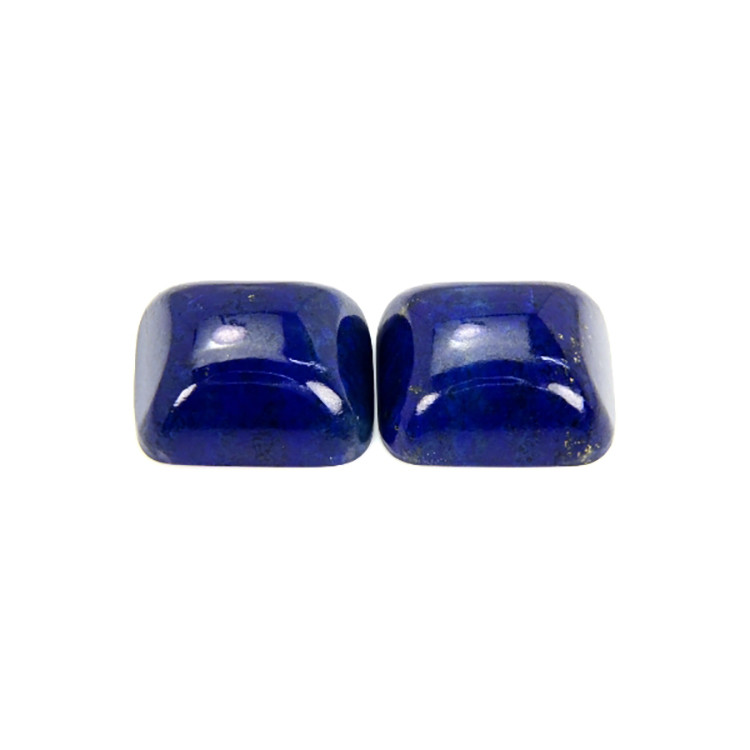


29.11 Ct.Tw.Total Carat Weight Cabochon Lapis Pair from Afghanistan
This pair of stones is available to ship now
Stone type: | Lapis | Lapis |
|---|---|---|
Item ID: | PR6660 | PR6660 |
Dimensions (MM): help | Length: 15.91 Width: 14 Height: 7.21 | Length: 15.75 Width: 14.05 Height: 7.16 |
Weight: | 14.51 Ct. | 14.60 Ct. |
Color: help | Blue | Blue |
Color intensity: help | N/A | N/A |
Clarity: help | Not Applicable | Not Applicable |
Shape: help | Cushion | Cushion |
Cut: | Cabochon | Cabochon |
Cutting style: | Cabochon | Cabochon |
Enhancements: help | No Enhancement | No Enhancement |
Origin: help | Afghanistan | Afghanistan |
Per carat price: help | $12 | $12 |
This matched pair of cushion shape lapis presents a rare combination of size, uniformity, and natural color, offered by The Natural Gemstone Company. Individually the stones weigh 14.51 carats and 14.60 carats respectively, with dimensions of 15.91 by 14.00 by 7.21 millimeters for one stone, and 15.75 by 14.05 by 7.16 millimeters for the other. Both are cabochon cut, opaque in body tone, and finished to an excellent polish, with no enhancement reported, and documented origin from Afghanistan. For an educated buyer these specifics matter, because the close match in carat weight, paired with near identical dimensions and polish, reduces the amount of technical adjustment required when fabricating a matched set, and increases the intrinsic and mounted value. From a practical perspective the size places each stone in a range that suits prominent earring settings, a pendant with a balanced companion piece, or a pair of bespoke cufflinks, while the cushion cabochon silhouette provides predictable curvature and a stable table area for secure bezel or prong work.
From a gemological viewpoint lapis is best evaluated using a different set of priorities than transparent gems, and the grading focus shifts toward color, homogeneity, presence or absence of calcite veining, and the character and distribution of pyrite inclusions. Lapis is a rock composed principally of the mineral lazurite, often accompanied by calcite and pyrite, and the most prized material exhibits a deep, saturated ultramarine to royal blue with minimal white calcite and finely dispersed, subtle pyrite that can add a tasteful metallic sparkle without interrupting the blue field. These two cabochons display a rich, vivid blue across the domed surface, with opacity appropriate for lapis and with an excellent polish that enhances both apparent saturation and surface luster. The notation of no enhancement is significant, because treatments such as dyeing or stabilization are sometimes applied to lower grade material to improve color or durability, and untreated Afghan lapis, particularly material sourced near classic mining districts such as Sar e Sang, commands premium consideration for collectors and makers who prioritize natural origin and geological provenance.
Matching lapis into a pair requires technical precision at multiple stages, beginning with careful selection of rough to ensure comparable grain and color distribution, and continuing through cutting and finishing to produce two pieces that will behave identically under light and in a mounted setting. The tolerance in our pair is extremely tight, with a carat variation of only 0.09 carats and dimensional differences under half a millimeter in each direction, which speaks to the cutter s skill in maintaining consistent dome height, curvature, and table symmetry. For jewelry fabrication this uniformity matters because unequal thicknesses will refract and reflect light differently, producing apparent variations in hue and depth when the stones are set side by side, and differences in dome curvature can affect how a bezel seats and how light glances across the finished piece. A lapidary aiming for matched pairs will control trimming to preserve parallel girdles, maintain consistent cabochon profiles, and match the surface polish grade, and when these controls are met as they are with this pair, the result is a visually seamless combination that requires minimal compensation from the setter.
Practical considerations for the buyer and the jeweler include setting style, protective measures, and long term care to preserve the stones natural qualities and provenance value. Because these lapis are opaque cabochons with excellent polish, bezel settings are often recommended to protect the edges and to provide a continuous frame that complements the cushion shape, while low prong or partial bezel approaches can be used where more of the stone s pavilion needs to be visible for design reasons. Avoid ultrasonic cleaning and steam treatments, and use only mild soap and lukewarm water with a soft brush to remove surface dirt, followed by a soft cloth to restore the polish. Given the untreated origin and the desirable Afghan provenance, buyers should consider documentation for insurance and for resale, and The Natural Gemstone Company can provide provenance information and guidance for certification if required. If you are commissioning a matched pair for a bespoke project, precise communication with your setter or designer about the measured dimensions and dome profile will minimize adjustments, and our team is available to advise on mounting tolerances and design choices to ensure that the final piece fully expresses the uniform color, consistent weight, and polished finish that make this pair exceptional.


