
- Pair12
- Reports4
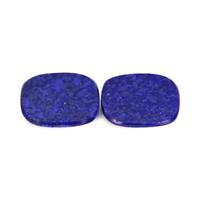



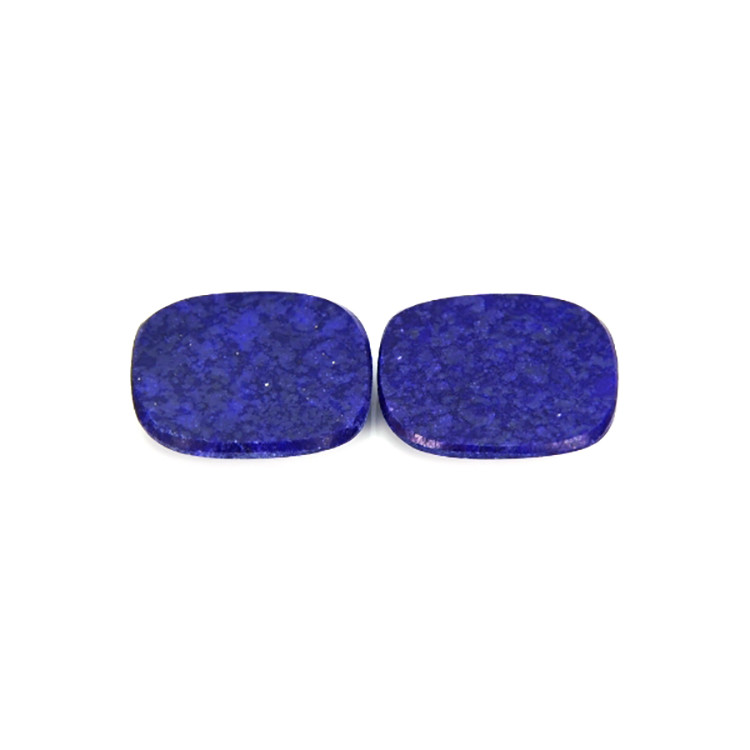


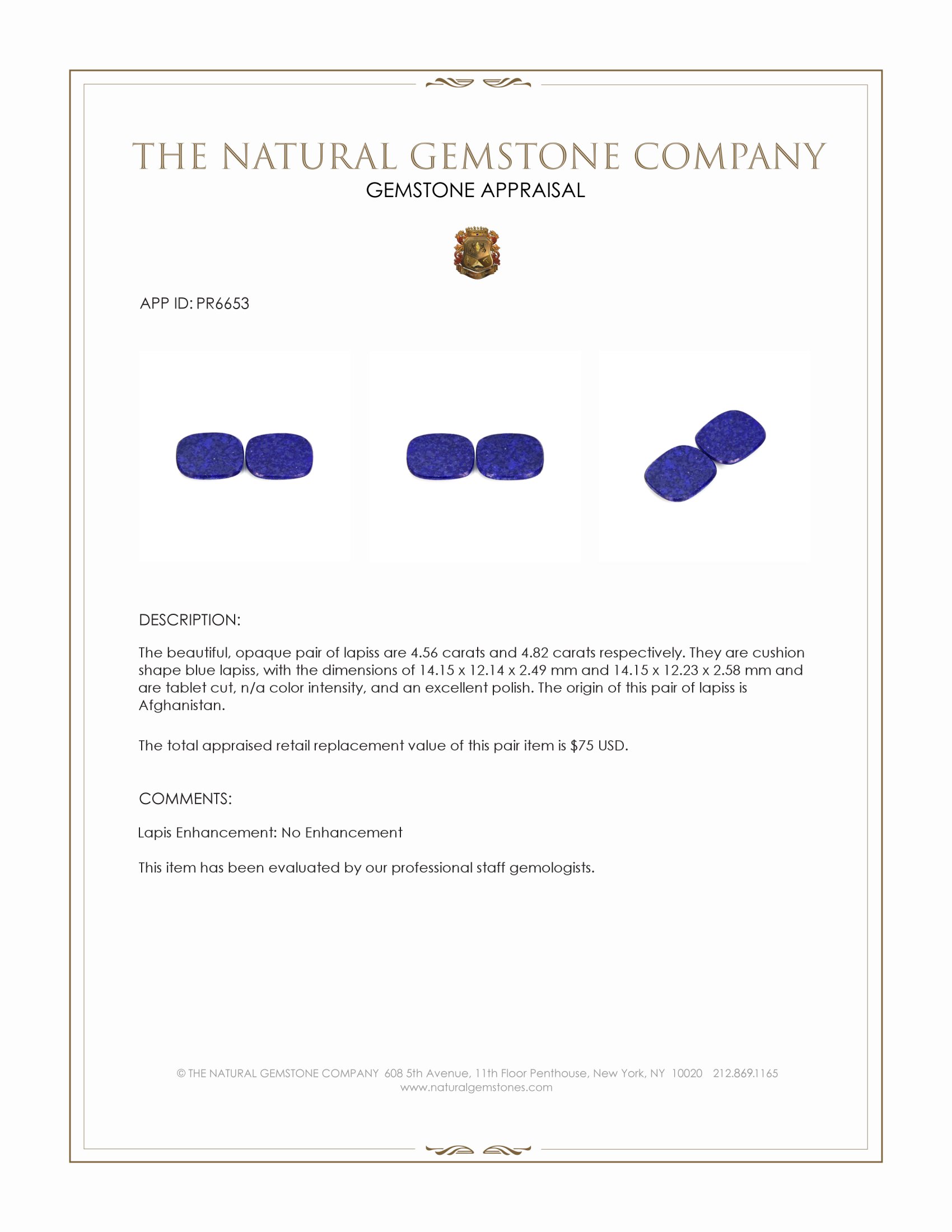
9.38 Ct.Tw.Total Carat Weight Lapis Pair from Afghanistan
This pair of stones is available to ship now
Stone type: | Lapis | Lapis |
|---|---|---|
Item ID: | PR6653 | PR6653 |
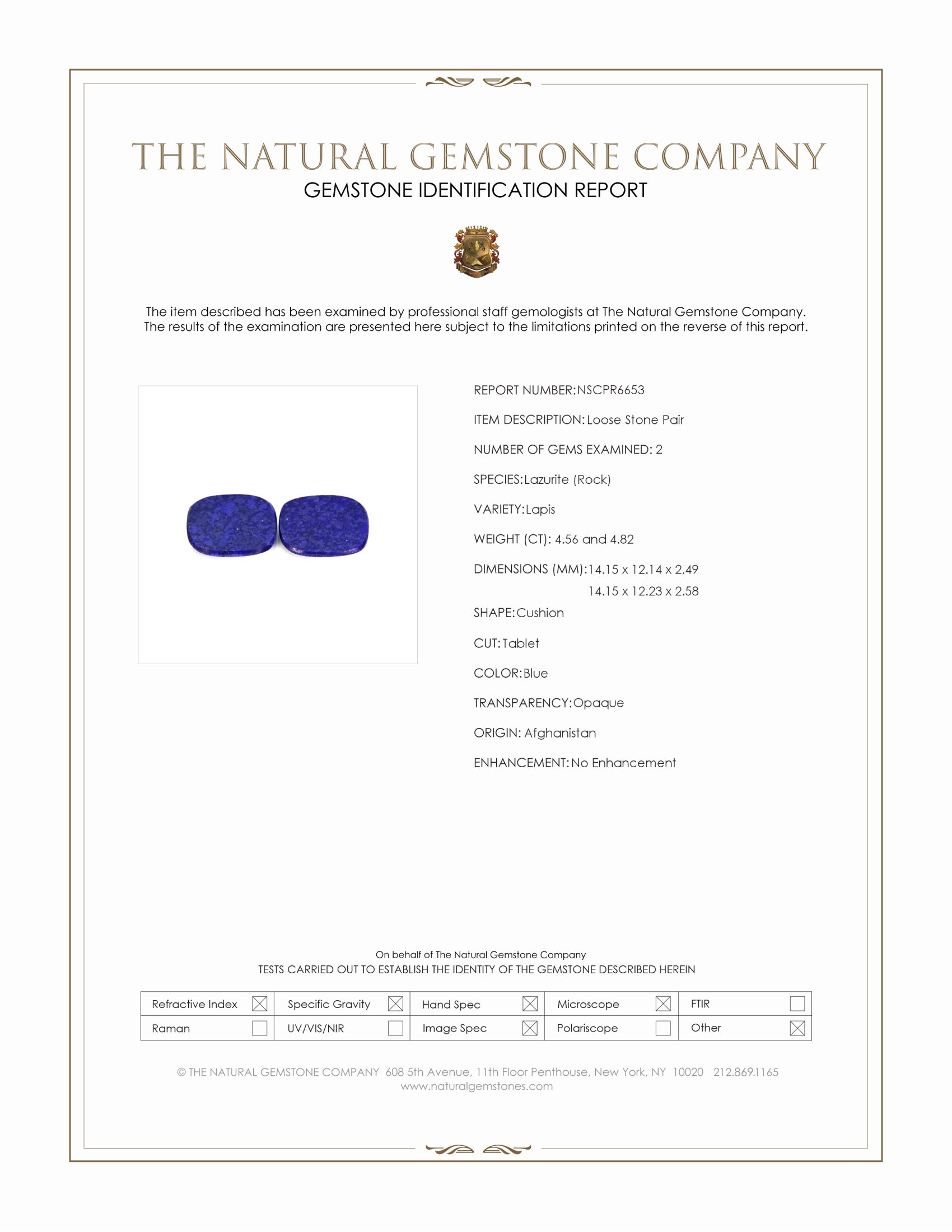
Dimensions (MM): help | Length: 14.15 Width: 12.14 Height: 2.49 | Length: 14.15 Width: 12.23 Height: 2.58 |
Weight: | 4.56 Ct. | 4.82 Ct. |
Color: help | Blue | Blue |
Color intensity: help | N/A | N/A |
Clarity: help | Not Applicable | Not Applicable |
Shape: help | Cushion | Cushion |
Cut: | Tablet | Tablet |
Cutting style: | Tablet | Tablet |
Enhancements: help | No Enhancement | No Enhancement |
Origin: help | Afghanistan | Afghanistan |
Per carat price: help | $8 | $8 |
This matched pair of cushion shaped lapis is presented by The Natural Gemstone Company as an example of carefully executed lapidary work on a naturally opaque material, each piece weighed and measured to publish exact specifications. The stones are 4.56 carats and 4.82 carats respectively, with dimensions of 14.15 x 12.14 x 2.49 millimeters and 14.15 x 12.23 x 2.58 millimeters, cut in a tablet profile and finished to an excellent polish, with no enhancement. The tablet cut in lapis is a deliberate choice for stones of this character, the low domed profile and flattened pavilion preserve color saturation while minimizing the exposure of internal heterogeneities, the cushion outline softens optical edges and allows the uniform blue field to read consistently in wearable applications. Because these specimens are fully opaque, conventional color intensity grading is not applicable in the same way it is for transparent gems, instead evaluation emphasizes hue stability, tonal evenness, and the absence of disruptive calcite veining or excessive pyrite speckling, attributes that these pieces exhibit consistent with high grade Afghan lapis.
The technical rarity of finding two perfectly matching lapis stones stems from the mineralogical and material challenges inherent to lapis lazuli, and this pair exemplifies why matched sets command attention. Lapis is a composite rock dominated by lazurite, with variable admixtures of calcite and pyrite, and natural variations in grain structure, veining, and distribution of accessory minerals produce color and texture differences at microscopic and macroscopic scales. Achieving a visual match therefore requires selective sawing of rough, meticulous orientation of material during cutting, and iterative fine trimming to align both surface contour and internal patterning, all without introducing stabilizing resins or dyes. The slight differentials in weight and thickness between these two pieces are within tight tolerances for natural material, the lengths are identical to the hundredth of a millimeter and the widths and thicknesses differ by less than a tenth of a millimeter, while the weight variance is a quarter of a carat, a remarkable achievement for untreated lapis from a single Afghan source. For clients seeking matched stones for earrings, cufflinks, or paired inlays, this degree of congruence delivers symmetrical appearance and balanced visual mass, while retaining the natural, untreated character that discerning collectors and artisans prefer.
From a craftsmanship perspective, the cut and finish convey specific technical decisions that speak to both usability and longevity, the tablet cut reduces stress concentration by presenting a broad bearing surface to settings, the cushion outline eases bezel forming and facilitates consistent light diffusion across the face of the stone, and the excellent polish indicates careful lapidary removal of saw marks, progressive abrasive grading, and final lapping that produced a uniform satiny to semi mirror luster without overworking the surface. The fact that these stones are untreated, reported with no enhancement, increases their desirability and also dictates recommended handling and setting protocols, avoid prolonged exposure to household acids, ultrasonic cleaners, and high heat, employ conservative mechanical fixing methods when possible, use appropriate backing or liner materials for inlay work to prevent moisture ingress, and consider sealed bezel settings or epoxy backing where additional protection is required. Provenance from Afghanistan adds a recognized geographic signature, Afghan lapis is historically associated with deep, saturated blues and a particular mineral fabric, and The Natural Gemstone Company documents this origin to support both provenance and quality expectations. For technical inquiries, custom pair matching, or detailed imagery at magnification to inspect surface texture and accessory mineral distribution, contact The Natural Gemstone Company for laboratory quality photos and specification sheets, we stand behind the natural, untreated status of these lapis stones, and we can advise on optimal mounting strategies to preserve their appearance and structural integrity.


