
- Stone7
- Reports2
-oval-yellow-moonstone-12.7900-cts-k5814-1.jpg?d=200x200&v=20240910003856)



-oval-yellow-moonstone-12.7900-cts-k5814-1.jpg?d=750x750&s=ngc&v=20240910003856)

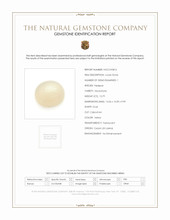
12.79 Ct. Cabochon Moonstone from Ceylon (Sri Lanka)
This loose stone is available to ship now
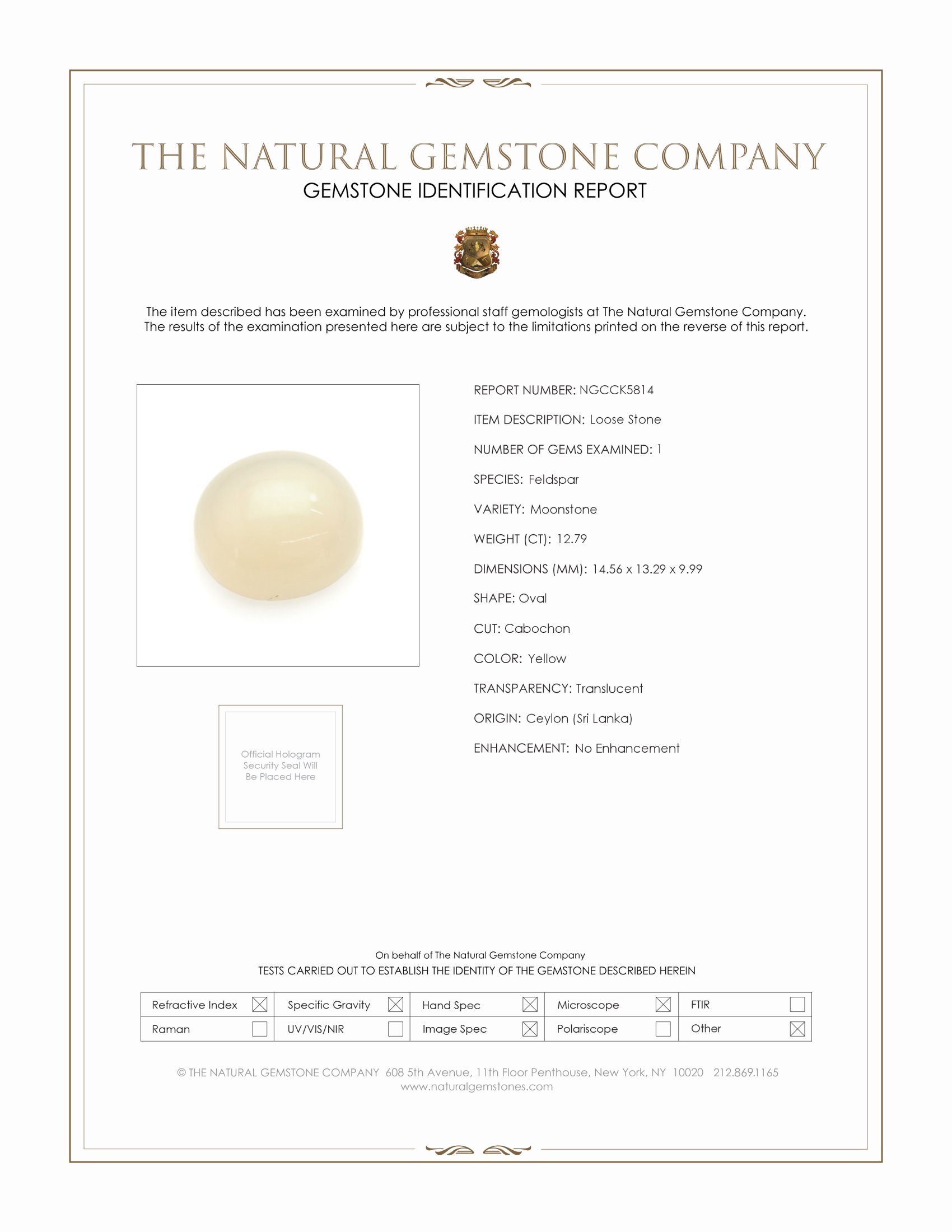
Item ID: | K5814 |
|---|---|
Dimensions (MM): help | Length: 14.56 Width: 13.29 Height: 9.99 |
Weight: | 12.79 Ct. |
Color: help | Yellow |
Color intensity: help | Light |
Clarity: help | Very Very Slightly Included |
Shape: help | Oval |
Cut: | Cabochon |
Cutting style: | Cabochon |
Enhancements: help | No Enhancement |
Origin: help | Ceylon (Sri Lanka) |
Per carat price: help | $14 |
This 12.79 carat oval yellow moonstone from Ceylon Sri Lanka presents a precise balance of size, proportion, and optical character that will appeal to collectors and setters who value technical refinement. The stone measures 14.56 by 13.29 by 9.99 millimeters, dimensions that indicate a substantial dome and a robust pavilion thickness for a cabochon of this weight. The cutting style is a classic high domed cabochon, executed with even curvature across the oval surface, and the carrier proportions are calibrated to produce a controlled adularescence, the floating schiller that defines quality moonstone. Clarity is graded very very slightly included evaluated at eye level, a designation that confirms the presence of only minimal internal features that do not detract from visual performance when mounted, and the overall transparency is described as translucent with a light yellow color intensity, a tone that reads warm and subtle under mixed lighting. The polish is excellent, indicating meticulous lapidary finishing that removes milling marks and delivers a smooth reflective sheen, and the stone is reported as untreated and unenhanced, preserving the natural state and original surface chemistry of the feldspar material.
From a lapidary and gemological perspective the most important technical attributes are the orientation of the microstructure and the dome geometry, both of which have been carefully managed in this piece. Moonstone adularescence results from submicroscopic intergrowths of orthoclase and albite that form stacked lamellae, and the visual quality depends on cutting the cabochon with the lamellar planes oriented parallel to the dome, maximizing the coherent scattering that appears as a bluish white or soft silvery sheen. In this specimen the cutter has prioritized a broad, gently rising dome to catch and display that sheen across the entire oval face, while maintaining sufficient base thickness to prevent light leakage and to preserve durability. The symmetry of the oval is precise, with proportional length to width ratios that facilitate secure settings, and the base has been flattened in a controlled manner to aid in bezel or prong seating. Excellent polish was achieved through progressive grit lapping and final compound polishing, yielding a surface finish that enhances adularescence without introducing reflective noise that can mask internal optical layers.
When evaluating natural moonstone against lab grown or synthetic alternatives, there are several technical advantages to consider that influence both aesthetic outcome and long term value. Lab produced feldspar analogs can reproduce color uniformity and consistent clarity, and they offer predictable price points, however the characteristic adularescence of natural moonstone arises from a random nanoscale lamellar structure that forms over geological time, a structure that is exceedingly difficult to reproduce with the same complexity and variation in the laboratory. Natural stones exhibit layered interference patterns that shift with viewing angle and light source, producing a depth and dynamism that synthetic pieces often render as a static or overly uniform sheen. Additionally natural inclusions in a very very slightly included stone act as microstructure markers, providing optical depth and unique identification traits, whereas lab grown pieces tend to lack such natural fingerprinting, which can be important for provenance verification and long term collector confidence. The provenance of this example, originating in Ceylon Sri Lanka, also adds an identifiable source history, and for many connoisseurs traceable origin contributes to both desirability and resale stability because it ties the specimen to known geological and artisanal contexts.
Beyond optical and provenance considerations there are practical factors where natural untreated material has clear benefits over many lab produced alternatives. The absence of enhancements in this moonstone means there are no introduced substances that might alter color stability or react adversely to repair processes, and untreated feldspar preserves original cleavage characteristics and surface energy, which matters during setting and during routine maintenance. In contrast some lab grown or treated stones require special adhesives or mounting techniques to compensate for post growth modifications. From a market perspective natural moonstones of substantial weight and clean appearance are rarer than equivalent laboratory produced pieces, and rarity translates into retained value for collectors and custom jewelers who seek one of a kind gems for bespoke work. Ethically sourced natural material with documented origin supports responsible supply chains and allows buyers to make informed acquisition decisions, a level of transparency that many consumers prefer over indistinct manufacturing provenance. Finally the tactile and visual subtleties of a natural Ceylon moonstone such as this are often cited by experienced jewelers as impossible to fully replicate in a mass produced laboratory environment.
For practical use recommendations and setting guidance this 12.79 carat oval cabochon will perform exceptionally in a variety of designs, but certain technical choices will maximize both durability and aesthetic expression. The overall dimensions and dome height make this stone well suited to a substantial bezel setting, where the flattened base and significant dome can be cradled and protected while the adularescence remains prominently visible, and a well proportioned bezel avoids excessive pressure on the girdle or base which could exploit feldspar cleavage planes. For prong settings, use of protective shoulders and a low profile gallery is recommended to reduce exposure to impact, and consideration should be given to using soft tines and minimal tightening to preserve the cabochon polish. Given the Mohs hardness near six to six and a half, routine care should avoid ultrasonic cleaners and steam, and instead rely on warm soapy water and a soft cloth for cleaning, while avoiding abrasive compounds that could abrade the polished dome. The weight to size ratio of this specimen offers flexibility for rings, pendants, and center pieces in multi stone arrangements, and its light yellow tone pairs effectively with warm metal choices for a cohesive color harmony.
At The Natural Gemstone Company we document technical specifications and provide imagery to support secure selection for designers and collectors, and this 12.79 carat Ceylon yellow moonstone is presented with full measurements, clarity grading described as very very slightly included evaluated at eye level, light color intensity, and a certification of no enhancement. If you require additional spectral analysis, microscopy images showing lamellar orientation, or bespoke recommendations for mounting and setting proportions we can provide technical support to integrate this gem seamlessly into your design, and our team is prepared to discuss comparative evaluations against lab grown alternatives to clarify how this natural specimen will perform visually and retain value over time.


