
- Stone8
- Reports3
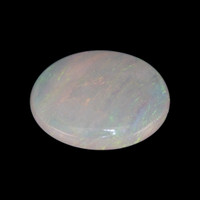
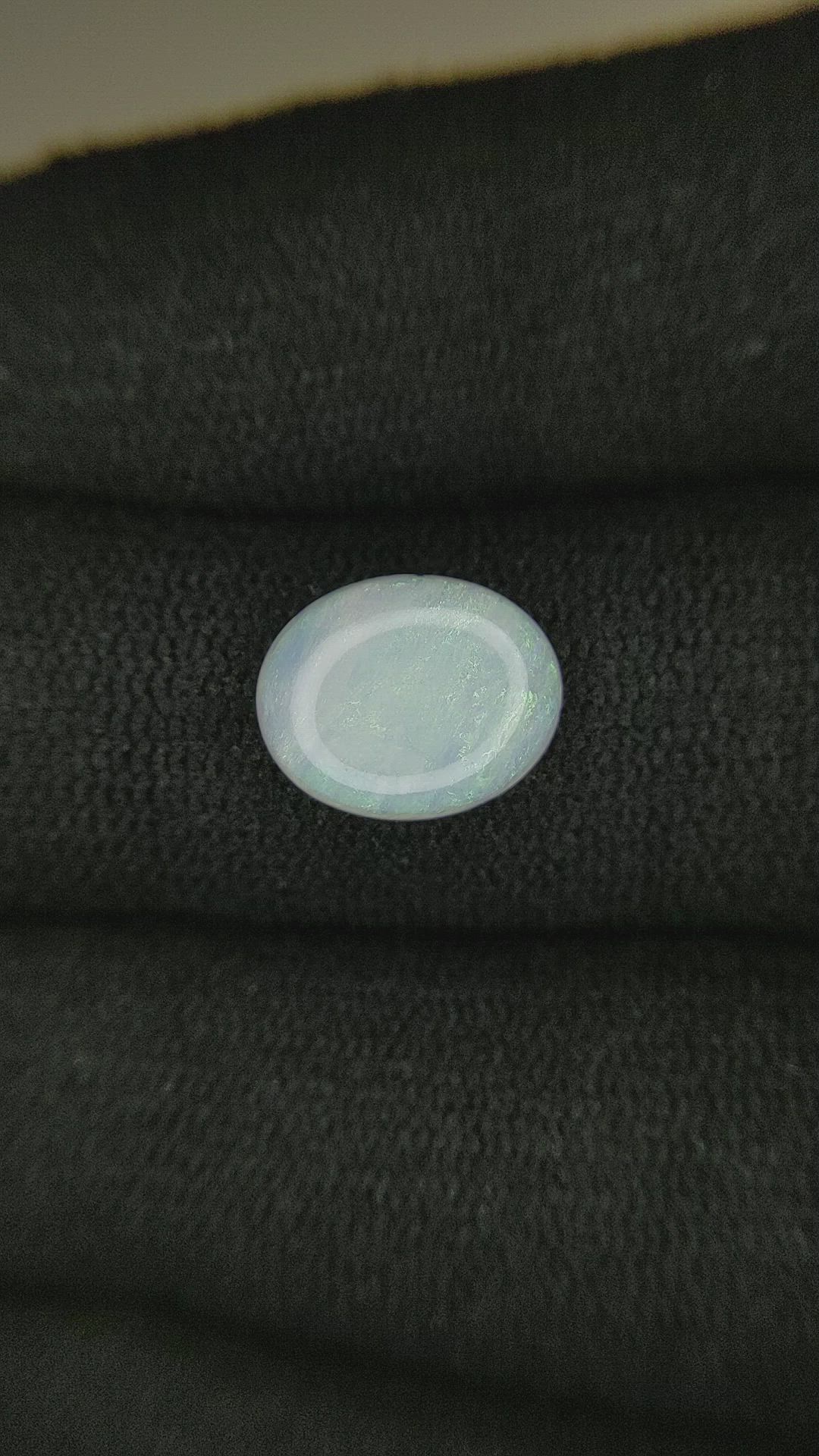
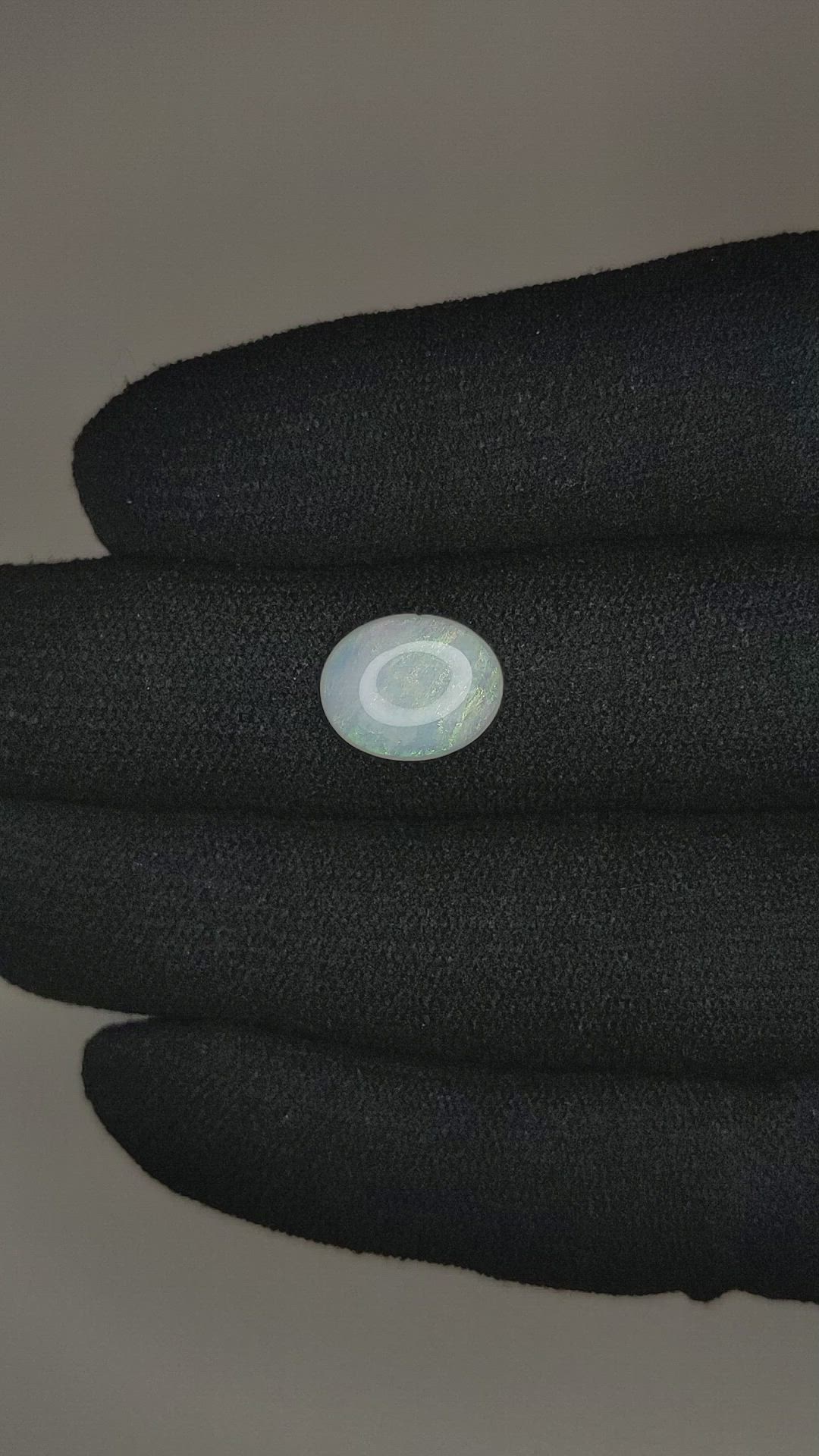


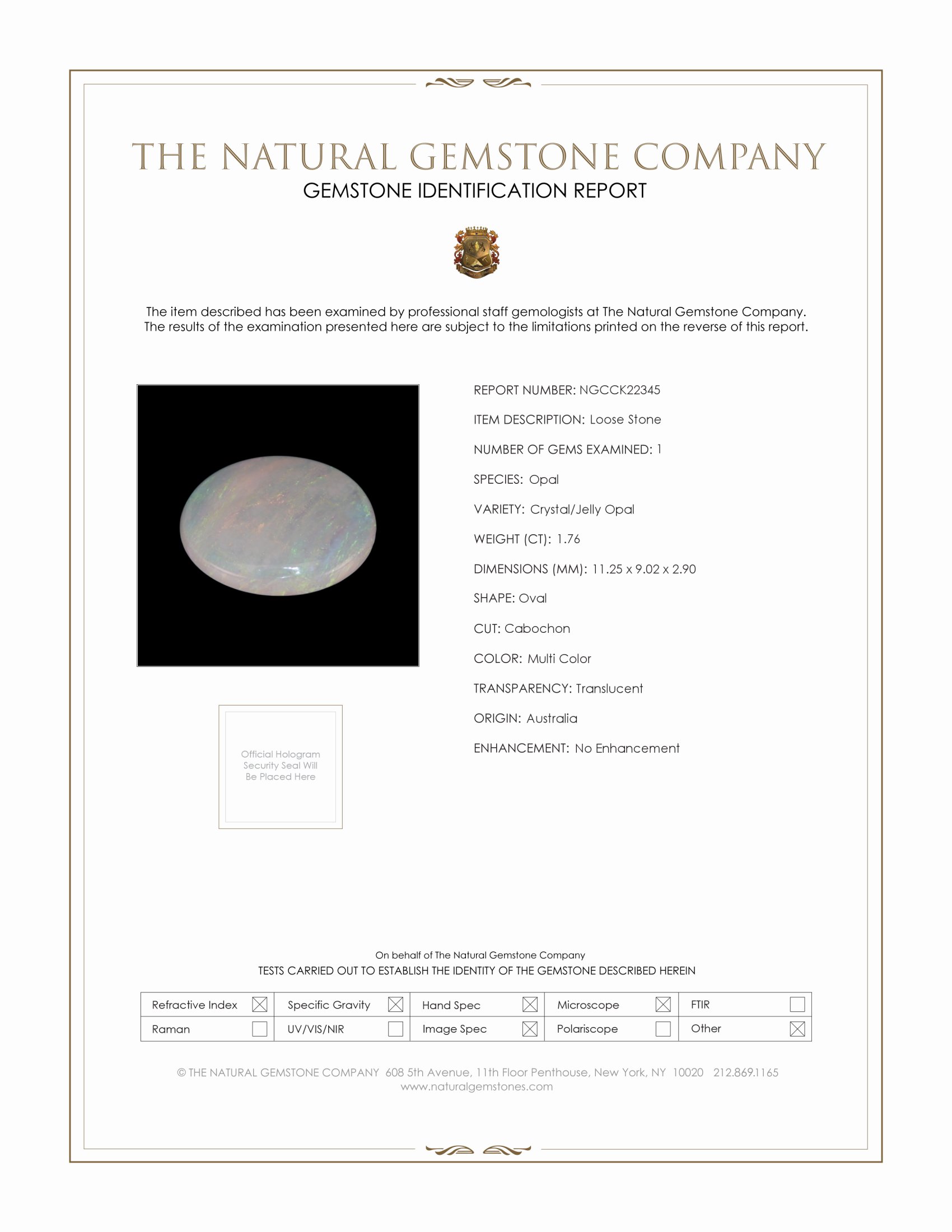
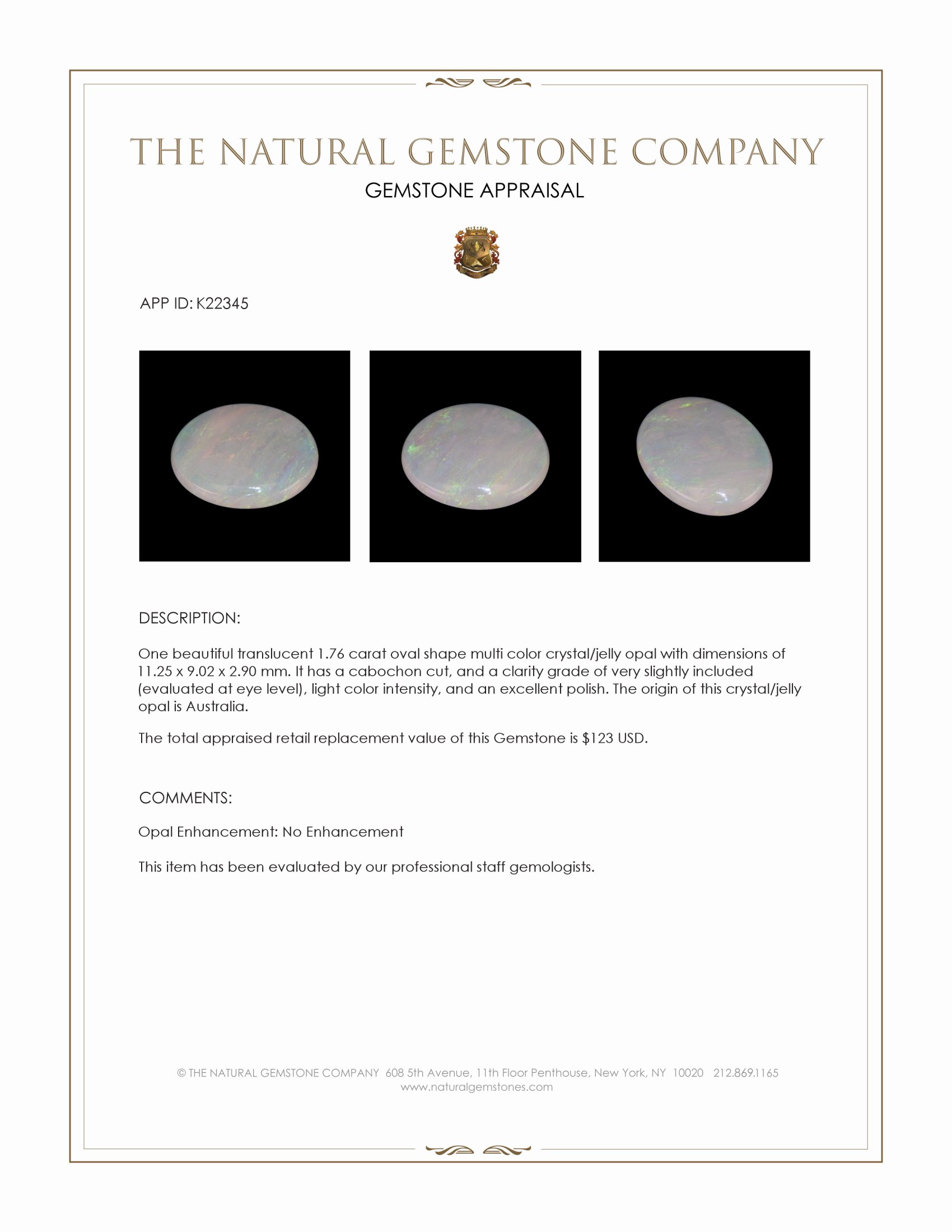
1.76 Ct. Cabochon Crystal/Jelly Opal from Australia
This loose stone is available to ship now
Item ID: | K22345 |
|---|---|
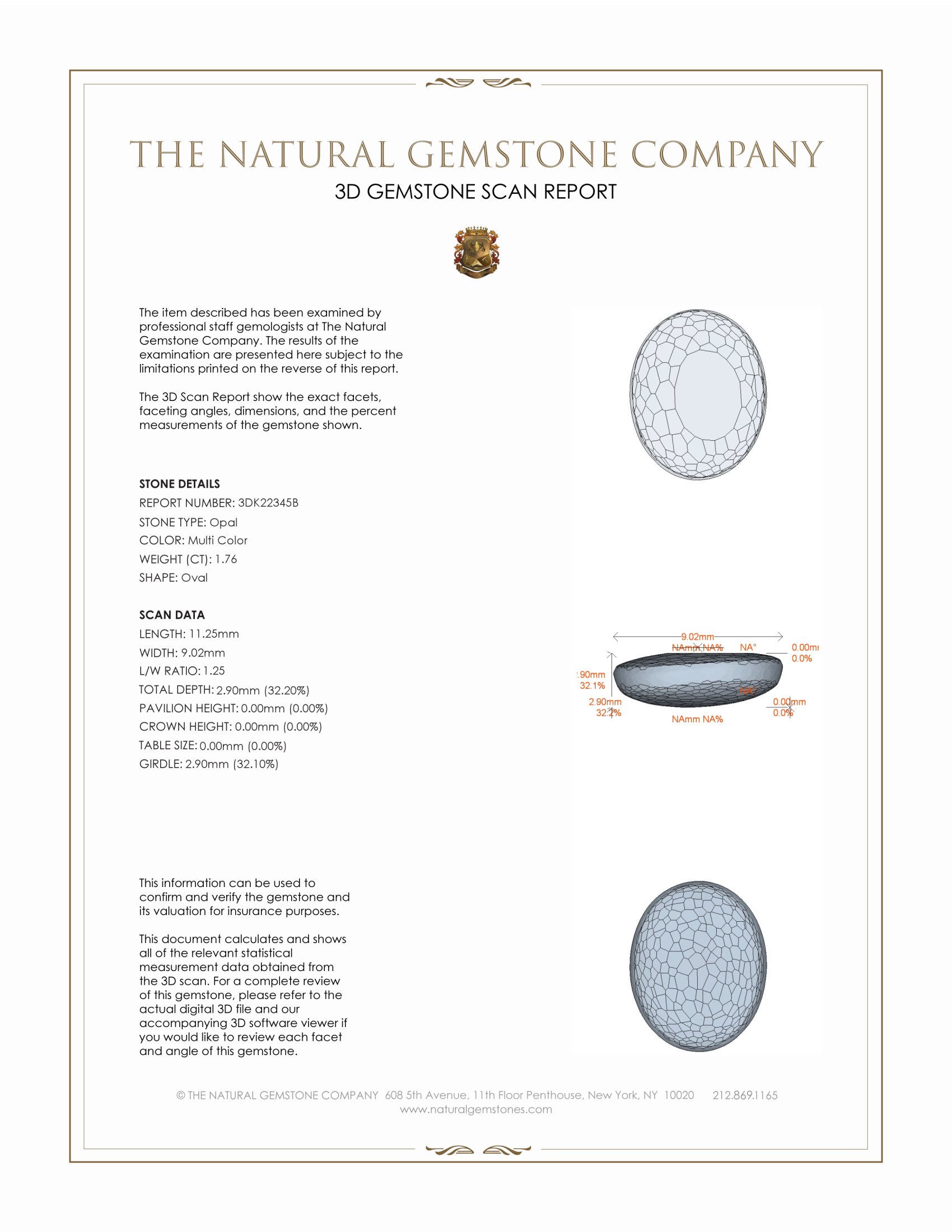
Dimensions (MM): help | Length: 11.25 Width: 9.02 Height: 2.9 |
Weight: | 1.76 Ct. |
Color: help | Multi Color |
Color intensity: help | Light |
Clarity: help | Very Slightly Included |
Shape: help | Oval |
Cut: | Cabochon |
Cutting style: | Cabochon |
Enhancements: help | No Enhancement |
Origin: help | Australia |
Per carat price: help | $70 |
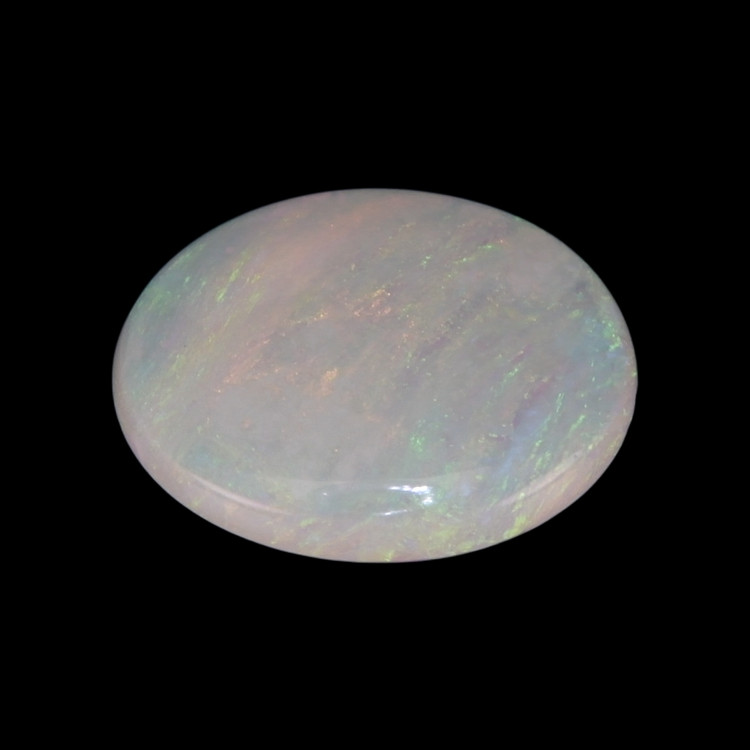
This offering from The Natural Gemstone Company is a single, translucent multi color opal, weighing 1.76 carat, presented in an oval outline, measuring 11.25 by 9.02 by 2.90 millimeters. The stone is identified as a crystal or jelly opal, with a cabochon cut, a clarity grade of very slightly included evaluated at eye level, light color intensity, and an excellent polish. There has been no enhancement to this material, and the provenance is Australia, which is consistent with the crystalline structure and play of color that collectors and designers expect from Australian opals. The piece displays a softly luminous body tone that allows internal diffraction phenomena to be seen across a wide range of viewing angles, while the multi color description reflects visible flashes of green, blue and warm orange to pink tones distributed through the translucent body.
From a materials science viewpoint, this crystal jelly opal exhibits the interplay of silica sphere packing and refractive index contrast that generates play of color, the defining optical property of opal. The translucent matrix permits incident light to penetrate, interact with ordered silica strata, and diffract as discrete spectral components, rather than merely reflecting at the surface. Because the body tone is light, the spectral output is rendered in subtle, pastel intensities, which is typical of thinner silica layers and modest sphere size variation, yet the multi color presence indicates there are zones where sphere spacing supports shorter wavelength diffraction as well as areas that favor longer wavelengths. The very slightly included clarity at eye level indicates minimal scattering centers, which preserves coherent diffraction and limits diffuse scattering that would otherwise wash out delicate color patches. The absence of enhancement means that the observed optical behavior is intrinsic to the native microstructure, enabling predictable aging and stability under normal wear.
The cabochon geometry has been executed to maximize the inherent light performance of this jelly type opal. The oval platform was chosen for its symmetry and ability to present broad flash phenomena without producing an overly dominant window, the dome curvature has been calibrated to allow oblique rays to enter, refract, and undergo multiple internal interactions before exiting, and the 2.90 millimeter depth balances the need for sufficient optical path length against excessive attenuation. The domed profile concentrates angular dispersion toward the viewer, converting subtle internal diffraction into visible color patches, while the finely controlled girdle and base thickness prevent chipping and reduce the risk of lamination during setting. Excellent polish reduces surface microrelief, increasing specular transmission and ensuring that surface scattering does not compete with internal diffraction, so the play of color remains crisp rather than blurred. The oval cabochon eliminates sharp facets that would otherwise create focused specular highlights, yielding instead an even field of color that shifts as the viewing angle changes.
For practical use and design integration, the combination of light body tone, translucency, and the cabochon dome makes this opal highly versatile in both closed and open settings, but orientation during mounting will materially affect perceived color distribution. Bezel settings that allow light to enter from the sides will preserve the stone in a secure frame while still permitting internal illumination, and open backed or halo configurations will accentuate the jelly like translucency and strengthen the presence of green and blue flashes. Avoid overly deep bezels that pressure the stone, and avoid opaque backings that extinguish transmission unless a contrasting foil effect is intentionally desired. Routine care should limit exposure to strong chemical solvents, sudden temperature shock, and prolonged direct sunlight, to maintain the natural hydration balance of the material. This natural, unenhanced, Australian crystal jelly opal from The Natural Gemstone Company is a technically refined specimen, with considered proportions and finish that emphasize coherent diffraction and stable optical performance, and our team is available to advise on mounting and provenance verification for connoisseurs and designers seeking predictable optical outcomes.


