
- Stone6
- Reports3
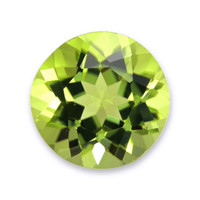


0.97 Ct. Peridot from Pakistan
This loose stone ships by Jan 5
Item ID: | K20449 |
|---|---|
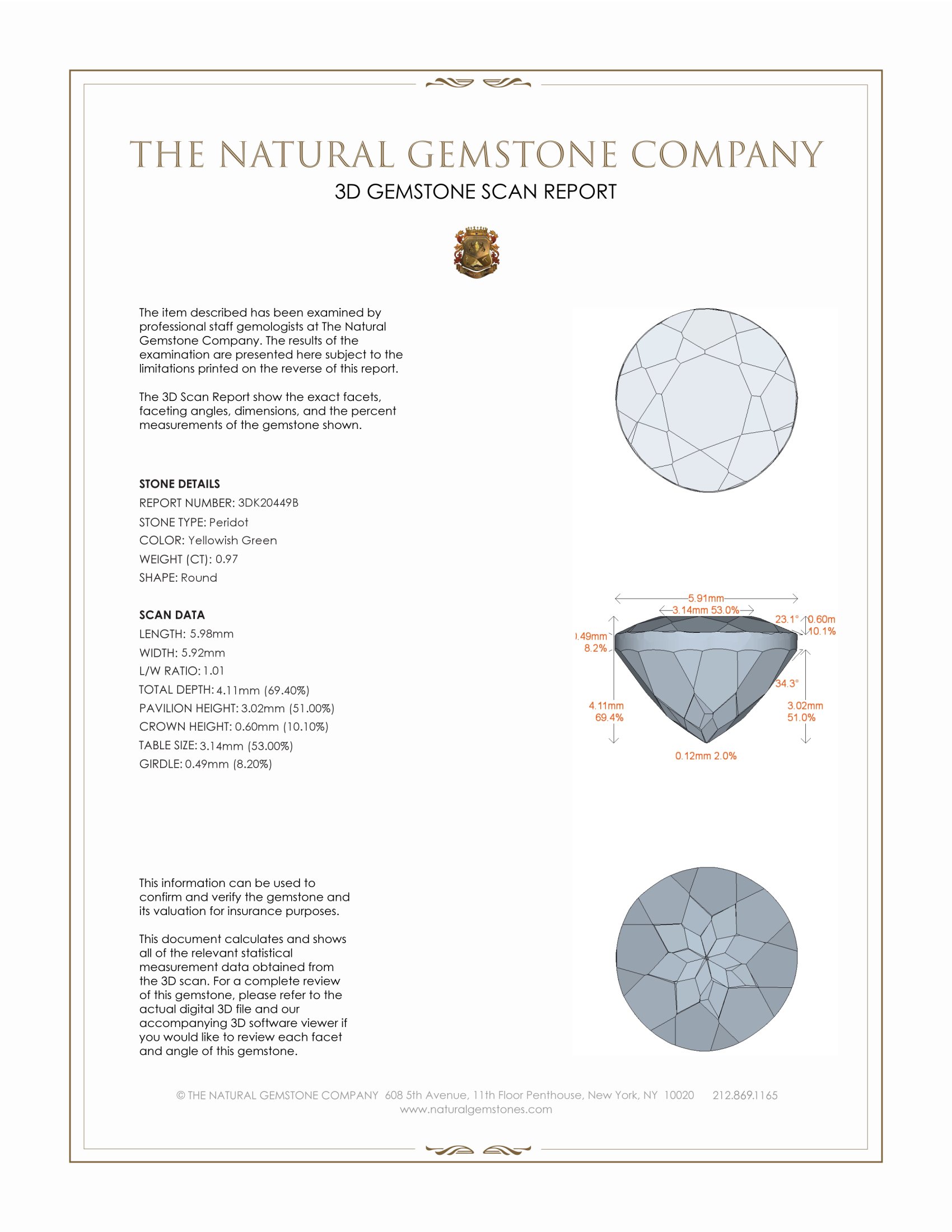
Dimensions (MM): help | Length: 5.98 Width: 5.92 Height: 4.11 |
Weight: | 0.97 Ct. |
Color: help | Yellowish Green |
Color intensity: help | Medium Intense |
Clarity: help | Very Very Slightly Included |
Shape: help | Round |
Cut: | Mixed Brilliant |
Cutting style: | Faceted |
Enhancements: help | No Enhancement |
Origin: help | Pakistan |
Per carat price: help | $62 |
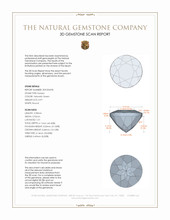
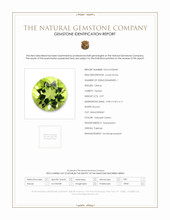
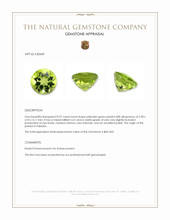
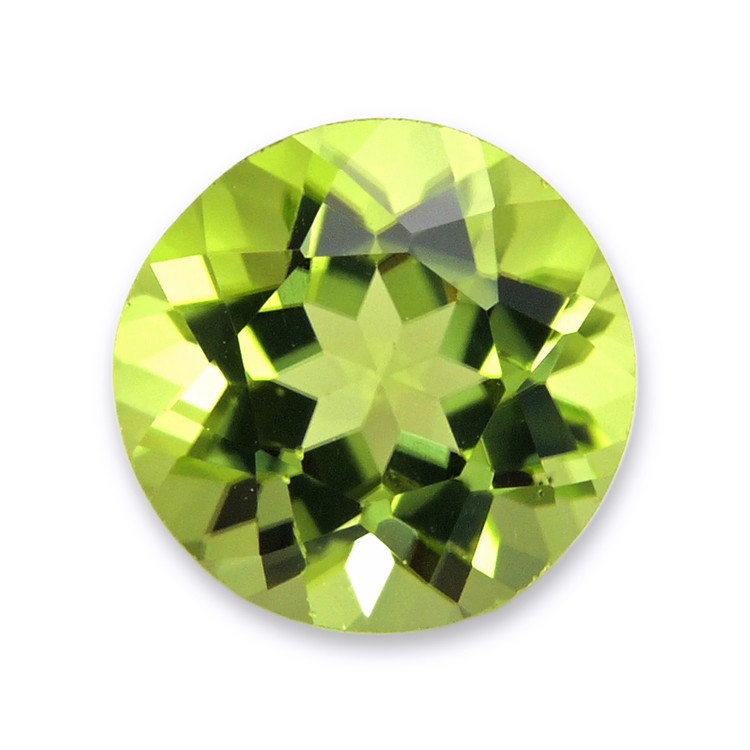
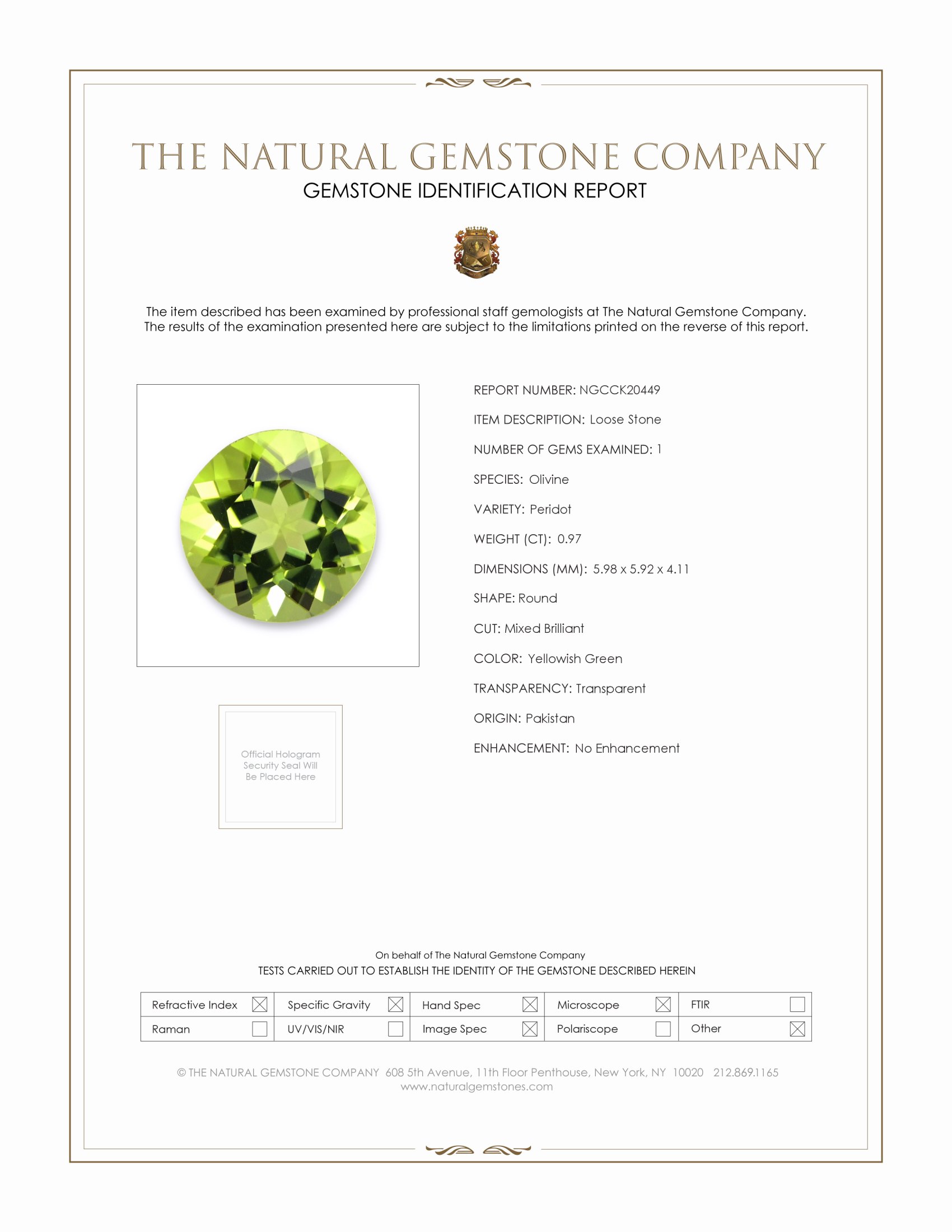
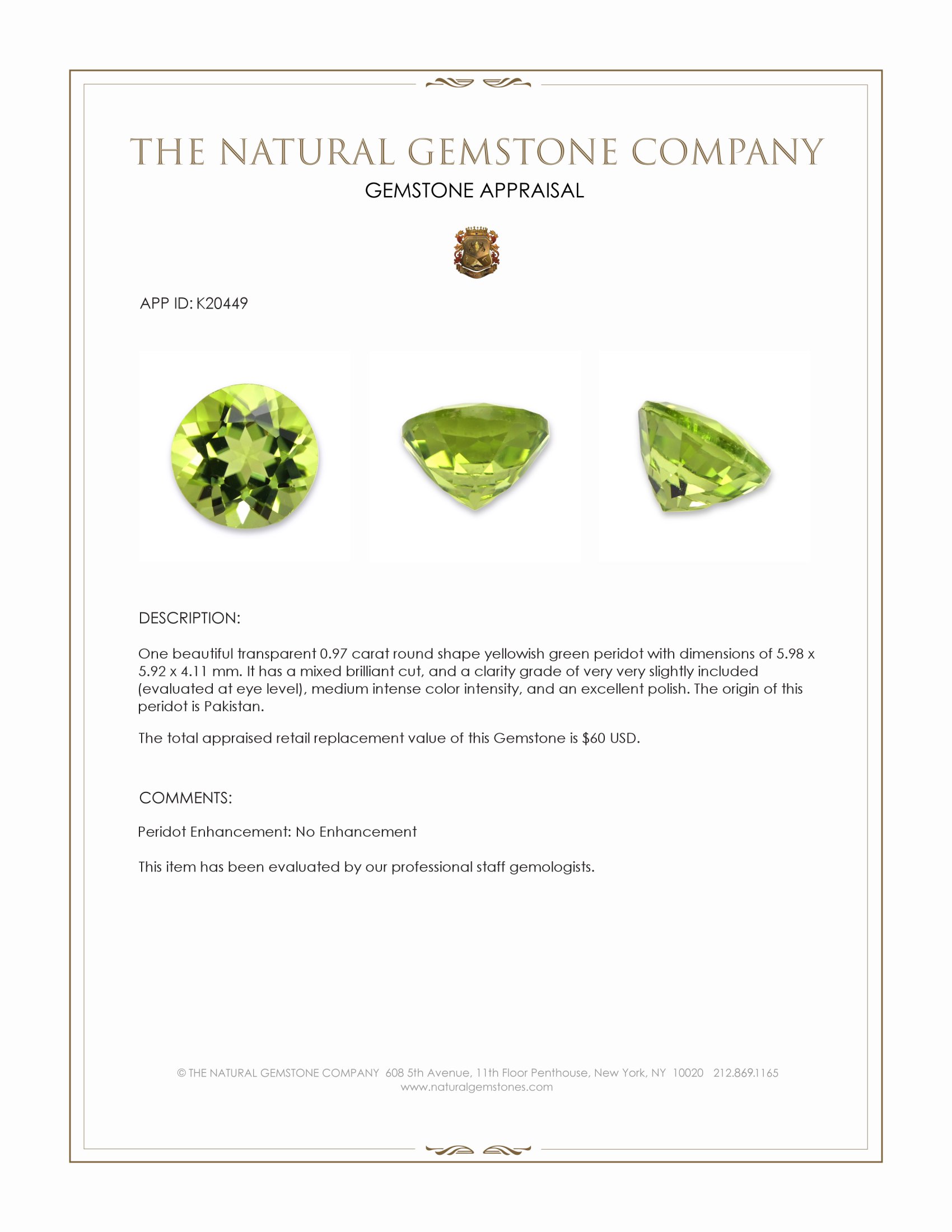
This listing describes one transparent 0.97 carat peridot, round shape, with dimensions of 5.98 x 5.92 x 4.11 mm, presented in a mixed brilliant cut that balances crown faceting with pavilion facets for lively return of light, medium intense yellowish green body color, and a clarity grade of very very slightly included when evaluated at eye level, an excellent polish that preserves crisp facet junctions and surface finish, no enhancement, and an origin in Pakistan. The proportions and cut style have been chosen to maximize the peridot character of spirited green tones leaning toward yellow, while maintaining measured scintillation across the table and facets. The nominal weight of 0.97 carat and the compact dimensions make this gem suitable for a wide range of mounting styles from solitaire rings to refined pendant settings, and the transparent nature of this material allows the internal features to contribute to overall personality rather than detract from clarity. The Natural Gemstone Company documents this peridot with straightforward gemological notation, and the accompanying record notes that the stone has not undergone heating or any treatment, which preserves the natural lattice and the inclusion patterns that are characteristic of fine peridot from Pakistan.
The inclusions in this peridot create an unmistakable signature that distinguishes it from more uniformly clean stones. Within the crystal there are a series of small reflective platelets and oriented needle like inclusions that produce localized scattering and subtle internal flash, these features are commonly described in peridot as platelets that interact with facet angles to produce tiny starbursts of light under oblique illumination. There are also minute dark mineral crystals visible at higher magnification, which appear as discrete, well defined grains that provide contrast against the luminous green body color, these dark points can include chromite or other accessory phases typical of olivine group minerals and they give the stone a textured three dimensionality when viewed through the crown. A few thin growth fissures and healed fractures are present internally, and these areas are rimmed with tiny reflective surfaces that catch the eye, the healed nature of some fissures results in areas that transmit light differently, producing faint variation in brightness that contributes to the stone having a living, dynamic appearance rather than a sterile uniformity. Taken together the platelets, needles, dark mineral grains, and healed fissures create an internal fingerprint, a pattern of inclusions that is consistent with natural, untreated peridot and that serves as a reliable identifier for connoisseurs and gemological examiners.
The mixed brilliant cut and the excellent polish collaborate with the inclusion pattern to create an engaging optical performance. The crown faceting disperses light into fast scintillation while the pavilion facets allow light to circulate around inclusion clusters, so that under direct light the peridot displays lively facet contrast, and under softer ambient lighting the internal texture becomes more apparent, revealing the layered interplay of color and inclusion relief. The medium intense color intensity remains balanced across lighting conditions, providing a vivid yellowish green that is unmistakably peridot, and the excellent surface polish ensures that the eye is drawn inward to internal features rather than distracted by surface irregularities. Origin information from Pakistan is significant because material from this region often exhibits a particular chromatic profile and a characteristic suite of accessory minerals, and in this instance the inclusion palette aligns with expectations for Pakistani peridot, offering a natural provenance marker for gemological study and for collectors who value locality associated attributes. The lack of enhancement further reinforces the natural state of the crystal, preserving the original optical and internal structures.
For design and maintenance considerations this peridot should be set in a manner that protects the girdle and pavilion, routine cleaning with warm soapy water and a soft brush is recommended, and the stone should be shielded from sharp knocks and exposure to strong chemicals to preserve polish and integrity. The inclusion signature makes this gem a strong candidate for jewelry where the wearer prefers visible character rather than absolute clarity, and the compact size and mixed brilliant cut give a pleasing balance between sparkle and internal depth, making it well suited for classic settings that emphasize the gem itself. Opal type Fire Opal is noted as a related offering in our catalog, Fire Opal being prized for warm body color and lively translucency, and pairing a warm toned fire opal with this yellowish green peridot can create a complementary contrast in a bespoke design. The Natural Gemstone Company provides transparent documentation for this peridot including weight, dimensions, cut type, clarity grade, color intensity, polish, enhancement status, and origin, ensuring that this gem can be evaluated on its merit and matched confidently to a considered setting.


