
- Stone16
- Reports3





12.11 Ct. Violetish Blue Cabochon Cat’s Eye Tanzanite from Tanzania
This loose stone ships by Nov 29
Item ID: | K19346 |
|---|---|
Dimensions (MM): help | Length: 11.58 Width: 11.4 Height: 9.49 |
Weight: | 12.11 Ct. |
Color: help | Violetish Blue |
Color intensity: help | Intense |
Clarity: help | Included |
Shape: help | Round |
Cut: | Cabochon |
Cutting style: | Cabochon |
Enhancements: help | Heat Treated |
Origin: help | Tanzania |
Per carat price: help | $740 |
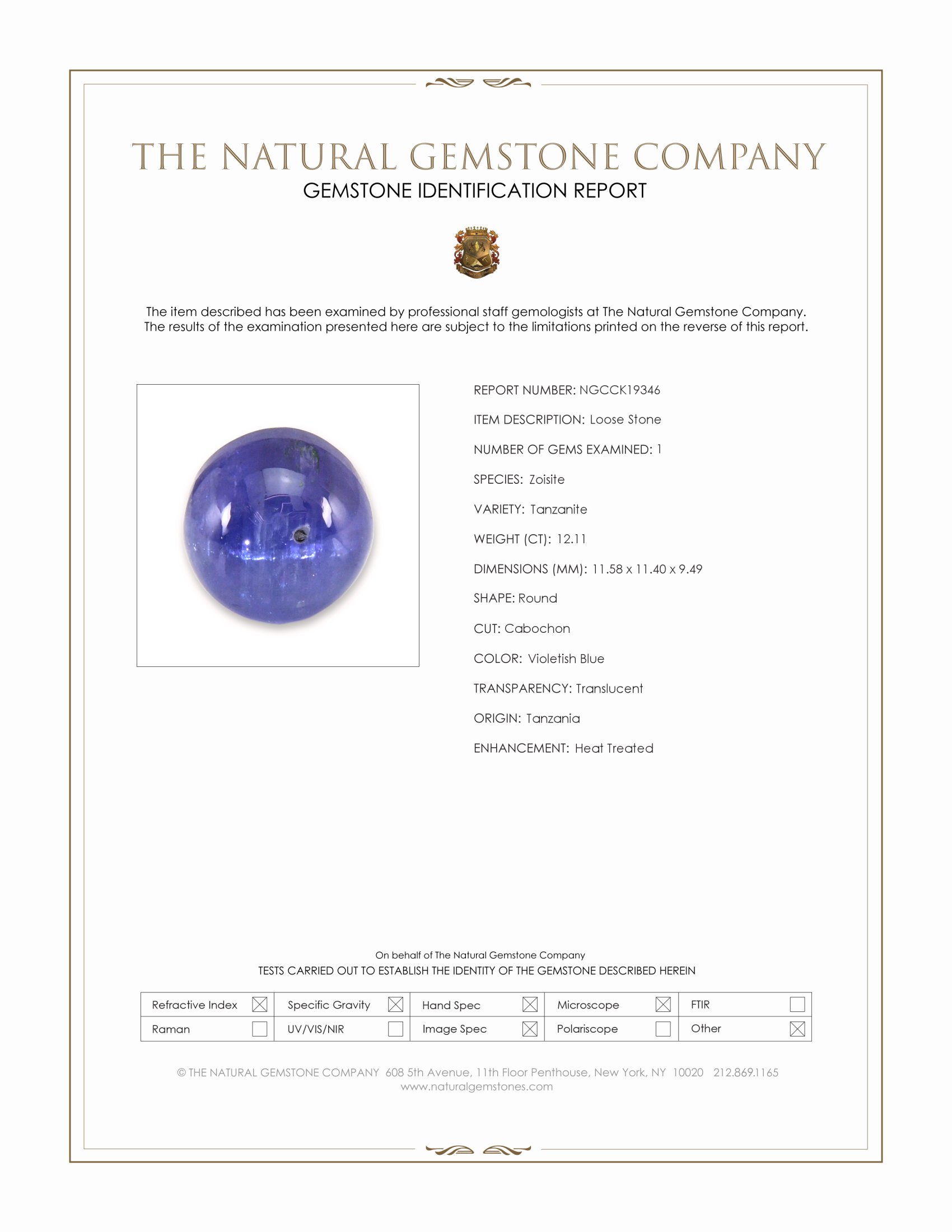
This 12.11 carat violetish blue tanzanite from Tanzania, presented by The Natural Gemstone Company, is a classic example of cabochon craftsmanship that emphasizes optical phenomena rather than faceted brilliance. The stone is round in outline with dimensions of 11.58 by 11.40 by 9.49 mm, and it has been shaped into a domed cabochon to maximize the display of chatoyancy. The cutting style removes facets in favor of a smooth convex surface that interacts with directional light to reveal a concentrated band of reflected light. Clarity is graded included at eye level, which means the internal fabric contains aligned acicular inclusions that are visible without magnification. These inclusions are instrumental in forming the cat s eye effect, and the cutter has oriented the cabochon axis to intersect those inclusions perpendicular to the dome apex, producing a consistent and well centered light band. The piece is heat treated, a stable enhancement that enhances the intrinsic blue violet trichroism characteristic of zoisite, and the polish quality is excellent, producing a clean surface reflection that distinguishes surface luster from internal optical phenomena.
From an optical physics perspective the reflective qualities of this cabochon differ in predictable ways from faceted tanzanite specimens, and from other cat s eye gemstones in the same market segment. Tanzanite, as a variety of zoisite, has a refractive index in the range of approximately 1.69 to 1.70, and a vitreous to silky luster depending on surface finish and internal scattering. In faceted stones the higher luster and refractive index produce individuated facets that yield brilliance and flashes of light. In a cabochon like this one, the smooth dome reduces facetular return and emphasizes internal light scattering and directional reflection, resulting in a soft luminous glow rather than discrete facet flashes. Compared to corundum based chatoyant examples such as star sapphire, which typically have a higher refractive index and therefore a stronger facetular return in polished areas, this tanzanite exhibits a softer, more muted sheen. When compared to chrysoberyl cat s eye, which tends to show a very sharp, well defined light band due to a higher refractive index and a very fine, parallel inclusion fabric, this tanzanite produces a slightly broader and more diffused band, which is characteristic of the thicker or more widely spaced inclusion bundles found in zoisite.
The cat s eye effect observed in this tanzanite is a linear, mobile band of light with a slight silvery quality against the intense violetish blue body color, and it behaves in a manner consistent with single ray interference and directional reflection from parallel aligned acicular inclusions. The band appears as a narrow luminous streak across the dome when light is moved across the stone, and it remains coherent and centered due to the precise orientation established by the lapidary. The subjective sharpness of the band is influenced by several factors, including the density and parallelism of the inclusions, the degree of translucency, and the quality of the surface polish. In this specimen the included clarity aids the visual contrast of the band, because some internal scattering is necessary to delineate the eye against the body color. The excellent polish preserves the integrity of the band, preventing surface scattering from diffusing the effect, and the domed geometry focuses reflected light into a condensed line rather than dispersing it across the surface.
For connoisseurs comparing reflective behavior, this tanzanite cabochon sits between highly chatoyant minerals and strongly refractive faceted gems. It lacks the scintillation and facet defined brilliance of a well cut sapphire or a faceted tanzanite, because the cabochon removes the plane interfaces that create flash. In return it offers a distinct directional optical signature, a concentrated band of light that moves with the light source, and an intense color saturation that remains visible even with the inclusion structure that gives rise to chatoyancy. For jewelry applications a bezel or closed back mounting will preserve the cat s eye visibility and protect the dome, while allowing the band to be viewed by angling the piece relative to a light source. Collectors who appreciate the interplay between internal structure and surface finish will value this piece for its combination of Tanzanian origin, intense color, and demonstrable chatoyancy, and The Natural Gemstone Company offers this item with transparent disclosure of enhancement and clarity, enabling informed selection based on technical optical criteria.


