
- Stone8
- Reports3
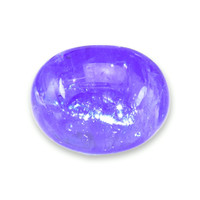
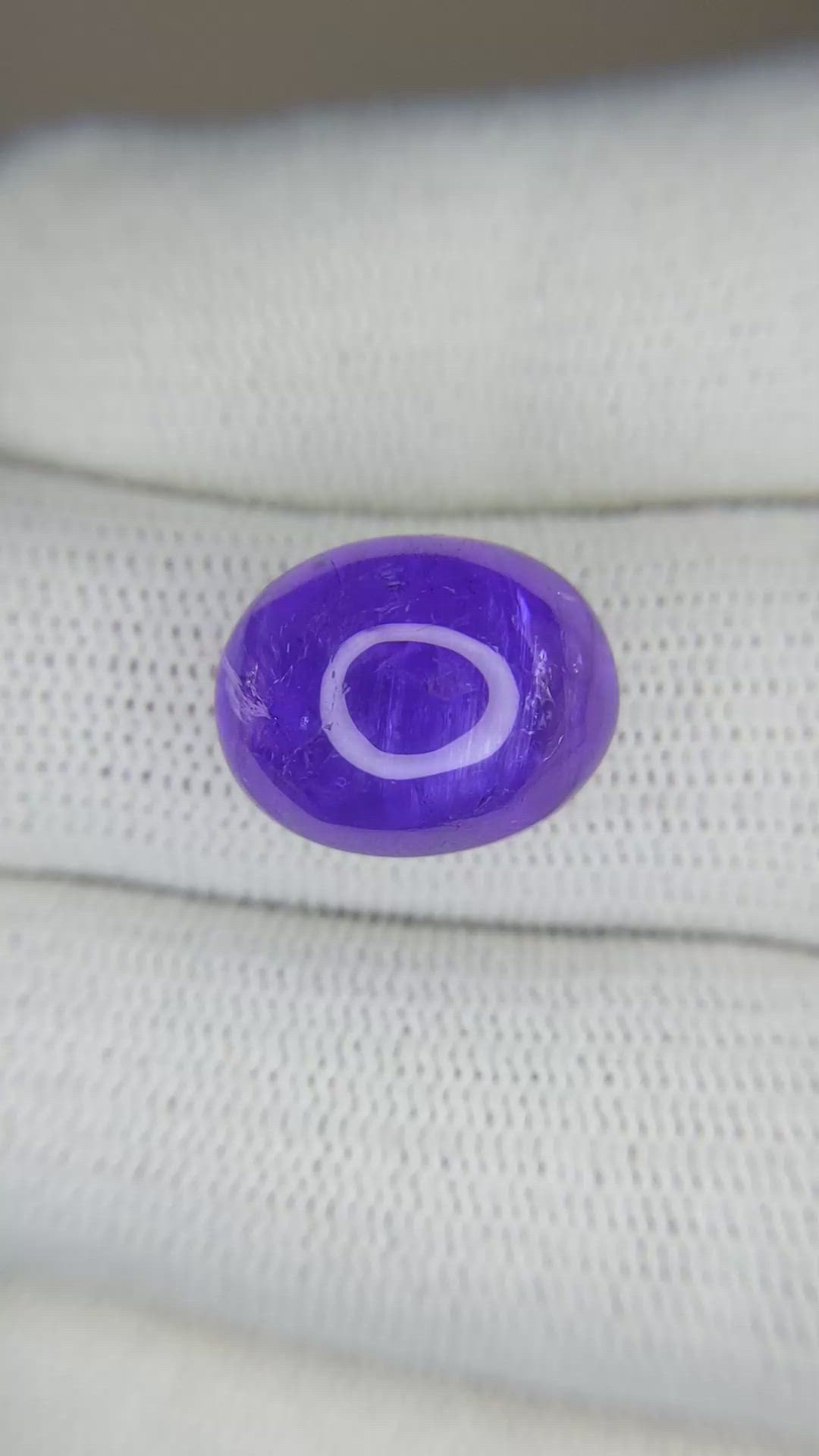
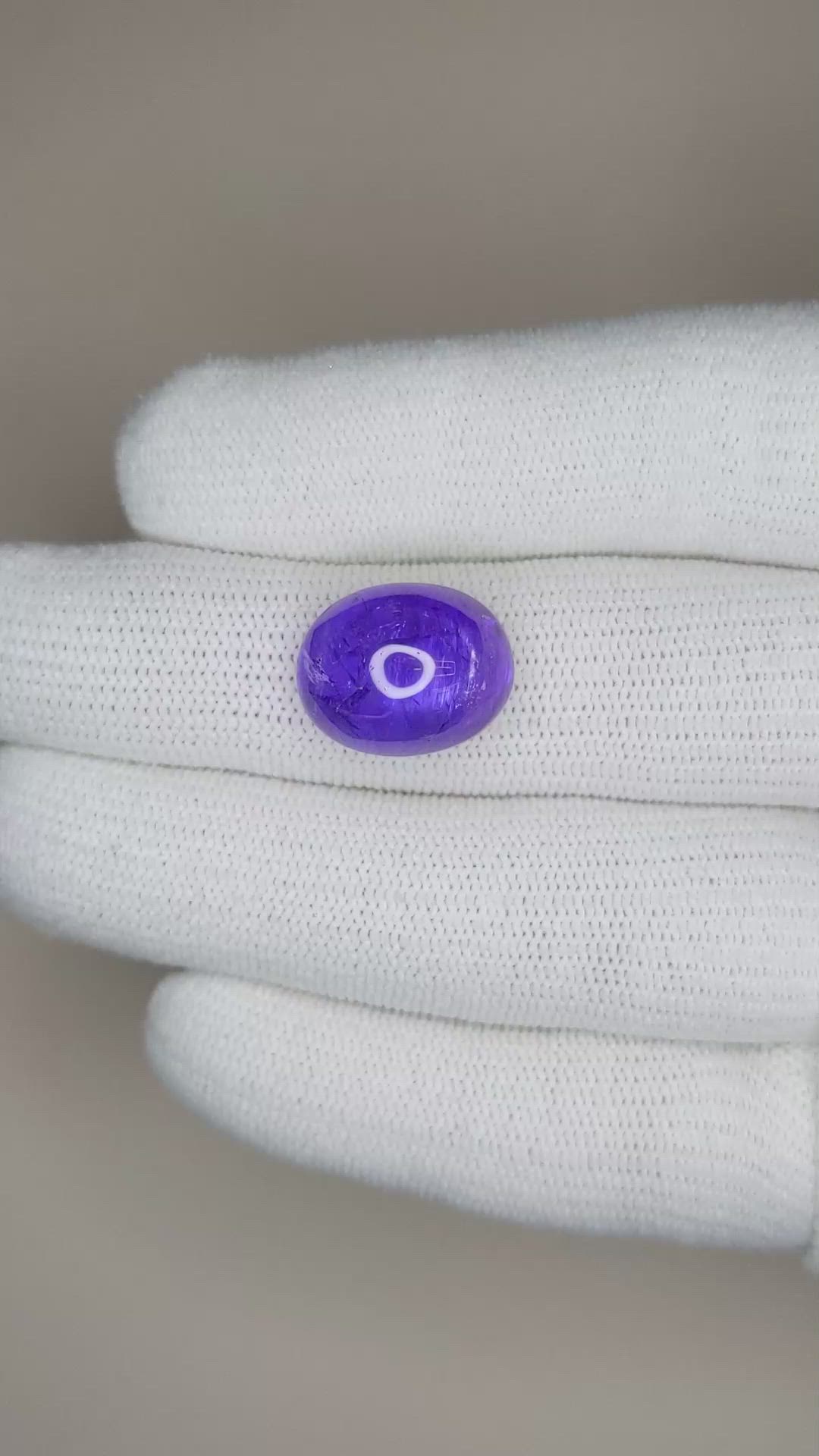


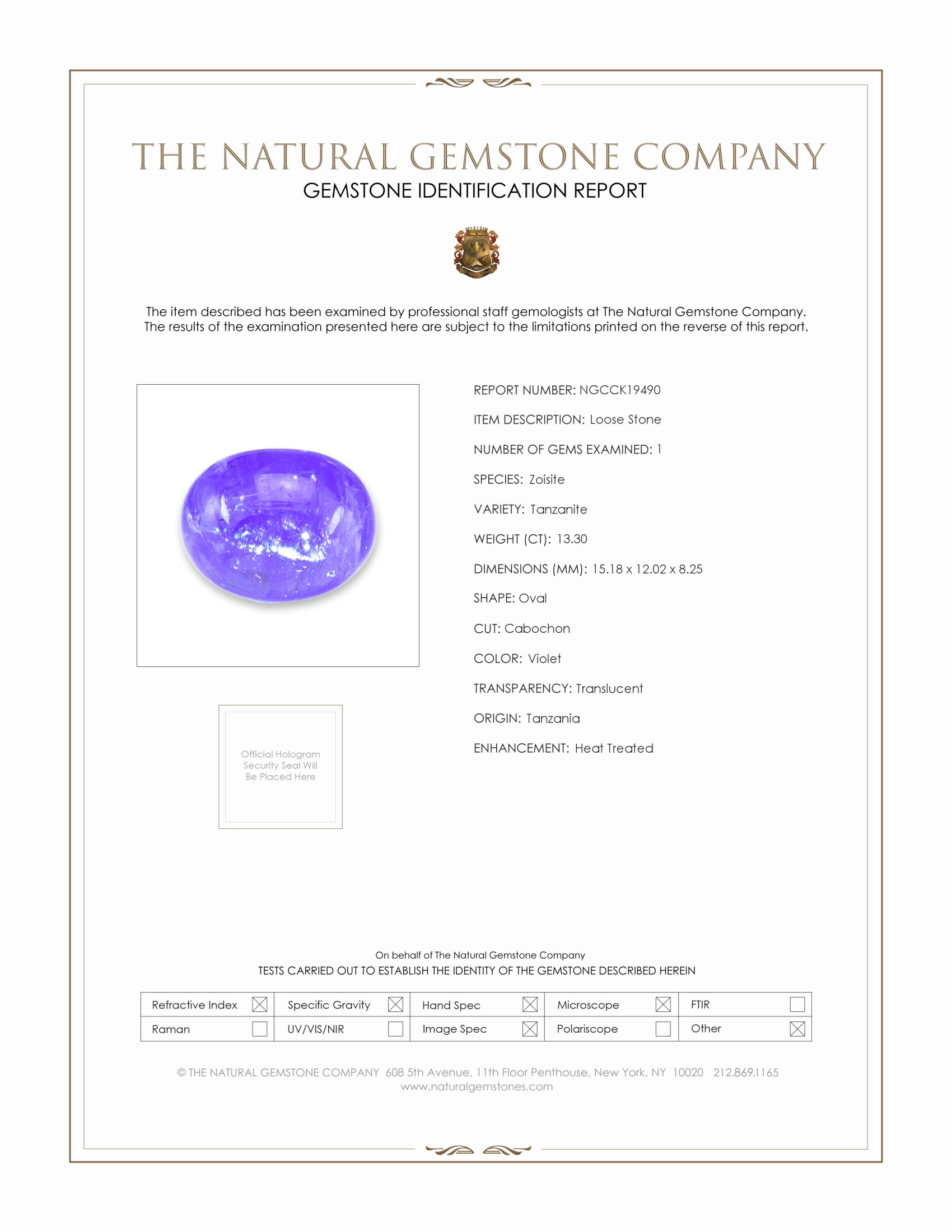
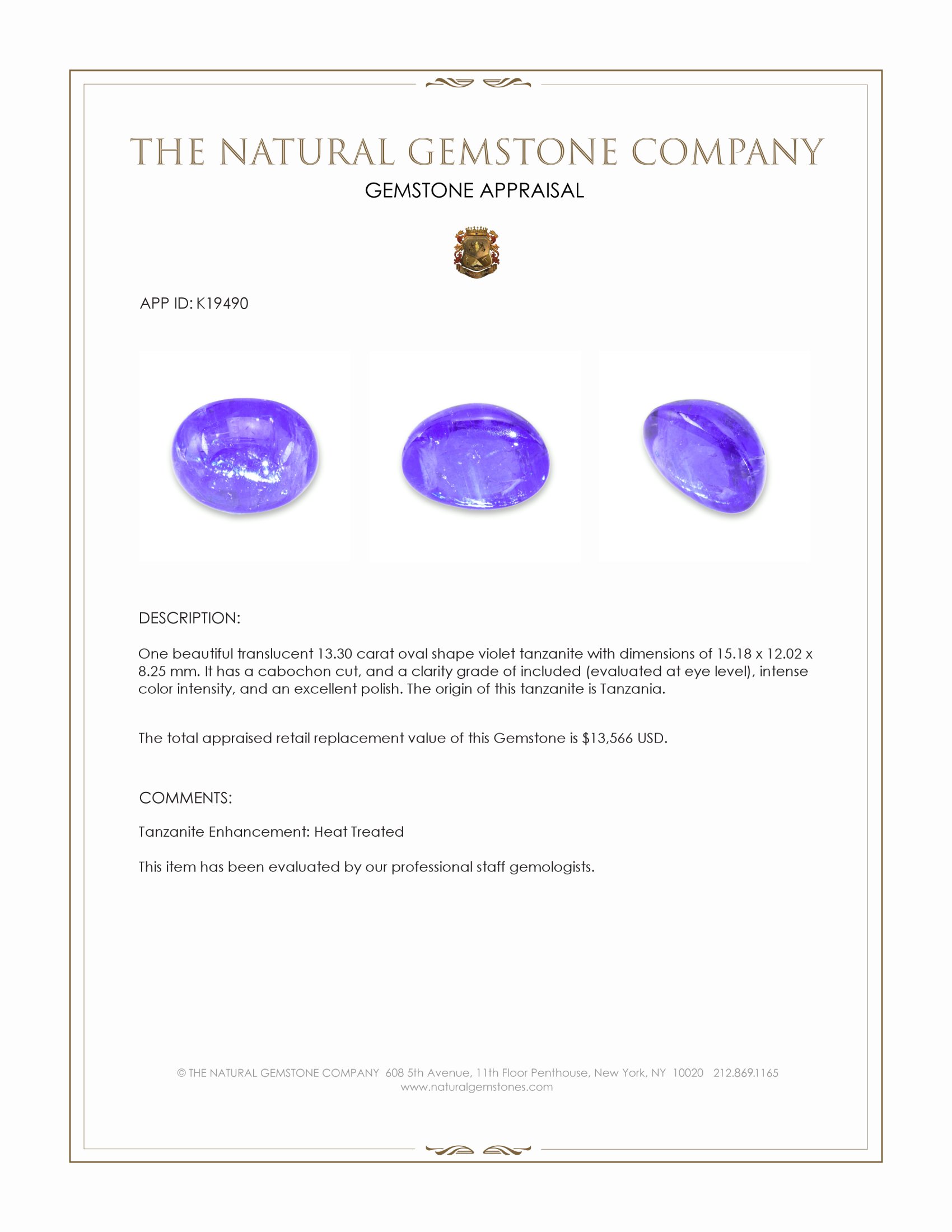
13.30 Ct. Cabochon Tanzanite from Tanzania
This loose stone ships by Jan 26
Item ID: | K19490 |
|---|---|
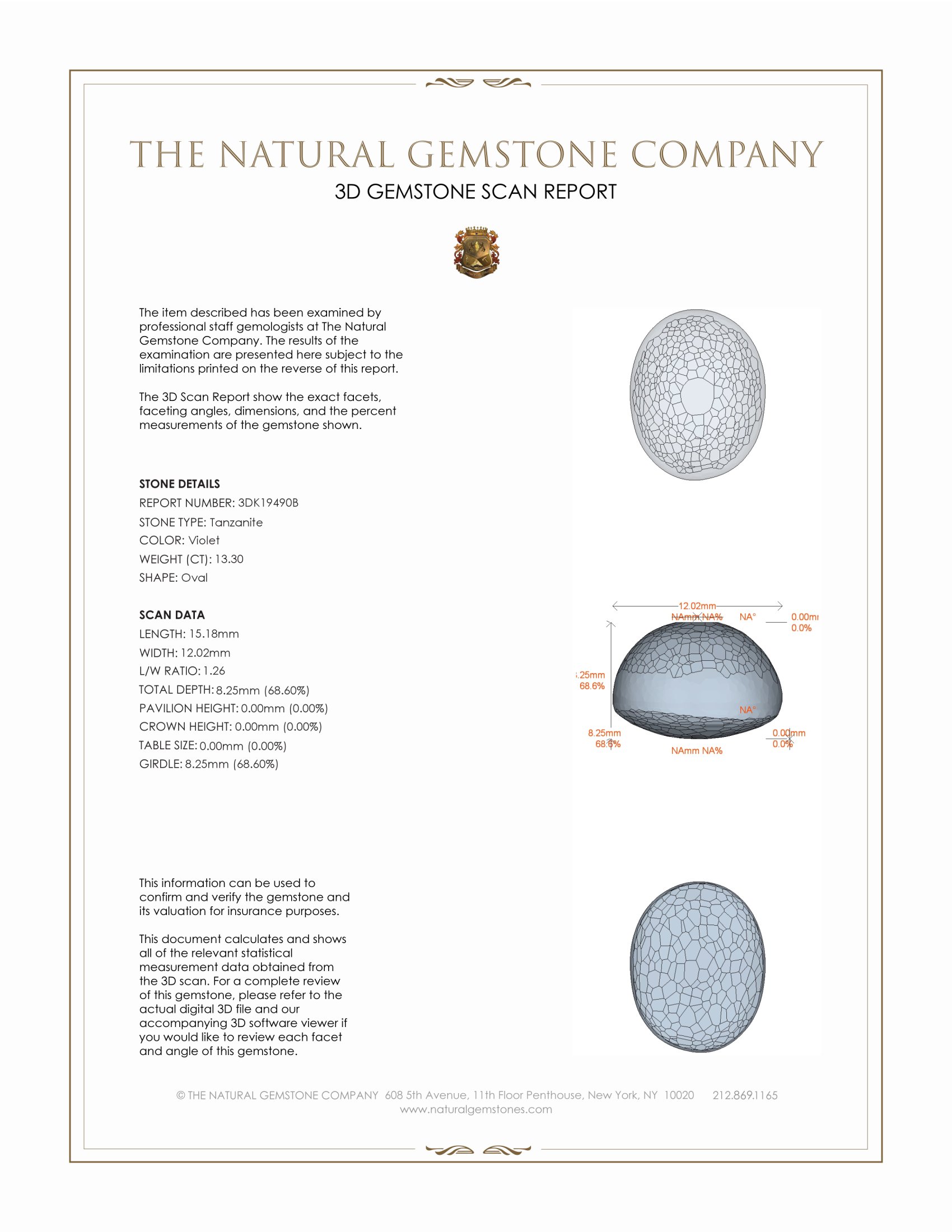
Dimensions (MM): help | Length: 15.18 Width: 12.02 Height: 8.25 |
Weight: | 13.30 Ct. |
Color: help | Violet |
Color intensity: help | Intense |
Clarity: help | Included |
Shape: help | Oval |
Cut: | Cabochon |
Cutting style: | Cabochon |
Enhancements: help | Heat Treated |
Origin: help | Tanzania |
Per carat price: help | $1,020 |
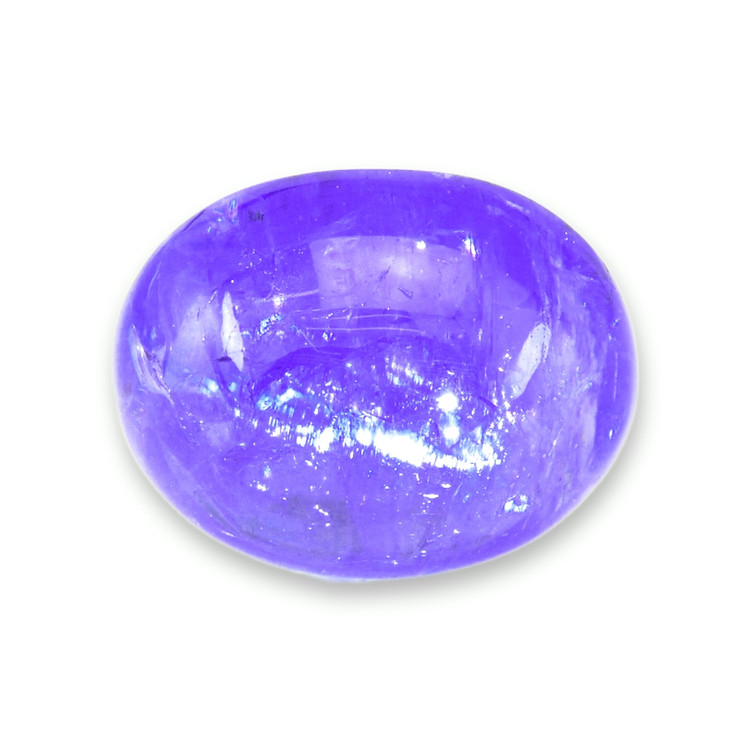
This 13.30 carat oval violet tanzanite from Tanzania presents as a classic cabochon, carefully shaped to 15.18 x 12.02 x 8.25 millimeters, with an emphasis on color saturation and internal luminous depth rather than faceted brilliance. The lapidary decision to use a cabochon profile was deliberate, allowing the dome to function as a controlled light integrator that softens surface reflections and amplifies the stone body color. The material is translucent with intense color intensity, and it carries a clarity grade of included when evaluated at eye level, which contributes to the internal character and diffuse light scattering that defines its visual signature. The piece has undergone standard heat treatment to stabilize and enhance the violet tones, and the surface exhibits an excellent polish that gives clean, well defined specular highlights along the dome while preserving the tactile smoothness expected from a premium cabochon. The craft evident in the symmetry of the oval outline, the evenness of the dome curvature, and the absence of facet junctions confirms the work of a practiced cutter who prioritized optical performance and wearability.
From an optical and gemmological standpoint this tanzanite demonstrates the properties that distinguish zoisite variants from higher refractive index gemstones. Tanzanite has a refractive index in the region of 1.69 to 1.70 and a modest birefringence in the order of 0.008 to 0.013, which translates to lower facet derived brilliance when compared to corundum family gems and spinel. The cabochon form minimizes facet reflection and instead highlights internal scattering and pleochroic color separation. Tanzanite is strongly trichroic, showing different absorption and color orientation along crystallographic axes, and in a cabochon this trichroism manifests as zones of more saturated violet against lighter blue violet depending on viewing angle and light incidence, creating a layered color depth rather than discrete flashes. Compared to a faceted tanzanite of similar color grade the cabochon will display reduced mirror like facet return, but it will deliver a consistent luminous glow, soft color windows, and an even surface sheen, attributes that appeal when the objective is to appreciate hue and tone rather than scintillation.
When comparing reflective qualities across its category and related species it is useful to contrast the behavior of this cabochon tanzanite with faceted tanzanite, sapphire, and spinel. Faceted tanzanite leverages precision angles to maximize contrast and directional color change, producing sharper flashes from facet planes albeit within the constraints of relatively low dispersion. Sapphire, with a refractive index near 1.76 to 1.77, and spinel, with an RI typically around 1.72 to 1.73, inherently produce stronger internal reflections and crisper facet brilliance when cut faceted, yielding a more lively play of light. In cabochon form these higher RI stones can still show pronounced surface highlights, but the fundamental difference remains that tanzanite’s optical personality is color oriented, driven by pleochroism and internal transmission rather than high index sparkle. The included clarity of this specimen introduces micro features that scatter light internally, which in this context enhances the velvety, candlelit quality of the glow, compared to cleaner, tighter light return from a high clarity, high RI stone. Dispersion is low across this family, so fire is minimal, and the visual interest of this tanzanite comes from saturated violet tone, translucency induced soft reflection, and directional color shifts when the stone is rotated or re oriented under different lighting.
For a client who evaluates gemstones by optical behavior, material provenance, and cutting technique this violet cabochon represents a clear statement piece. The excellent polish and balanced dome geometry ensure uniform surface highlights that work in concert with the internal color to present an even, intense body color under diffused and mixed illumination. Set in a bezel or low prong mounting the cabochon will maintain its functional profile and continue to present the internal glow without excessive surface glare, and the included clarity should be considered in the design to either showcase the internal character or to minimize visibility with metal framing. The Natural Gemstone Company discloses the heat treatment and Tanzanian origin, and we present this specimen as a studied choice for connoisseurs who value trichroic behavior, artisanal cabochon work, and the subtle, diffuse reflective qualities that set tanzanite apart from higher refractive index gems. For buyers seeking a gem where color depth and internal luminosity trump facet scintillation this piece offers a technically coherent expression of tanzanite, backed by refined lapidary execution and clear disclosure of enhancement and clarity.


