
- Stone14
- Reports3

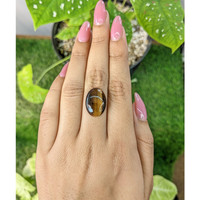
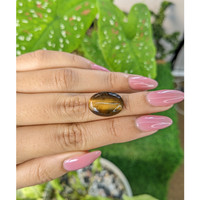
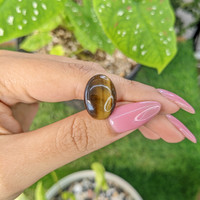


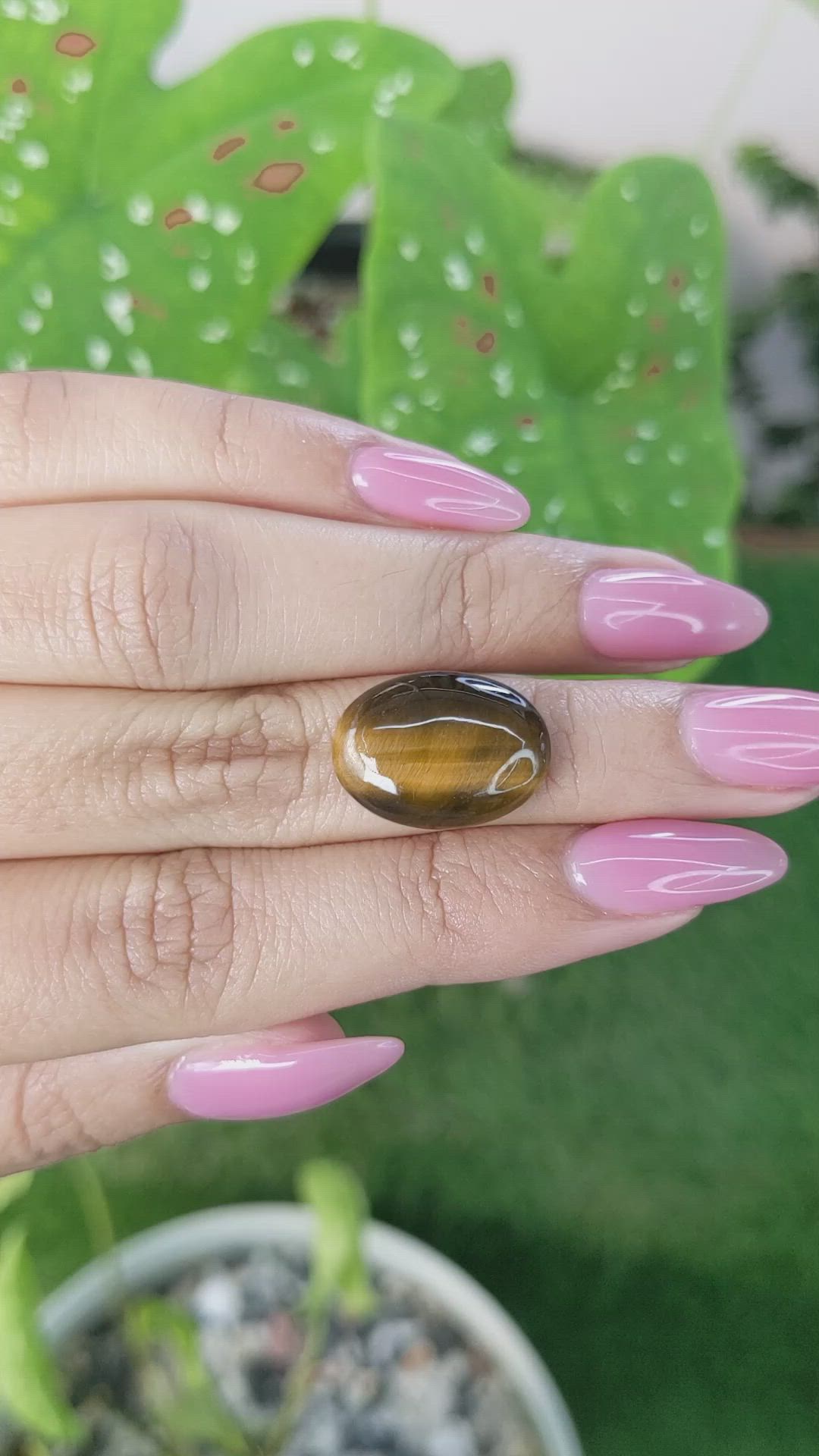




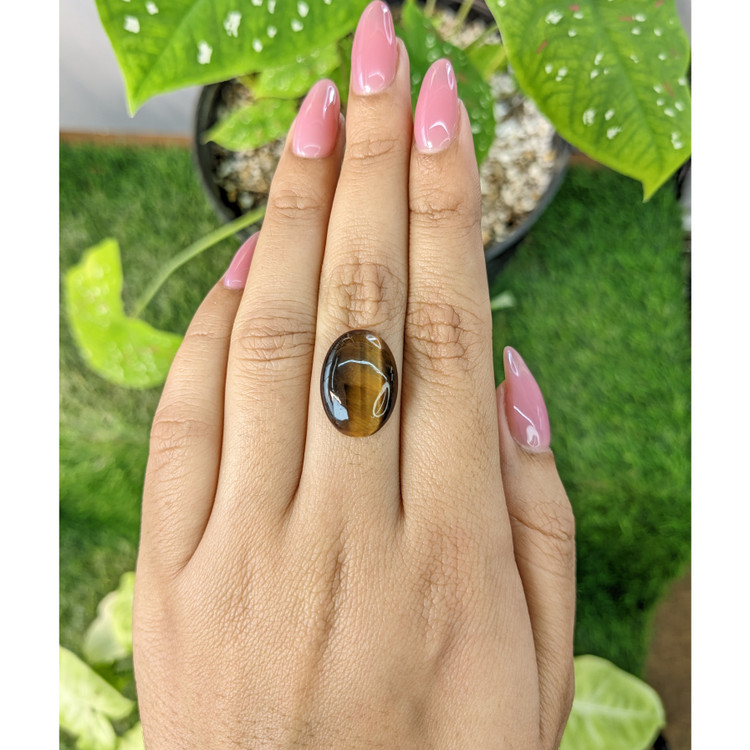
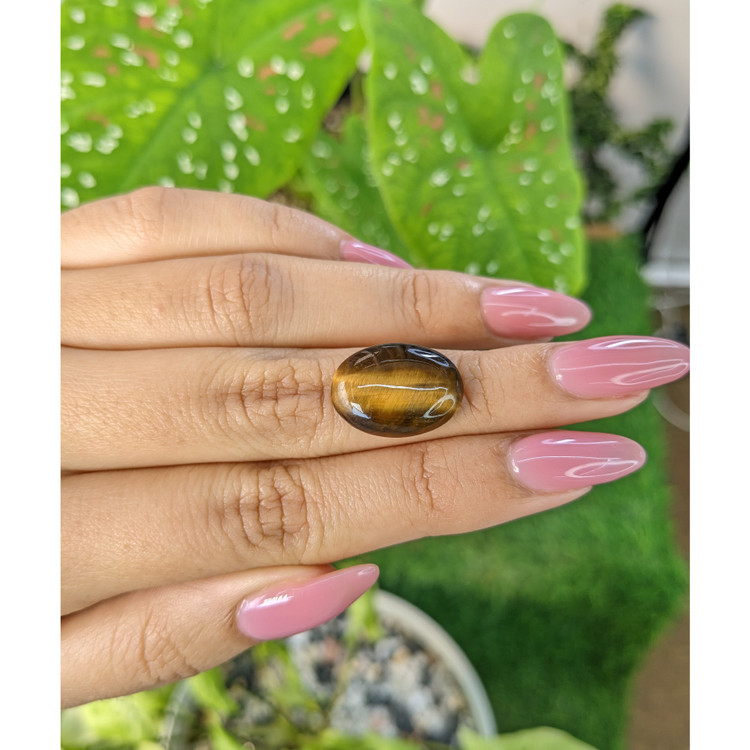
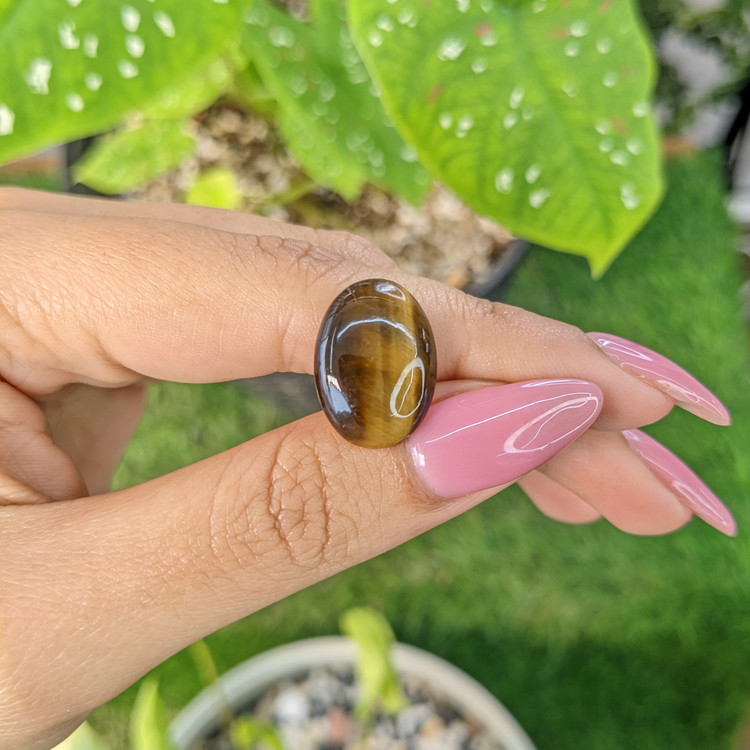

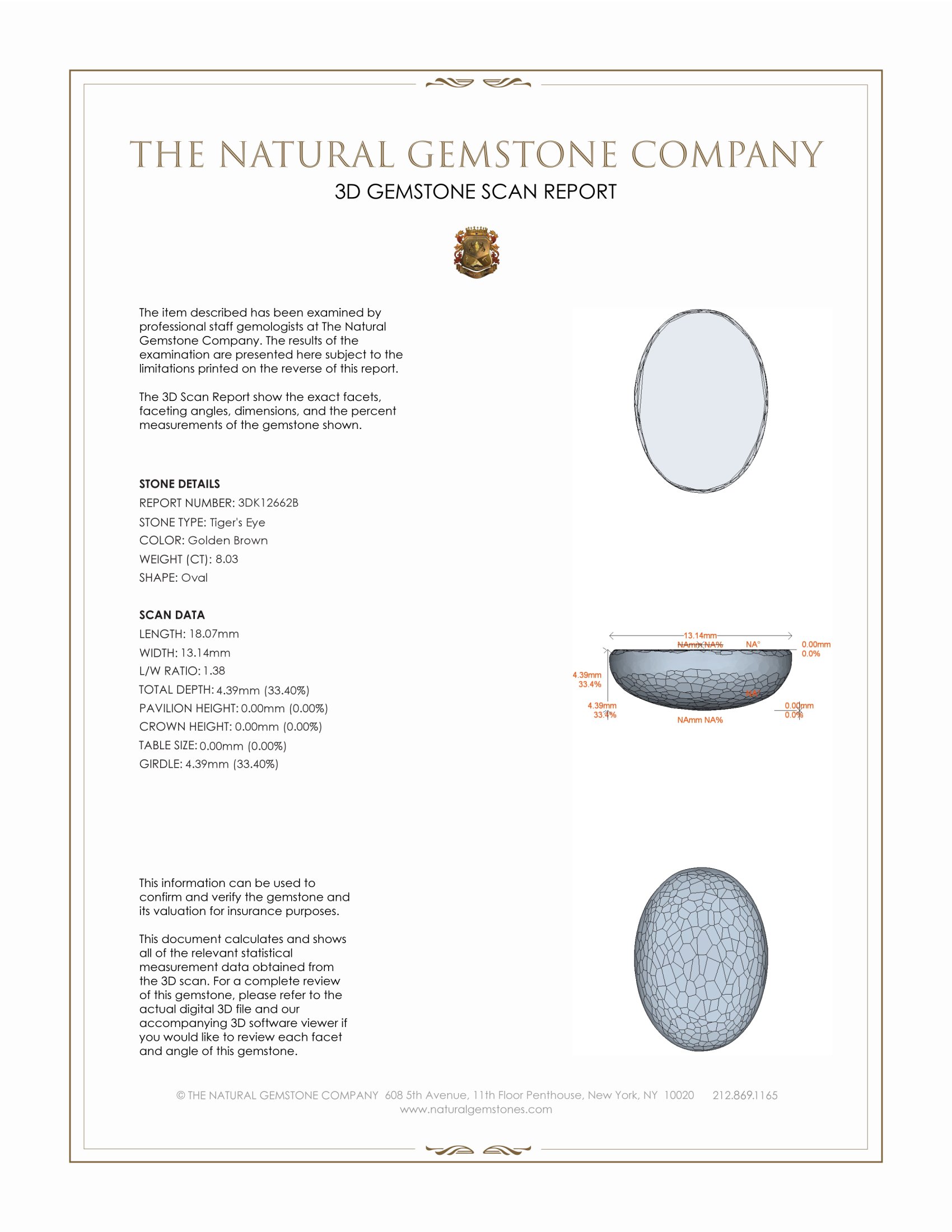
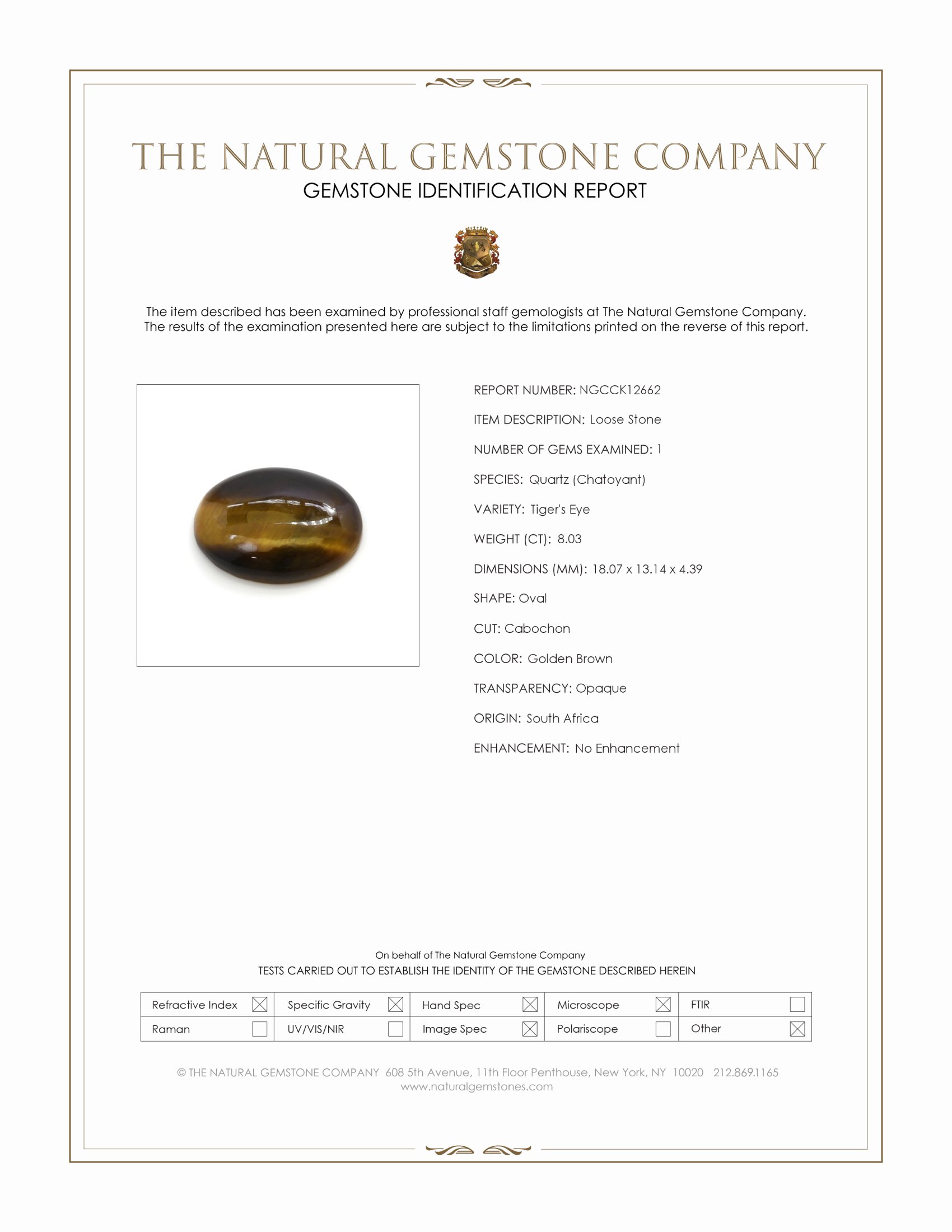
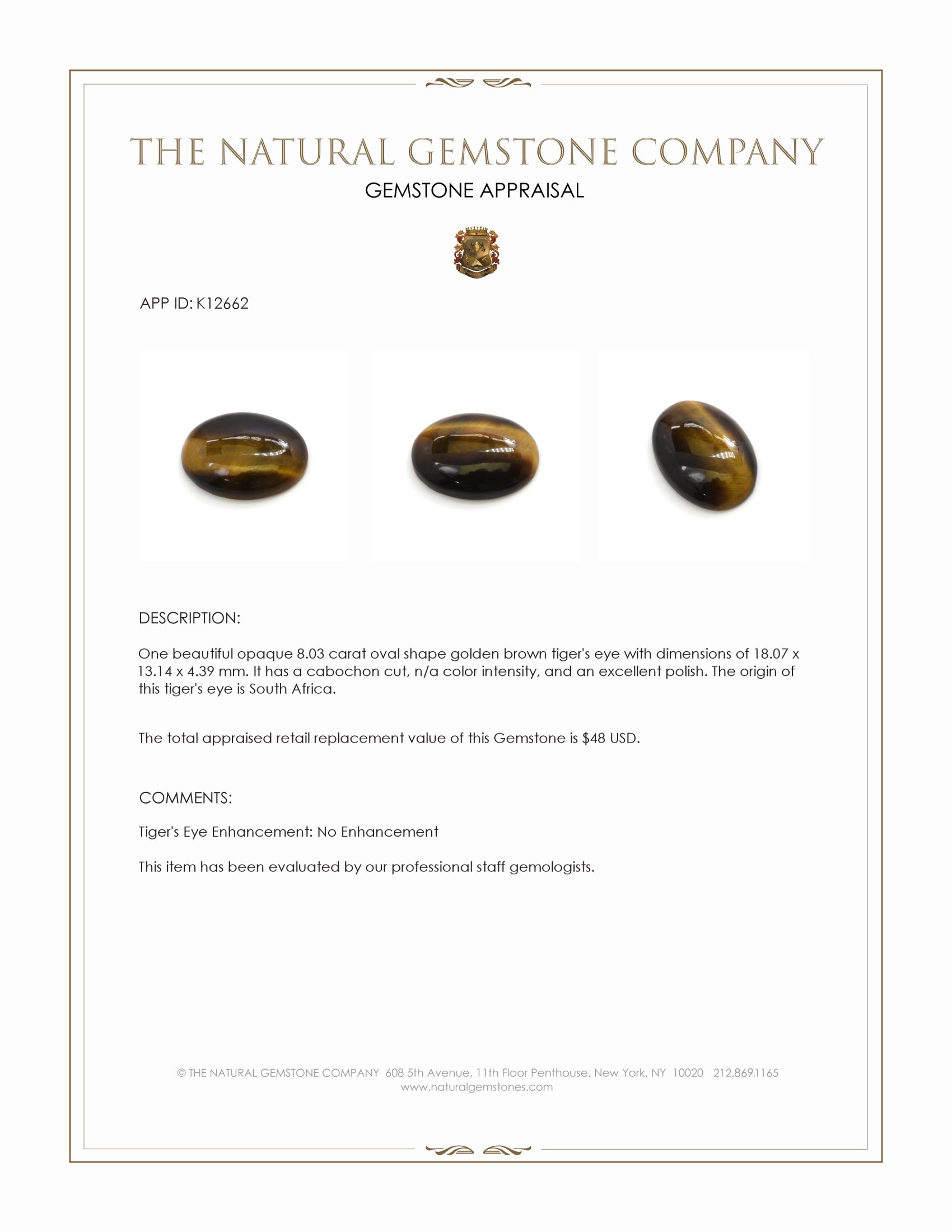
8.03 Ct. Cabochon Tiger's Eye from South Africa
Item ID: | K12662 |
|---|---|
Dimensions (MM): help | Length: 18.07 Width: 13.14 Height: 4.39 |
Weight: | 8.03 Ct. |
Color: help | Golden Brown |
Color intensity: help | N/A |
Clarity: help | Not Applicable |
Shape: help | Oval |
Cut: | Cabochon |
Cutting style: | Cabochon |
Enhancements: help | No Enhancement |
Origin: help | South Africa |
This piece is an 8.03 carat, oval shape tiger eye, with precise dimensions of 18.07 by 13.14 by 4.39 millimeters, presented as an opaque cabochon cut. The cutting style is a traditional domed cabochon, chosen to maximize the chatoyant effect intrinsic to tiger eye. Coloration reads as golden brown through deep chocolate brown with a pronounced eye that traverses the long axis of the oval, and the overall surface condition is described as excellent polish with no visible abrasions or polishing marks under standard 10 times loupe inspection. There has been no enhancement to this material, and the origin is South Africa, a locality known for producing well defined and structurally coherent tiger eye material. The nominal color intensity is listed as not applicable given that tiger eye is evaluated more by band definition and luster than by classical color grading used for transparent gems.
From a gemological standpoint the chatoyancy seen in this specimen is the result of parallel fibrous silica replacement of crocidolite, leaving a finely aligned structural texture that reflects light as a single linear band. The band is continuous and well centered along the length of the oval, indicating that the lapidary oriented the fibrous structure carefully during preforming. The depth of the dome, at 4.39 millimeters, provides a medium to high dome ratio relative to the length, which allows the cat eye to form a crisp, single band under directional lighting. Refractive behavior is consistent with quartz based material, with refractive indices that typically fall within the range expected for silica based chatoyant stones, and the specific gravity is consistent with the expected range for tiger eye. Hardness on the Mohs scale is approximately 7, which makes the stone robust enough for many jewelry applications, while still requiring standard care to avoid surface scratching during setting work.
The craftsmanship evident in this cabochon reflects sound lapidary technique. Preforming was executed to maintain symmetry, the pavilion is smoothly finished to avoid light leakage, and the crown curvature has been carefully controlled to center the chatoyant band. During cutting the lapidary would have gross shaped the preform to align the fiber direction, then progressed through sequential abrasive grits to refine the dome and remove undulations. Final polishing was likely accomplished on a felt or leather lap with a fine cerium oxide or diamond paste, yielding the high gloss surface observed. The absence of pits or cleavage planes at the girdle indicates careful material selection and control of blade pressure during dopping and shaping. For jewelers this cabochon presents a predictable seat in bezel settings due to its even profile and stable thickness, and the oval proportions provide good balance between visual impact and mechanical stability when set.
Practical considerations for integration into high quality jewelry are straightforward. The dimensions and weight make this stone well suited for a statement ring, a pendant where the long axis can be oriented vertically to emphasize the chatoyant band, or a brooch where the stone can be protected by a partial bezel. Because the stone is natural and untreated, certification or documentation of origin can add value for collectors who prioritize provenance, and The Natural Gemstone Company can provide detailed images and handling notes for lapidaries and designers. Routine care should avoid prolonged exposure to strong acids or high heat, and cleaning is best achieved with warm soapy water and a soft brush, avoiding ultrasonic or steam cleaners to protect the stone from sudden thermal shock. For design and appraisal purposes the combination of well centered chatoyancy, excellent polish, and natural South African origin places this tiger eye as a technically desirable specimen for connoisseurs and artisans seeking material with both visual character and reliable physical properties.


